
How the Philadelphia Inquirer Endorses Candidates as Nonprofit News

A week ago I kicked around the question whether tax exempt newspapers can endorse candidates. The doctrinal answer is still “no.” But the question is important because to stave off extinction, local newspapers are converting to tax exempt status and yet they would like to continue traditional editorial activities, including candidate endorsements. The Philadelphia Inquirer appears to have successfully solved the problem. The Religious Broadcasters suit against the Johnson Amendment points to the Lenfest Institute’s ownership of the Inquirer as an example of how the Service allows liberal but not conservative exempt organizations to endorse candidates without penalty. The Institute is a 501(c)(3) and the Inquirer, which the Institute owns but does not control, endorses candidates for public office. I wanted to find out what the Broadcasters are talking about and how the Inquirer combines tax exemption with political endorsements.
It turns out that the Lenfest structure is as available to conservative organizations, including churches, as it is to Lenfest. So there is no discrimination. Besides, the Lenfest structure doesn’t exactly facilitate an exempt organization’s campaign intervention. The Inquirer makes political endorsements but it is a taxable public benefit corporation. To be sure, Lenfest uses deductible contributions to invest in and provide grants to the Inquirer. The grants support the Inquirer’s investigative reporting and other special news gathering efforts not involving political endorsements. Those sorts of “program related” grants are consistent with Lenfest’s exempt purpose to support local news. But money is fungible, let’s not forget.
Lenfest transparently describes and illustrates the structure. The Philadelphia Foundation is a (c)(3) that owns the Lenfest Institute for Journalism Special Asset Fund, a Type I Supporting Organization. Donations to both organizations are deductible as charitable contributions. The Lenfest Institute for Journalism is a disregarded entity through which the Asset Fund owns 100% of the Inquirer’s non-voting stock. Lenfest has equity without voting rights. Presumably, the non-voting stock is evidence of a significant capital contribution to the Inquirer.
The Inquirer Trust is a non-exempt charitable trust supporting local journalism by its exclusive governance of the Philadelphia Inquirer. The Trust owns 100% of the Inquirer’s voting stock. The Trust appoints the Inquirer’s directors and Lenfest has no authority to appoint the Trust’s directors. Presumably, the Trust is formed and operated to avoid any private foundation excise taxes triggered by IRC 4947. The Inquirer’s operating costs are probably paid from subscriptions and advertising revenue. But it might have also received an initial endowment via Lenfest’s purchase of the nonvoting shares using tax deductible dollars. The Inquirer also receives “targeted grants” from Lenfest. As mentioned above, the “targeted grants” pay for a variety of journalistic projects none of which involve the editorial board’s endorsement of or opposition to political candidates.
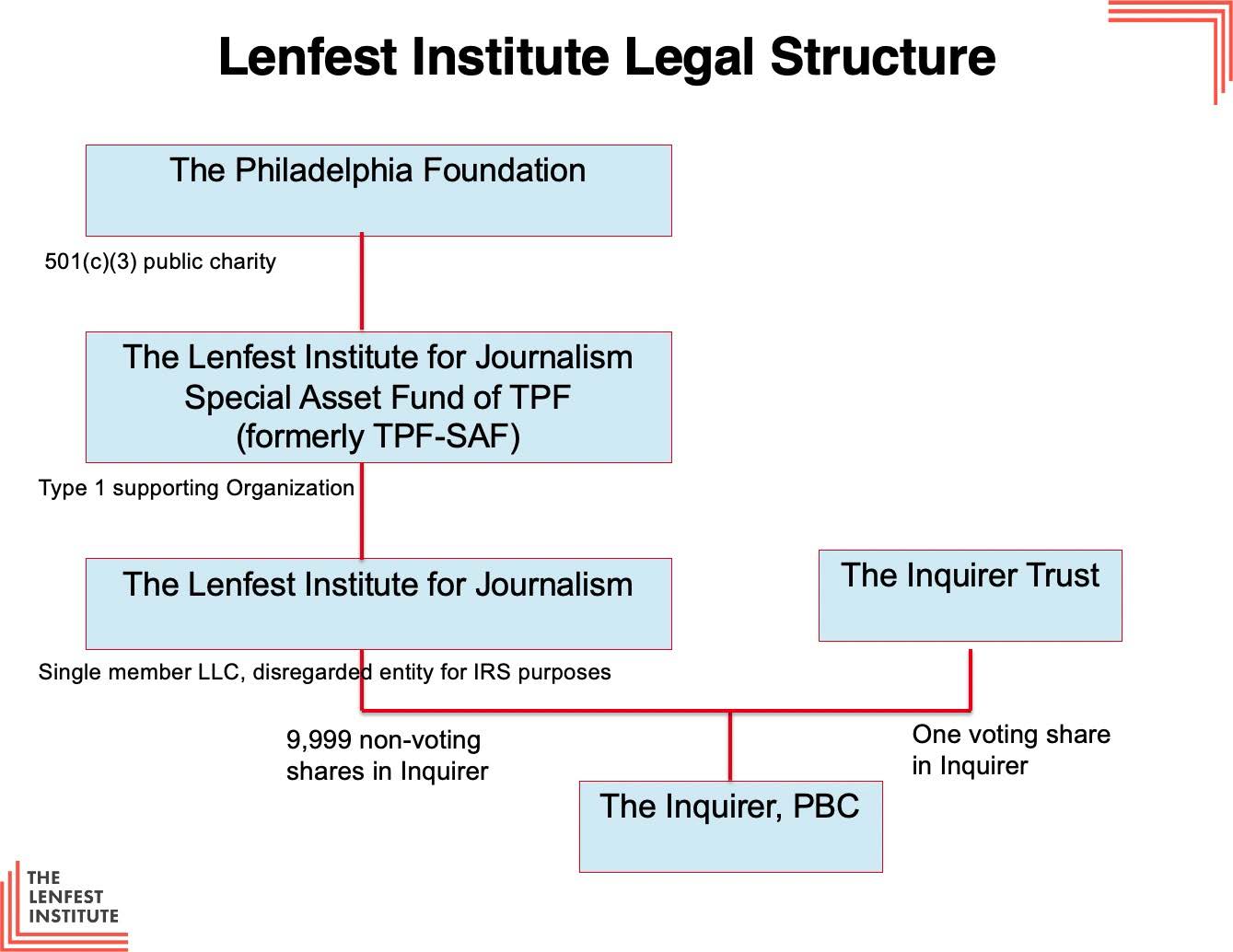
The structure allows an exempt organization, Lenfest, to support a nominally taxable corporation, the Inquirer (nominally, because print news hardly makes a profit anymore), that engages in campaign intervention otherwise prohibited to the exempt organization. Still, the structure precludes Lenfest from participating in or controlling endorsements. Thus an exempt organization uses tax subsidized dollars to support a taxable entity that endorses candidates. We probably can’t discount Lenfest’ charitable purpose of supporting local journalism. It appears Lenfest just wants to support local journalism with all its traditions, including political endorsements, rather than a slightly watered down version. If instead it wanted to get involved in politics through a sophisticated disguise, there are a whole lot less complicated ways.
darryll k. jones