
Tax Court Dismisses Claims of Administrative Irregularity in Conservation Easement Penalty Assessment
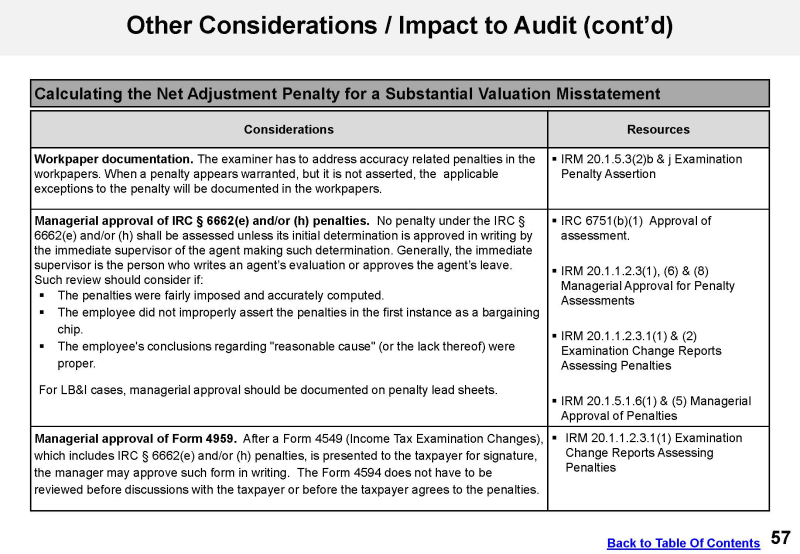
We have previously posted about the IRS foot fault regarding the requirement to obtain written supervisor approval before proposing valuation related penalties on conservation easement participants. I haven’t been able to find out how the Court ruled in that prior case. But in a memorandum opinion, Tax Court Judge Lauber brushed aside another procedural objection to a $7.5 million valuation penalty. This time, taxpayers argued that caselaw suggests that supervisory approval must be obtained at a point in time when any initial inclination to assess penalties can still be rejected as unwarranted or ill advised, not as pro forma exercise. The examiner appeared to have consulted with Chief Counsel’s office and there was a suggestion that penalties were initially ordered by that office rather than by the examiner. Apparently, the supervisory approval requirement imposes a bottom up process whereby the proposal for penalties is made in the trenches and then reviewed in higher offices. That sounds reasonable, actually. Those on the ground know best but they should have to articulate facts and policies to support what can be a high fine.
But Judge Lauber relied on common sense to assert that those in the trenches may legitimately consult with HQ and there is no violation for doing so:
Under a literal application of the standard enunciated in Kroner, supervisory approval could seemingly be secured at any moment before actual assessment of the tax. But the Eleventh Circuit left open the possibility that supervisory approval in some cases might need to be secured sooner, i.e., before the supervisor “has lost the discretion to disapprove” the penalty determination. See Kroner v. Commissioner, 48 F.4th at 1279 n.1; cf. Laidlaw’s Harley Davidson Sales, Inc. v. Commissioner, 29 F.4th 1066, 1074 (9th Cir. 2022) (treating supervisory approval as timely if secured before the penalty is assessed or “before the relevant supervisor loses discretion whether to approve the penalty assessment”), rev’g and remanding 154 T.C. 68 (2020); Chai v. Commissioner, 851 F.3d 190, 220 (2d Cir. 2017) (concluding that supervisory approval must be obtained at a time when “the supervisor has the discretion to give or withhold it”), aff’g in part, rev’g in part T.C. Memo. 2015-42.
Second, while not disputing that RA Garcia was the “examiner” for the Dorchester audit, petitioner questions whether RA Garcia made the “initial determination” to assert the penalties in question. Petitioner speculates that it was not RA Garcia, but “the IRS Office of Chief Counsel or [someone] at another level of [r]espondent” who made that decision. Petitioner notes that, on October 7, 2019, RA Garcia recorded in his activity record his receipt of a “[Form] 866–A draft” from IRS chief counsel. This occurred four days after Ms. McCarter had signed the penalty approval form. Surmising that RA Garcia may have had previous consultations with other IRS officers before recommending the penalties that he set forth on the penalty approval form, petitioner has issued informal discovery seeking “any communications or guidance provided to [RA] Garcia or Ms. McCarter regarding the imposition of penalties.”
We accept arguendo petitioner’s premise that RA Garcia may have consulted with other IRS officers in connection with the recommendations he set forth on the penalty approval form. But an “initial determination” signifies a “consequential moment” of IRS action. Belair Woods, 154 T.C. at 15 (quoting Chai v. Commissioner, 851 F.3d at 221). Preliminary discussion among IRS officials as to whether a penalty is appropriate does not constitute the “initial determination of [a penalty] assessment” within the meaning of section 6751(b)(1).
darryll k. jones