
Polygamy and Church Tax Exemption
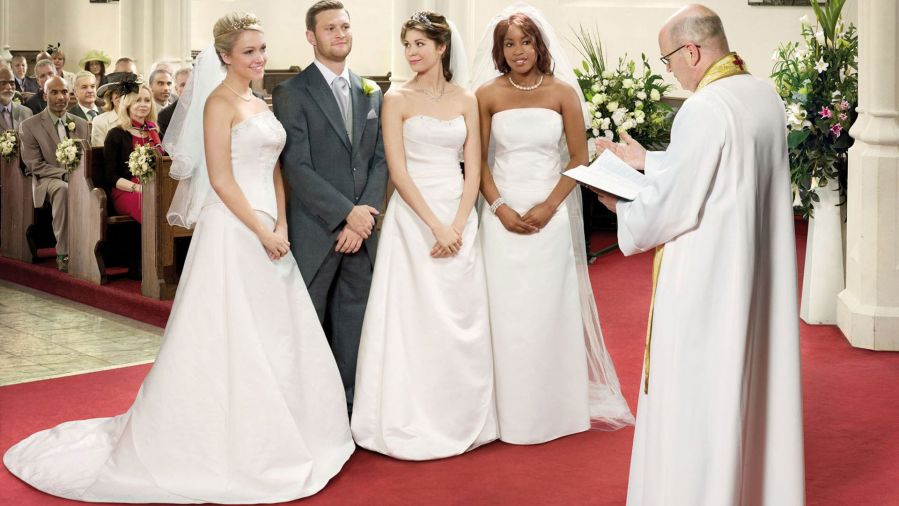
Just shoot me right between the eyes if I ever thought about having more than one wife, that’s all I’m gonna say. At the same time?! Just shoot me!
But first, Sam had an interesting conversation about church tax exemption over at By Common Consent. And guess what, after more words than even I would have used, he agrees that churches can do just about anything with their tax exemption. By the way its lazy to say “churches” or even “houses of worship” when what the law must really mean is “worship groups.” That is probably the least that can be said to comply with the First Amendment. And thanks to Mike for the idea that even “houses of worship,” a term thought to be generic, suggests government bias towards Christianity or other organized religions that “do not forsake the congregation.” Anyway, Sam concludes that worship groups can ignore some explicit legal prohibitions. A worship group could practice polygamy if it wanted to and still retain tax exemption. I would add that worship groups can use controlled substances too, though the government has a legitimate interest in requiring proof [whatever that may be] that drugs are part of the religious beliefs. The more interesting part of the conversation happened in the comments where readers discussed the public policy doctrine as it might apply after the law became much more protective of religious liberty. For context, Sam asserted that if the Church of Latter Day Saints ever practiced polygamy again, it would not violate Bob Jones public policy because laws have evolved to give worship groups a whole lot more freedom since Bob Jones. By the way, if we don’t start getting more comments on this blog right here, boys and girls, I am gonna start cold calling on people. That’s how its done in law school. Here is the interesting conversation:
lastlemming said:
There are two ways to think about polygamy as a legal matter. (OK, there’s more than two, but nobody will read my comment if I go beyond two. The two I’m dealing with both concern polygyny.)
1. The Church teaches that it is OK for a man to go through religious ceremonies called “marriages” with more than one woman, as long as the first wife gives consent. No attempt is made to convince the state to validate more than one of those marriages.
2. The Church teaches that it is OK for a man to to try to convince the state (implicitly through fraudulent means) to recognize his marriages to more than one woman.
The second would clearly violate public policy and, in my opinion, be grounds for denial of a tax exemption. To be clear, the Church has never done this and there is no reason to believe it ever would. But I’m not sure that nonmembers understand that, so I think it needs to be spelled out. If the Church were to restore polygamy (which I can imagine only under the most extreme demographic conditions), I would expect it to look like the first scenario. But does that violate public policy? Consider another scenario (which does not count as a third one because nobody calls it polygamy).
1.1 The Church announces that it will no longer impose any Church discipline on men who commit adultery as long as the wife knows about and consents to it.
The only difference between the two is that the original assumes a religious ceremony and the alternative does not. Since most churches have long since ceased imposing meaningful discipline on adulterers, it is hard to imagine that an announcement of alternative 1.1 by the Church would trigger any tax controversy. And the 1st amendment would seem to protect the addition of a formalizing ceremony. So as long as we’re talking about the first scenario (which I think you were), I agree with your conclusion,
Sam said:
lastlemming, you’re right, I absolutely wasn’t thinking about #2. And #2 reminds me of a Revenue Ruling from the 1970s. In it, a would-be exempt organization devoted to world peace encourages people to protest against war and, in the interest of maximizing the effects of the protests, to act illegally. The illegal actions are pretty small: Mostly they’re supposed to block traffic and get in the way of government work, things, the IRS notes, are “violations of local ordinances and breaches of the public order.” The IRS says that because the org encourages or induces violations of the law, it doesn’t qualify as exempt.
I’ll say upfront that I’m skeptical of this Revenue Ruling. It’s pretty lightly reasoned and honestly I don’t think it holds up as good law. But even if it does, it doesn’t deal with a religious organization, and religious liberty protections have become much stronger over the last decade or so. I don’t think that would prevent the church from being prosecuted for criming itself (see the SEC violation, though that was a civil, not criminal, violation), but I’m not convinced that the church saying, Do what you can to live this religious principle [ed: which, for the record, doesn’t exist and won’t] would get you there.
That said, I do think your second example would be a tougher call because of the indeterminate language of illegality in Bob Jones and the IRS’s Revenue Ruling.
Mike said:
I think that we could look at analogous situations in the time before same-sex marriages were legalized. Were churches that solemnized same-sex marriages threatened with or actually lost their tax exempt status? Did secular organizations that lobbied and advocated for same-sex marriages have to do so as non-tax exempt organizations?
Sam said:
Mike, interesting question. A couple answers: the first one is no, no organization has had their exemption revoked for solemnizing or refusing to solemnize same-sex marriage.
But there is a great case from the 1970s called Big Mama Rag. In that case, the IRS denied a tax exemption to feminist organization. And it denied that exemption on three grounds: (a) that it was a commercial newspaper, (b) that it engaged too much in politics, and (c) “the articles, lectures, editorials, etc., promoting lesbianism.”
In the end, though, the suit dropped the question of lesbianism; the question came down to whether it had an exempt educational purpose or was too commercial. (The court ended up deciding the the test to see if an organization was educational was unconstitutionally vague, so Big Mama Rag got its exemption.)
darryll k. jones