
The Return of United Cancer Council: FTC And Ten States Sue Cancer Recovery Foundation
Veteran nonprofit denizens remember United Cancer Council v. Commissioner. That’s the case involving a struggling exempt cancer prevention and treatment organization that hired a fundraiser to help stave off bankruptcy. The fundraiser worked on commission. Between the commissions and expenses charged to the organization, the fundraiser consumed about 95% of all the donations raised. The case took about 10 years to work its way up and down the 7th Circuit, only to have Judge Posner remand the case back to the tax court again. His holding that the fundraiser was not an insider and that the Service asserted the wrong theory — private inurement instead of private benefit — led to enactment of the “first bite rule.” United Cancer Council ended up bankrupt anyway and then entering into a closing agreement stipulating to retroactive revocation.
Well last week, the Federal Trade Commission and ten states sued Cancer Recovery Foundation for collecting $18 million in donations and then paying one cent on the dollar to charity:
The Federal Trade Commission and 10 states are suing sham charity Cancer Recovery Foundation International, also known as Women’s Cancer Fund, and its operator, Gregory B. Anderson, for deceiving generous donors who sought to offer financial support to women battling cancer and their families. In a complaint filed in federal court, the FTC and states allege that, from 2017 to 2022, Women’s Cancer Fund collected more than $18 million from donors. The sham charity claimed that it would use the donated funds to help women who were undergoing treatment for cancer and their families pay for basic needs. Instead, the complaint charges, only about a penny of every dollar donated went to provide such support, while the overwhelming majority went to pay for-profit fundraisers and Anderson.
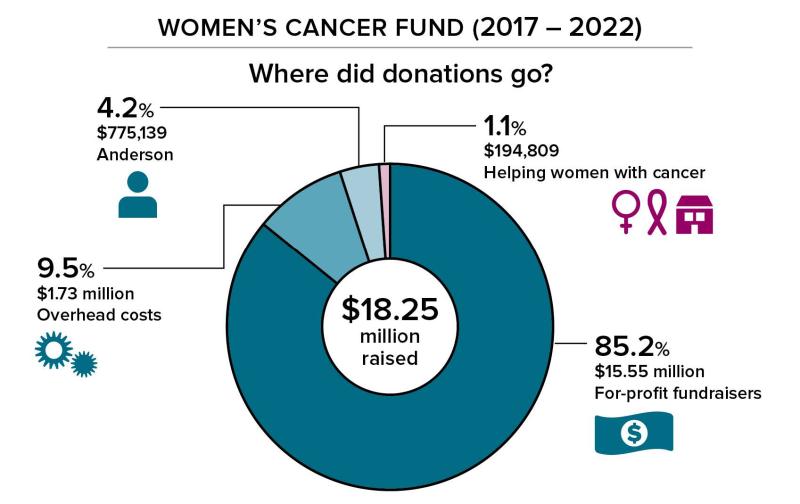
You can read the 34 page complaint here. I guess the government must be getting wise to the power of social media because the extended announcement, entitled “Donation Vexation,” reads almost like a teaser for an upcoming movie. And that picture above tells a horrible story too, I’ll tell you that. Cue the Civil Action music. From the announcement:
Think about the two women across from you in the office. Now consider the sobering statistic that of those two women, one will battle cancer in her lifetime. The bad news gets worse when you realize there are sham charities out there that claim to offer financial assistance for people undergoing cancer treatment, but then spend donations for other purposes. The FTC and 10 states just sued Cancer Recovery Foundation International (also known as Women’s Cancer Fund) and Gregory B. Anderson, alleging the defendants collected $18 million from generous Americans between 2017 and 2022 while providing only $194,809 in financial support for cancer patients – literally about a penny of every donated dollar. According to the lawsuit, Anderson pocketed $775,139, nearly four times more than what the “charity” gave collectively to women battling cancer. But hold on to your hat – and your wallet – when you learn where the FTC and the States say the rest of the money went.
The defendants solicited charitable donation chiefly through telemarketing. As one telemarketing script claimed, “Your donations mean the world to a woman fighting for her life, helping pay basic household bills like rent, water, and heat.” Another pitch promised donors that their gift would “go to directly help cancer patients and their families who are in need” with essential living expenses. A pledge letter showed a woman with a head covering typically worn by patients undergoing chemotherapy and asked people to increase their donations, citing “the double jeopardy of cancer patients in the time of Coronavirus.”
That’s where the defendants said the donated money was going. But according to the FTC, California, Florida, Maryland, Massachusetts, North Carolina, Oklahoma, Oregon, Texas, Virginia, and Wisconsin, in addition to the $775,139 that went to Anderson, the for-profit fundraisers that Anderson hired grabbed $15.55 million – 85% of the total.
I just hope this case doesn’t take ten years.
darryll k. jones