
Why Does OpenAI’s Joint Venture with Microsoft Still Bother Us?
Numbers sometimes communicate better than words. They clarify. But numbers can also be perplexing. Take the numbers below, for example. According to the WSJ, the numbers show how profits are shared amongst the owners in OpenAI (c)(3)’s joint venture with Microsoft, et al. The joint venture uses waterfall distributions to send profits to investors, and only after the first three falls — “only then,” according to the chart below — are earnings plowed back into the charitable mission. How can this be consistent with tax exemption? The notation below the chart says the numbers are from the actual deal documents.
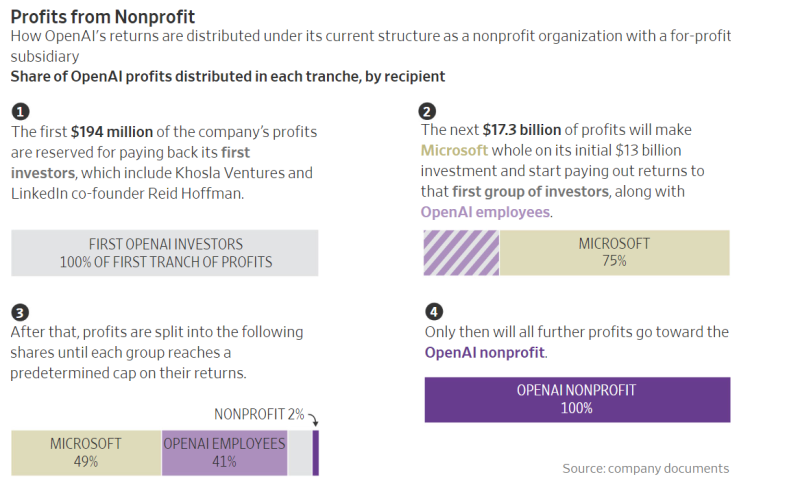
The numbers show that a tax-exempt organization (OAI) conducts scientific research, the results of which are astronomically profitable. Big discoveries usually have that effect, even if in many cases they arise from charitable efforts. Gatorade, the best selling sports drink came from an academic science lab at the University of Florida.
But OAI doesn’t care about profit, at least not admittedly. The people running OAI just want to play their computer games. They aren’t concerned with whatever business opportunities arise. They just need lots of quarters to keep playing. They can (1) borrow quarters, pledging to repay the loan with revenue from the sale of products derived from their computer games, or (2) prospectively sell part of that revenue to a profit-motivated buyer in exchange for lots of quarters right now with which they can keep playing computer games. If they select the first option, we might hardly think twice. Borrowing is not abnormal, not even for charities. We probably wouldn’t mind the second option either if the sales are infrequent and to any willing buyer. If the sales are regularly carried on, even if to acquire more quarters to play more computer games, we might wonder whether they aren’t just a regular business. And if they sell to only one customer, we might wonder whether they are existing just for that buyer’s private benefit.
Either way, OAI must use a portion of its computer game revenue to buy quarters. It has no other currency. OAI selected the second option; it used a portion of its unrealized computer game revenue to buy a huge bucket of quarters so it could keep playing computer games. But not in a “one-off” transaction and not just to any willing buyer. OAI entered an exclusive continuing contract where, in exchange for a huge bucket of quarters, it pays a portion of its future computer game revenue to just one buyer (MS). The ultimate price to OAI varies from $0 to $100 times the number of quarters in the bucket. Scientific exploration is economically risky, and a variable price allocates some of the risk to the buyer. OAI settled upon the $100 limit because it knew its bid needed to be at least equal to the price other sellers would pay MS for the quarters, plus a risk premium associated with variability. Otherwise, MS should insist on loaning the quarters or selling them to another buyer on better terms. Thus, the price for the bucket is both variable and limited, and results in less risk to OAI than conventional borrowing.
Has OAI violated its charitable oath by entering the transaction? Rev. Rul. 98-15 is not about reasonable compensation, by the way. It only requires that the price paid MS be proportionate to whatever MS provides to OAI. What about the fact that OAI must pay MS before it may use any of its profit to play more computer games? That priority necessarily delays and may even preclude pursuit of the charitable mission. Is that necessarily inconsistent with OAI’s tax exempt status? Delayed spending is a normal borrowing consequence. Every borrower has to pay bills first and only then can the borrower spend on other desires. Like everybody else, OAI has to pay its bills and only then can it spend money on more computer games. That’s true under either financing option described above. Another relevant point is that MS cannot get paid except by pursuit of the charitable mission. If the charitable mission is coterminous with profit making, as is likely the case in any new scientific exploration, the priority might be meaningless. That OAI must pay MS first is therefore economically unremarkable and shouldn’t impeach OAI’s tax exempt status. As a normative manner, OAI is doing nothing that can be described as extraordinary as a matter of economic finance.
I think the numbers are clarifying. So why is it that the joint venture between OAI and Microsoft is still so perplexing?
darryll k. jones