
Johnson Amendment Challengers File Motion for Summary Judgement: Two Good Arguments Buried in too much verbiage
The National Religious Broadcasters and their allied plaintiffs (two churches and a religious organization) filed a Motion for Summary Judgment this week in their effort to prove the Johnson Amendment is unconstitutional. Here is the proposed order they seek:
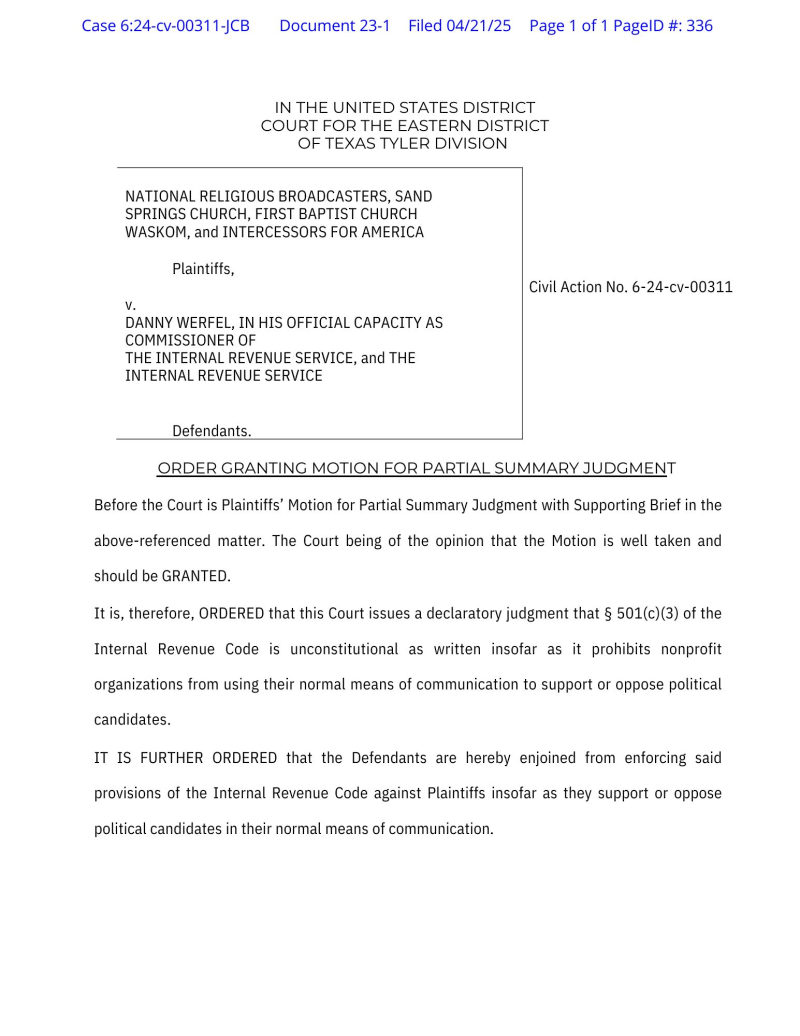
I try not to be a pompous jerk law professor. But the plaintiffs’ writing in this case . . . well . . . it sucks. The motion is hard to follow and rambles on about too many weak and extraneous arguments. For example, that the Johnson Amendment constitutes invidious discrimination because it applies only to (c)(3)s and not (c)(4)s, (5)s or (6)’s. I didn’t know that (c)(3)s are a protected class. The proposed order, pictured above, doesn’t even follow the arguments. Only law professors know the pain of reading poorly written final exams. And this Motion seriously makes my butt hurt. It’s almost as if the plaintiffs work hard to obscure the winning argument.
Still, the Motion makes two good assertions somewhere in the verbiage. First, that tax exemption for organized worshippers is not a subsidy. That is an important assertion because the argument that most often saves the prohibition against campaign intervention is that taxpayers should not subsidize other folks’ political activity. Ben has a good article in Tax Notes summarizing the rationale.
The constitutional argument about the Johnson Amendment is relatively straightforward. It can be succinctly summarized as follows: The Constitution protects charities’ free speech rights, including the right to endorse a candidate, but the government may constitutionally prevent charities from using what is effectively a tax subsidy for that speech. In other words, the Johnson Amendment is constitutional because it properly balances the speech rights of charities against the government’s interest in preventing charities from using tax-subsidized funds to pay for that speech, which is sometimes called nonsubvention.
But if tax exemption is not a subsidy, at least not for organized worshippers, and is instead merely a way to keep government from religious entanglement, the nonsubvention rationale does not apply and the prohibition should be ruled unconstitutional as applied. The plaintiffs are seeking a ruling that it is facially unconstitutional by the way. They should make it easier for the Court to rule in their favor by asking for an “as applied” [to churches] ruling. And remember, at least one Circuit has come pretty close to ruling that tax exemption is not a subsidy. Ellen and Lloyd have argued that tax exemption is a subsidy except when it isn’t. Anyway, the plaintiffs cite Walz v. Tax Commission for the proposition that exemption avoids entanglement but does not subsidize. That is not a bad argument.
The second good assertion is that the unconstitutional conditions doctrine prohibits the government from requiring the recipient of a discretionary benefit to forfeit a constitutional right. That too is a pretty good argument, even if the unconstitutional conditions doctrine is hard to explain or justify. One criticism I might offer is that the plaintiffs are unnecessarily conceding that the government may validly tax churches in the first place. It is not often asserted because churches are generally exempt from taxes everywhere in the United States. But if the power to tax is the power to destroy (or even just to regulate), a logical assertion can be made that government doesn’t even have the right to tax organized worshippers. If that argument holds, tax exemption for organized worshippers is mandatory, not discretionary, and cannot be conditioned on a prohibition against campaign intervention.
From Jonesing.