
Japan Revokes One of it Largest and Richest Church’s Tax Exemption
Here is one of two posts from today’s Jonesing on Nonprofits. The second post regards another nonprofit story you are unlikely to find anywhere else. Please see my note below.
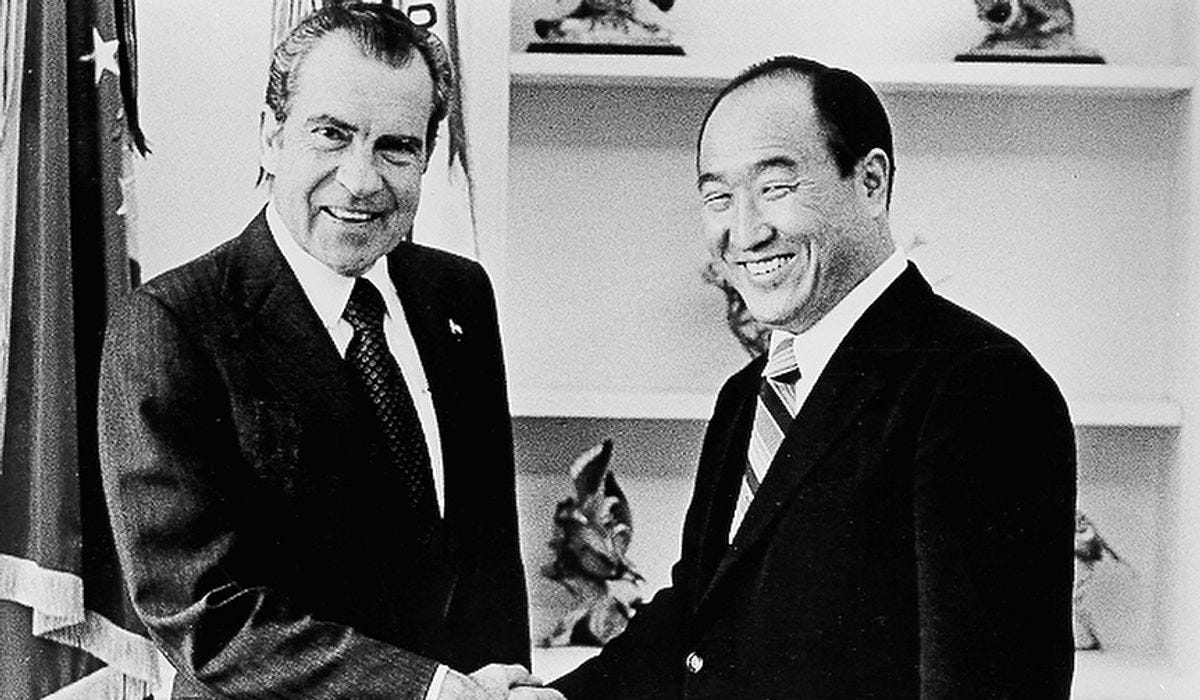
It must be a rare thing for organized worship groups to lose tax exemption. Especially in countries that protect religious freedom. But a Japanese court did just that when it revoked the Unification Church’s tax exemption a few days ago. In the past, the church was sometimes referred to as the “moonies,” after their founder, Rev. Sun Myung Moon. In the United States Moon supported Tricky Dick during Watergate and even founded the Washington Times.
I remember the church gaining almost as much influence on my college campus as the International Society for Krishna Consciousness – the Hare Krishnas. As undergrads, we used to call them moonies. But that term has come to be viewed as a word as derogatory as the N word, according to Wikipedia. Still, media reports about Japan revoking its tax exemption use the term.
It was 2000 that Japanese Prime Minister Shinzo was assassinated while giving a campaign speech. The assassin was angry because his mother had donated her life savings to the Unification Church, which the assassin thought was aligned with and supported by Abe and his political party. In the aftermath, the Japanese Education Ministry launched an exhaustive investigation of the Church:
The resulting investigation uncovered that the Unification Church—whose followers are often referred to colloquially as “Moonies”—had wreaked havoc in Yamagami’s life, leading to his mother giving the sect the family’s savings—approximately $700,000—after his father died by suicide. His brother also later took his own life. When these facts came to light, the public’s sentiment toward Yamagami shifted, “A year after Abe’s death, his murder has come to seem less the random act of an unhinged loner than a tragedy unfolding slowly over decades,” The Atlantic reported in a September 2023 article.
Public sentiment led Japanese media and authorities to investigate Yamagami’s claims of the Unification Church’s political influence. Hundreds of connections between the sect and Japan’s Liberal Democratic Party were unearthed, leading The Atlantic to report, “The rising numbers exposed a scandal hiding in plain sight: A right-wing Korean cult had a near-umbilical connection to the political party that had governed Japan for most of the past 70 years.”
Eventually the Ministry petitioned a court to strip the church of its registration under the Religious Corporation Act. Here is a summary from the NY Times:
In a ruling that was widely expected but unusual in its severity, the court agreed to a government request to strip the church of its legal status to exist, saying that it had violated laws governing religious activities. The education ministry, which has oversight of religious groups, requested in October 2023 that the church be disbanded after determining that it forced members to make donations and buy religious goods. The ministry collected the testimonies of some 1,550 former members who claimed to have suffered financial damages of 20.4 billion yen, or $140 million. The church, known for its mass weddings, was founded in South Korea by the Rev. Sun Myung Moon, who died in 2012. It has branches in scores of countries.
The Court’s order “dissolving” the church effectively revokes the Church’s tax exempt status (granted under Article 10, Corporate Tax Act) and forces the Church to liquidate according to other media reports.
Note: I still have dreams of creating an enduring nonprofit subscription journal to which I can devote my full time attention after life in the academy. The Tax Notes for nonprofits. When I first started, I asked Streckfuss, who still publishes the EO Tax Journal, for advice on avoiding pitfalls and mistakes. He replied that he was neither “inclined nor interested” in talking about it. So I set the initial subscription price at something substantially lower than the EO Tax Journal subscription price. The goal was to attract law firms and law libraries. Still, a helpful and thankfully candid reader advised me recently that the price was too high. So yesterday, I cut it in half ($25 per month, $300 per year). If you are interested in helping found a new long-running source informative for nonprofit practice and scholarship, please consider subscribing. Thanks.
darryll k. jones