
Dark Money Think Tanks in America
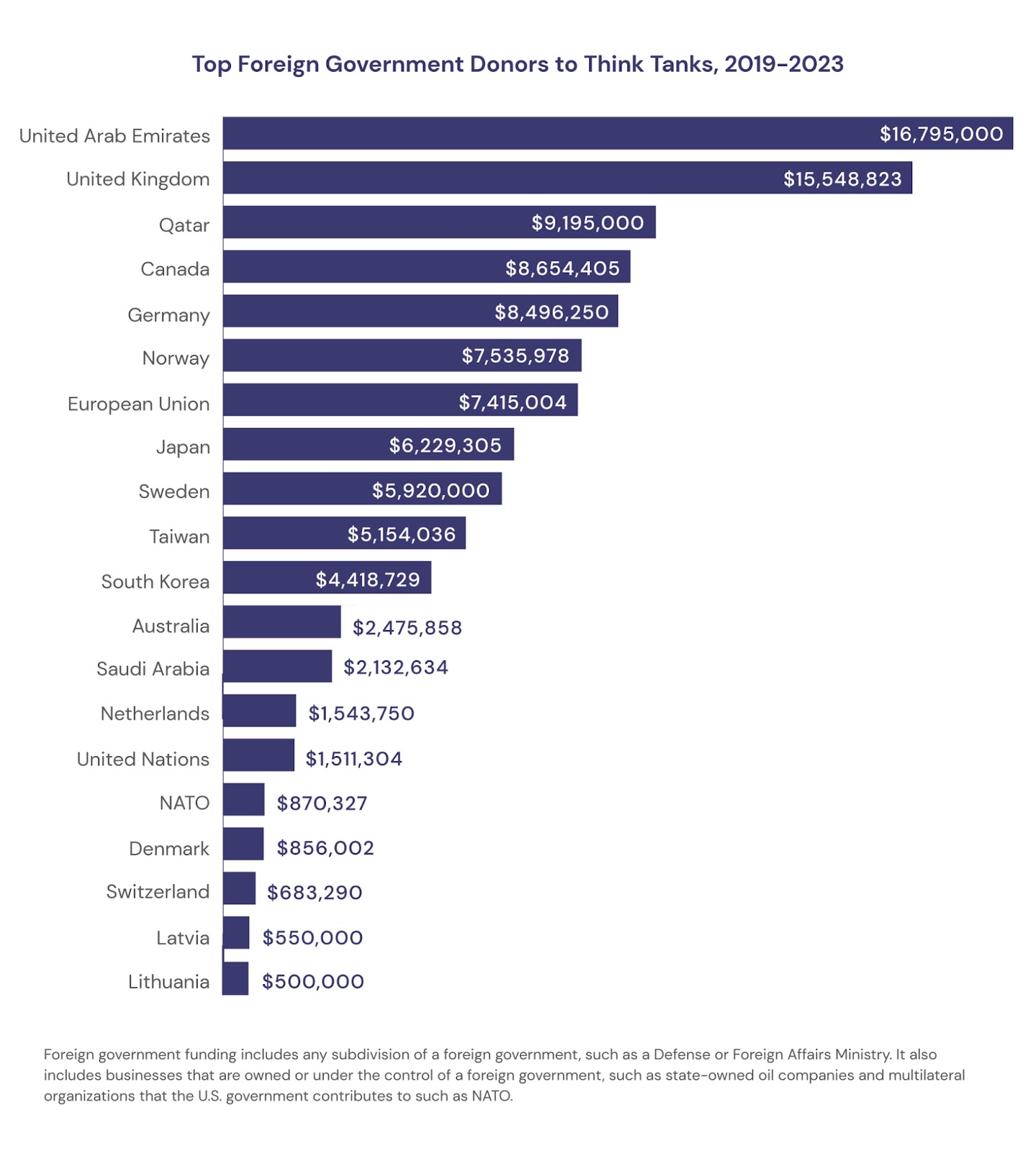
Last week, I told you that DOJ issued proposed regulations under the Foreign Agents Registration Act. Those regulations interpret two of the primary exceptions to FARA coverage, those contained in 22 USC 613(d) and (e). The proposed regulations focus mostly on subsection (d). But subsection (e) is much broader. That subsection exempts think tanks, among others, from FARA’s disclosure and registration requirements. A new report — published by a think tank to which the broad exemption applies — implicitly advocates for the exemption’s repeal or restriction. The Quincy Institute for Responsible Statecraft thinks its bad policy that politically influential think tanks can be so awash in foreign and domestic government funding without any required disclosure. The Quincy does not think it sufficient that think tanks may but are not required to disclose the source of their funding. Here is an excerpt from “Big Ideas and Big Money: Think Tank Funding in America:”
Nine of the top 50 think tanks (18 percent) are fully transparent, while 23 think tanks (46 percent) are partially transparent. Most concerning, the remaining 18 think tanks (36 percent) are “dark money” think tanks, entirely opaque in their funding without revealing donors. In the past five years, foreign governments and foreign government-owned entities donated more than $110 million to the top 50 think tanks in the United States. The most generous donor countries were the United Arab Emirates, the United Kingdom, and Qatar, which contributed $16.7 million, $15.5 million, and $9.1 million to U.S. think tanks, respectively. The Atlantic Council, Brookings Institution, and German Marshall Fund received the most money from foreign governments since 2019: $20.8 million, $17.1 million, and $16.1 million, respectively.
In that same period, the top 100 defense companies have contributed more than $34.7 million to the top 50 think tanks. The top donors include Northrop Grumman, Lockheed Martin, and Mitsubishi, which provided $5.6 million, $2.6 million, and $2.1 million, respectively, to the tracked think tanks between 2019 and 2023. The Atlantic Council, Center for a New American Security, and the Center for Strategic and International Studies were the top recipients of Pentagon contractor money: $10.2 million, $6.6 million, and $4.1 million, respectively.
The U.S. government has directly given at least $1.49 billion to American think tanks since 2019. However, the vast majority of this funding — $1.4 billion — goes to the Rand Corporation, which works directly for the U.S. government. While think tanks exist to produce independent analysis, the prevalence of special interest funding raises questions of intellectual freedom, self-censorship, and perspective filtering. This is compounded by instances in which individual researchers simultaneously hold positions at a think tank and a given foreign government or corporation, a clear potential conflict of interest.
The well-researched and written report doesn’t explicitly address 613(e), but it recommends that Congress “pass legislation requiring all nonprofit organizations that seek to influence public policy to publicly disclose all of their corporate, U.S. government, and foreign government donors above $10,000, and improve the conflict of interest disclosure requirements for congressional witnesses.” The report refers to think tanks that make no disclosure at all as “dark money” think tanks and notes that the Form 990 contributes to the opaqueness:
Out of the 50 think tanks analyzed in this paper, 18 of them are almost entirely opaque when it comes to donors and received a score of zero. Due to federal regulations, think tanks do report some information on their Form 990 — an Internal Revenue Service form that all nonprofits are required to complete — such as a broad breakdown of revenue sources (i.e., what percentage of revenue comes from contributions, sale of assets, or investment). However, think tanks are not obligated to publicly identify the sources of donations, which typically make up the vast majority of their funding. This “dark money” makes it virtually impossible to determine think tank funding sources and determine conflicts of interest, real or perceived. In rare cases, there is public reporting of dark money sources. In others, the think tanks themselves accidentally let slip their funding sources. During an American Enterprise Institute, AEI, event, for example, the moderator noted that Pentagon contractors fund the think tank by saying, “We’d be remiss if we didn’t mention that both Lockheed [Martin] and Northrop [Grumman] provide philanthropic support to AEI. We are grateful for that support.” Yet, AEI is remiss in that it does not publicly disclose any donors on its website or in its annual reports.
Some of these dark money think tanks, like AEI, are among the most prominent think tanks testifying in front of Congress. In 2021, Quincy Institute Senior Advisor Eli Clifton reported that less than 30 percent of think tank-affiliated witnesses before the U.S. House Foreign Affairs Committee, HFAC, fully disclosed their donors. That trend continues today. Between 2021 and 2024, 34 percent of all think tank witnesses before HFAC came from dark money think tanks. For example, 11 analysts from the Foundation for Defense of Democracies, which does not disclose any information about its donors, testified to HFAC during that period.
darryll k. jones