
Zelinsky on Revenue Ruling 2007-41 and Campaign Intervention
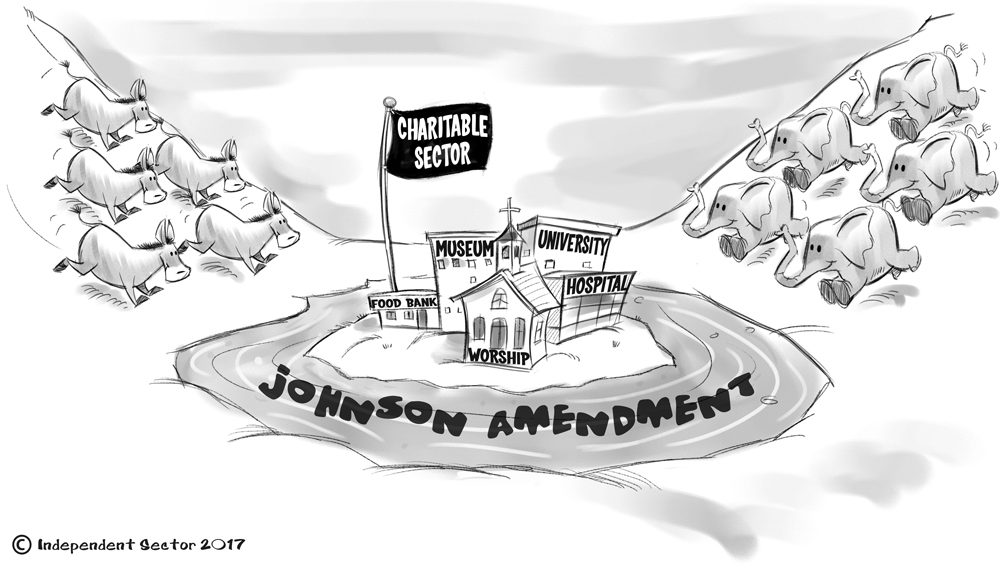
In this week’s Tax Notes, Ed Zelinksy continues an interesting conversation kicked off by Ben Leff last month regarding the prohibition against campaign intervention in IRC 501(c)(3). Ben’s essential position is in support of the “alternative means” endorsed in Taxation With Representation. He disputes the notion that requiring a (c)(3) to set up an unsubsidized but thoroughly controlled (c)(4) through with to endorse or oppose is an unconstitutional burden on free speech. SAFE SPACE doesn’t exactly make that argument, though it is one with which I agree.
SAFE SPACE asserts instead that there is hardly a subsidy at all if political speech costs a (c)(3) nothing or almost nothing. That is the case, according to SAFE SPACE, if campaign speech appears on an existing and already paid for web page. Something bothers me about that argument. Nothing costs nothing or hardly nothing. An endorsement is never cost-free to an organization even if it is written or spoken by a volunteer, it seems to me. The “no additional cost” argument just doesn’t sit right with me because opportunity costs aren’t free. In any event, Ben thinks Revenue Ruling 2001-41 is unconstitutional to the extent that it precludes “attribution” of the (c)(4)’s explicit endorsement or opposition to its controlling (c)(3), or that it views a (c)(3)’s invariable control of the (c)(4) as evidence of prohibited campaign intervention.
Zelinsky thinks Revenue Ruling 2007-41 is just plain unconstitutional for its vagueness and chilling effect. Here is his introduction:
In a recent Tax Notes article, professor Benjamin Leff argues that organizations that are tax exempt under section 501(c)(3) have a constitutional right to endorse candidates for public office. However, to protect the integrity of the income tax charitable deduction, Leff argues that this constitutional right must be exercised through an affiliated entity that is controlled by the section 501(c)(3) organization but that is not itself tax exempt under section 501(c)(3). The IRS’s “leading guidance on the issue, Rev. Rul. 2007-41,” is unconstitutional, Leff concludes, insofar as it inhibits this constitutionally protected structure of a section 501(c)(3) organization making political endorsements through a controlled, non-section 501(c)(3) entity.
I agree with Leff that Rev. Rul. 2007-41, 2007-1 C.B. 1421, is constitutionally infirm, but for a different reason. Rev. Rul. 2007-41 declares that a section 501(c)(3) organization’s vaguely defined issue advocacy may violate the statutory ban on campaign activity. This declaration flouts the First Amendment standards articulated in Minnesota Voters Alliance. In that case, the Supreme Court held that statutes affecting protected expression must meet “objective, workable standards” of reasonability to eliminate “the potential for erratic application.” Rev. Rul. 2007-41’s imprecise regulation of issue advocacy fails this test. Thus, this portion of Rev. Rul. 2007-41 is unconstitutional, too “indeterminate” for First Amendment purposes.
I’m not sure whether Zelinsky thinks the TWR “alternative” would be constitutional assuming Revenue Ruling 2007-41 can be fixed. I doubt that it can be fixed. He and Leff have both written extensively on the campaign intervention prohibition and you can get to their other scholarship through their Tax Notes discussion. The unconstitutional conditions doctrine is murky and situational, at best, but it can still stand for the proposition that government may not require the forfeiture of a constitutional right in exchange for tax exemption. If a court is biased towards striking down the prohibition, it can easily rely on that doctrine. I don’t know whether either of them address that particular issue in their other scholarship.
darryll k. jones