
The Ninth Circuit Doesn’t Understand Private Inurement: Grand Canyon University v. Cardona
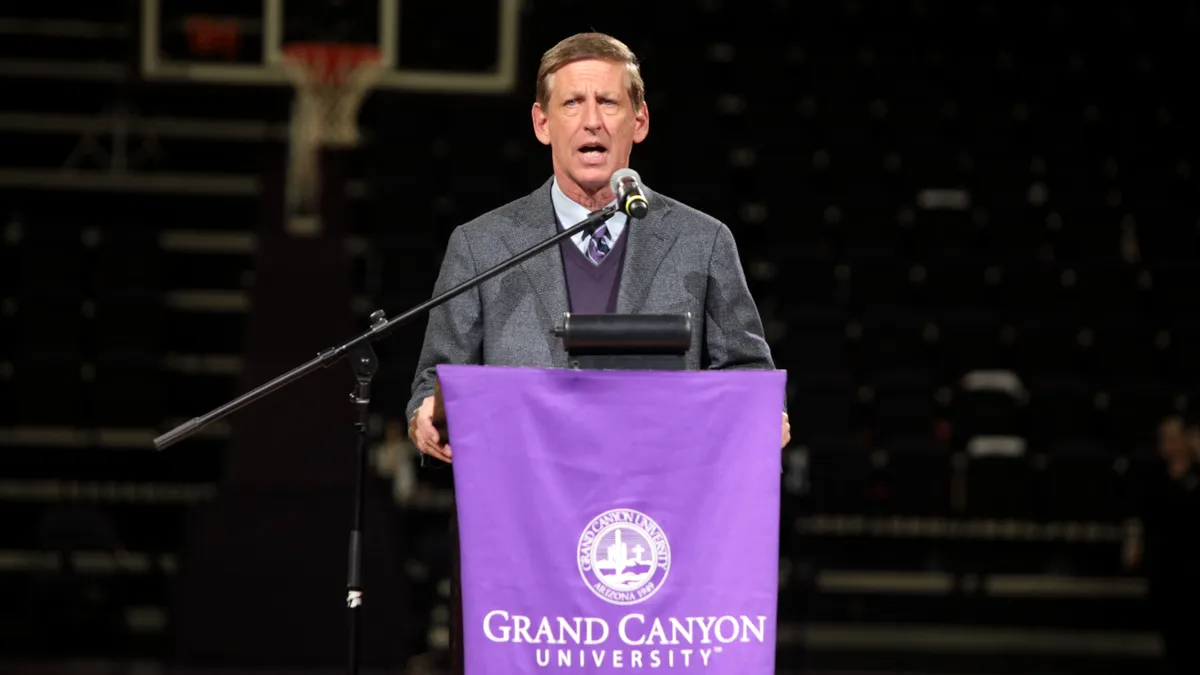
Grand Canyon University President and Grand Canyon Education CEO Brian Mueller is on both sides of a management agreement transaction. “Heads I win, tails you lose.”
If the President of a tax-exempt university received a fixed salary plus a percentage of profits from ancillary services – bookstore, IT services, security, food services, dorm rentals, and the like – would we think the real or potential private inurement intolerable? We probably would, for two reasons: (1) the President would be incentivized to skimp on expenses or raise prices because the lower the expenses or the higher the prices, the greater his profit share, and (2) the receipt of profits from the university violate the literal prohibition against private inurement even if annual percentage payments approximate a reasonable fixed salary. And would we conclude that the tax-exempt university operated for private benefit, thus failing the operational requirement? Of course, because all private inurement is private benefit. Private inurement is just private benefit exclusively to insiders.
In Grand Canyon University v. Cardona, the Ninth Circuit nevertheless reversed a Department of Education determination that Grand Canyon University isn’t a nonprofit because of obvious private inurement of the sort described above except through the use of an entity controlled by the President. The private inurement prohibition is identical in the Higher Education Act and IRC 501(c)(3), by the way. The Court agreed to that much. But citing Loper Bright, the Court stated that the HEA contains no “operational” requirement and DOE erred by referring to tax regs that require charities to be organized and operated exclusively for public benefit. Except that DOE’s conclusion that GCU is not operated for public benefit is based entirely on obvious private inurement, prohibited in the HEA by the exact language used in IRC 501(c)(3). The Court thinks the “operational requirement” is something different when its not, at least not in this case.
The gist of the issue between Grand Canyon University and the Department of Education is that the President of Grand Canyon University is also the CEO of Grand Canyon University’s for-profit management company, Grand Canyon Education (GCE). GCE has an exclusive management agreement with GCU, whereby GCE provides ancillary services to GCU. Under the initial contract, GCE received 65% of the “net revenues” in exchange for its services. When DOE expressed concern, the parties amended the contract so that GCE would receive 67% of tuition payments. The Ninth Circuit did not consider that change legally significant. I don’t either. The same incentives – lower expenses or higher tuition prices – exist.
Under the HEA, it is harder for students to get federal financial aid if they attend a for-profit educational institution. GCU applied for nonprofit status but the Department of Education denied the application finding that the management agreement allowed for private inurement and therefore GCU failed the operational test found in 1.501(c)(3) and incorporated by reference into the HEA regs. In a silly waste of time, and in its apparent eagerness to cite Loper Bright, the Ninth Circuit stated that the “operational” requirement is nowhere found in the HEA. From that, it concluded that DOE applied the wrong legal standard. Never mind that DOE found a violation of the operational requirement precisely and only because of private inurement, and that prohibition is stated identically in HEA and 501(c)(3).
DOE may have invited the Court into the word maze by stating in its administrative denial that GCU failed the “operational” test because of private benefit resulting from private inurement. All private inurement is private benefit, though the opposite is not true. Reliance on the “operational test” not explicitly stated in the HEA was unnecessary but it certainly doesn’t contradict the finding of private inurement. But the Court threw out DOE’s entire finding and said that DOE must issue an entirely new administrative decision:
The Department also failed to apply HEA §103(13)’s private inurement requirement. Instead, the Department applied the IRS’s “operational test,” under which it examined, not whether “net earnings” inured to private benefit, but whether “the primary activities of the organization and its stream of revenue” primarily benefit private parties. Because the Department failed to apply the correct legal standards, its decisions must be set aside. . . The Department’s decisions also fail to make clear what significance Mueller’s “dual roles” as the CEO of GCE and the President of GCU would have under the proper legal standards.
That makes no sense at all. The last sentence, by the way, only proves that the Court has no idea what private inurement is about. The President’s dual status makes him a rather obvious personification of private inurement. I suppose that it might not be the Court’s fault that it has no idea what its talking about. Judges are generalists, by necessity. It is the litigants’ burden to educate judges. Either these litigants didn’t do enough teaching, or the Court slept through class.
The Court remanded the case back to DOE, so there is an opportunity to prepare better lesson plans. GCU’s President, who also serves as CEO of GCE, GCU’s management company, told investors in an earnings call that GCE expects “a more accommodating regulatory environment” now that Trump has been elected. The DOE is right that the transaction facilitates private inurement, but I’d say look for DOE to grant nonprofit status early next year. Because GCU is a large Christian University and nobody in the new administration loves DOE.
darryll k. jones