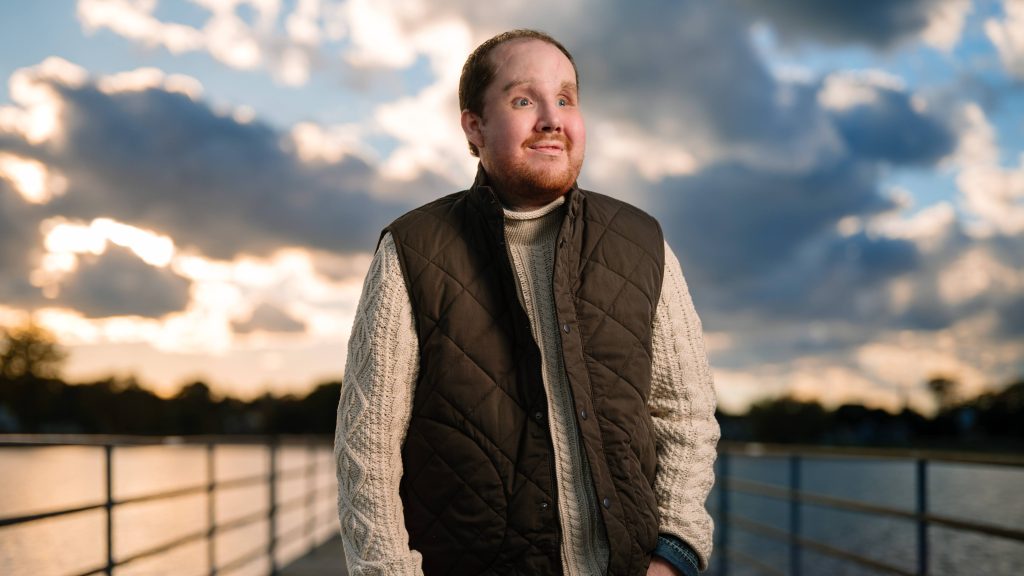
Ten years ago Derek Pfaff tried to kill himself. He survived but ended up shooting his face off. Mayo Clinic rebuilt him like the $6 Million Dollar Man:
A Michigan man can blink, swallow, smile and breathe through his nose for the first time in a decade thanks to a face transplant performed at Mayo Clinic. This transformative and complex procedure underscores Mayo Clinic’s skilled multidisciplinary surgical team who provide hope to patients with complex medical needs. Derek Pfaff’s life changed forever on March 5, 2014, when a tragic incident during his college years left his face severely damaged by a gunshot.
“I was under a lot of pressure at college. I don’t remember making the decision to take my own life. When I woke up in the hospital, I originally thought I had been in a car accident,” he says. Despite undergoing 58 reconstructive facial surgeries in 10 years before going to Mayo Clinic in Rochester, he was still unable to eat solid food or speak casually with friends and family. Wearing glasses proved impossible without a nose. This transformational face transplant at Mayo Clinic means the now 30-year-old from Harbor Beach, Michigan, will once again be able to do all those things he has missed. He has also become a passionate advocate for suicide prevention and plans to share his story to encourage others who are struggling to get help.
Mayo Clinic surgeons performed Pfaff’s face transplant in February 2024 in a procedure that lasted more than 50 hours and involved a medical team comprised of at least 80 healthcare professionals, including surgeons, anesthesiologists, nurses, technicians, assistants and other specialists.
I imagine it must have cost a lot more than $6 million dollars to fix Pfaff’s face. Lee Major’s $6 million surgery in 1973 would cost about $50 million today. And I bet Pfaff hardly paid for any of it. He benefitted rather handsomely, don’t you think? The only thing he needs now is a tan, maybe. That’s as it should be. Because his private benefit is incidental, qualitatively and quantitatively, to Mayo’s charity and our public benefit. And with each successful effort, Mayo and other nonprofit hospitals can better restore faces and other body parts, if not whole lives, of soldiers and civilians shot up or bombed in Gaza or the Ukraine, for example. Or people with horrible disfigurements from other causes, like car crashes or from birth like the Elephant Man. There is tax and nonprofit law everywhere, I tell my students. You can read Mayo’s 2023 990 in the link at the end of this post. Meanwhile, here is a little more about the procedure:
The intricate transplant required replacing virtually everything below Pfaff’s eyebrows and part of his forehead, including his upper and lower eyelids and intraorbital fat, upper and lower jaws, teeth, nose, cheek structure, neck skin, hard palate and parts of his soft palate. Relying on the preoperative facial nerve mapping, one of the most critical aspects of the face transplant surgery was ensuring the donor and recipient’s delicate facial nerves — 18 branches between the two sides — were properly connected to restore function. A new microsurgery technique also was employed to transplant the donor’s tear drainage system, which allows Pfaff’s tears to drain normally into his new nose. Pfaff can now express happiness, sadness, joy and disappointment through his transplanted facial muscles and nerves.
Mayo Clinic’s Charity Care Spending (in dollars)

The Rochester Post Bulletin reports that Mayo’s charity care is increasing, though still lower than its pre-Covid 19 levels:
Across its enterprise, Mayo Clinic doled out $57.8 million to patients through its financial assistance program in 2023, according to its federal Form 990 tax filings. That figure includes $14.75 million distributed by Mayo Clinic’s non-hospital clinical practice in Rochester, per a Mayo Clinic spokesperson, with the remainder given to patients through Mayo Clinic’s other entities, including Mayo Clinic Hospital in Rochester and its Florida and Arizona practices. The financial assistance, also known as charity care, given by Mayo Clinic increased 9% over 2022, but still trails behind its pre-COVID-19-pandemic figures. In 2019, Mayo Clinic spent $96 million on charity care. In 2023, Mayo Clinic reported a $1.08 billion operating margin. Charity care spending represents 0.34% of Mayo Clinic’s expenses, which totaled $16.9 billion last year. Per Mayo Clinic’s current financial assistance policy — something all nonprofit hospitals in the U.S. are required to have — patients with a household income of up to 400% of the Federal Poverty Guidelines can qualify for a 50% reduction of their medical bill, and those making 200% or less of the Federal Poverty Guidelines could qualify for free care.
Financing charity care is an intricate and delicate balancing act. A nonprofit hospital needs paying patients because donations and government grants aren’t enough. They have to collect from those who can pay for the premium care we assume results from health care professionals motivated more by research and cures than by profit. So we shouldn’t be too quick to judge when nonprofit hospitals hound patients for payment. Besides, failing to collect from able patients results in non-incidental private benefit. We don’t subsidize nonprofit hospitals so they can give free services to people who can afford to pay.
On the other hand, nonprofit hospitals owe it to all of us to care for people who are can’t afford the cost of that care in a system that allocates health — a human right, after all — on the basis of wealth. Wealth, by the way, is increasingly just an accident of birth. You are born with it or you are not, that’s just the way it is. So even Mayo has to calibrate its efforts so that able patients pay and thereby help cross-subsidize those unable to pay. And also help pay for the years-long and careful research from which Pfaff and everybody else benefits. A Minnesota Star Tribune report last week shows how Mayo has recalibrated its collection apparatus along these lines:
Mayo Clinic wrote off nearly $90 million in unpaid patient bills after changing how it determines eligibility for financial assistance, a step that consumer advocates are urging more hospitals to take as patients’ concerns grow over medical debt. It’s part of an emerging trend where some medical centers, pushed at times by state laws, are adopting or expanding what’s called “presumptive eligibility” with charity care programs. It can be an alternative to waiting for patients to complete applications for financial aid that some find confusing and difficult to navigate. Mayo disclosed the new approach, as well as the sizable write-off, in a tax filing released this week to the Minnesota Star Tribune.
Many U.S. hospitals including Mayo are organized as nonprofit organizations, and federal and state law exempts them from a variety of taxes. Hospitals must provide what are called “community benefits” to qualify for federal exemptions as charitable entities, the OLA says. Community benefits typically include financial-assistance programs, also called charity care, that provide free or at a discounted services to patients at certain income levels.
Neither federal nor state law sets a specific minimum amount that hospitals are required to spend on community benefits, but nonprofits must report totals annually as part of lengthy filings with the Internal Revenue Service. After an April 2022 report from Lown Institute alleged that Mayo Clinic had the 11th-highest fair share deficit among hospitals nationally, the Wall Street Journal and Rochester Post Bulletin followed up with stories questioning if Mayo could do more to make patients aware of its charity care programs.
The Star Tribune reporter, Chris Snowbeck was kind enough to pass along Mayo’s 990, in case you are interested.
darryll k. jones
