
AmeriCorp and Census: Volunteerism is on the Rebound
AmeriCorp, and the U.S. Census Bureau have issued the 4th biennial report on civic engagement and volunteering. Here is a an excerpt from the Report:
Every two years, AmeriCorps partners with the U.S. Census Bureau to conduct the most robust survey about civic engagement across the United States and over time. The data informs AmeriCorps’ Volunteering and Civic Life in America research, a comprehensive look at how Americans make a difference in their communities and promote the common good. This latest analysis finds that:
• Overall, the picture emerging from findings about formal volunteering, informal helping, and other metrics is one of renewed engagement in American civic life.
• Formal volunteering is rebounding. Over 28 percent of Americans volunteered through an organization between September 2022 and 2023, an increase of five percentage points from the historic low documented in 2021. Other civic behaviors that declined substantially during the COVID-19 pandemic are following the same trend.
• Informal helping is climbing. From 2017 to 2021, about half of Americans consistently helped their neighbors informally. The 2023 data shows a national informal helping rate of 54 percent, a meaningful three percentage point increase from previous years.
. . .
ORGANIZATIONAL ENGAGEMENT
The CEV asks about three ways individuals can engage with organizations to make a difference in their communities and promote the common good: formally volunteering, charitable giving, and joining groups like nonprofits or neighborhood associations. National rates of all three measures are rebounding in the latest data, but the largest relative gains are in formal volunteering and belonging to an organization.
Over 28 percent of Americans—or 75.7 million people—volunteered for an organization between September 2022 and 2023. Half of formal volunteers served 24 hours or more during this period. Collectively, formal volunteers served an estimated 4.99 billion hours and contributed over $167.2 billion in economic value. A first-of-its-kind measure of virtual volunteering introduced in 2023 also shows that 18 percent of formal volunteers served completely or partially online.
The 2023 national formal volunteering rate is five percentage points higher than the historic low documented in 2021,
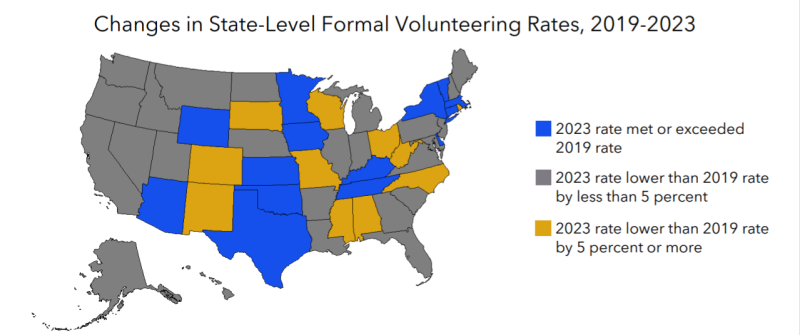
which represents an unprecedented growth rate of 22 percent over a two-year period. Yet rebounds are unequally distributed at the state level and within the largest twelve metro areas where reliable estimates are available. The latest rates of formal volunteering match or exceed 2019 levels in 14 states and five of the largest metro areas: Boston, Dallas, New York, Phoenix, and San Francisco. In contrast, formal volunteering rates remain more than five percentage points below pre-pandemic figures in 11 states and the District of Columbia metro area.
The Census Bureau press release has links to all the underlying data:
NOV. 19, 2024 — The U.S. Census Bureau and AmeriCorps, the federal agency for national service and volunteerism, today announced release of the 2023 Current Population Survey (CPS), Civic Engagement and Volunteering (CEV) Supplement Microdata File. It is the most robust longitudinal survey about volunteerism and other forms of civic engagement in the United States.
The data support evidence-based decision-making and efforts to understand how people make a difference in communities across the country. The 2023 CEV also introduces a new measure of virtual volunteering, making it the first federal survey to include such a measure.
The CEV includes information such as:
-
- The number of individuals involved in virtual and other unpaid volunteer activities.
- The frequency and intensity of formal volunteering through organizations.
- The extent to which individuals in the United States informally help their neighbors.
- Other types of civic activities such as donating to charity, participating in organizations, and contacting public officials.
- How individuals perceive the relationship between their work and civic activities.
- How rates of civic engagement vary by geography, demographics and socioeconomic status.
- How civic life in America has changed over time.
The Census Bureau conducts this AmeriCorps-sponsored survey. Data were collected from Sept. 17-26, 2023. The CEV takes the pulse of our nation’s civic health every two years. CEV data are available on census.gov through Volunteering and Civic Life.
AmeriCorps provides opportunities for Americans to serve their country domestically, address the nation’s most pressing challenges, improve lives and communities, and strengthen civic engagement. Analytic data files, an interactive dashboard, and other CEV resources are available on data.americorps.gov. Visit America Counts to learn more and read the featured story.
darryll k. jones