
Idaho is Latest State Supreme Court To Provide Accidental Guidance on Federal Income Tax Exemption
%20Stock%20Photo%20purchased_ID%20Sate%20Supreme%20Court%20Building.jpg)
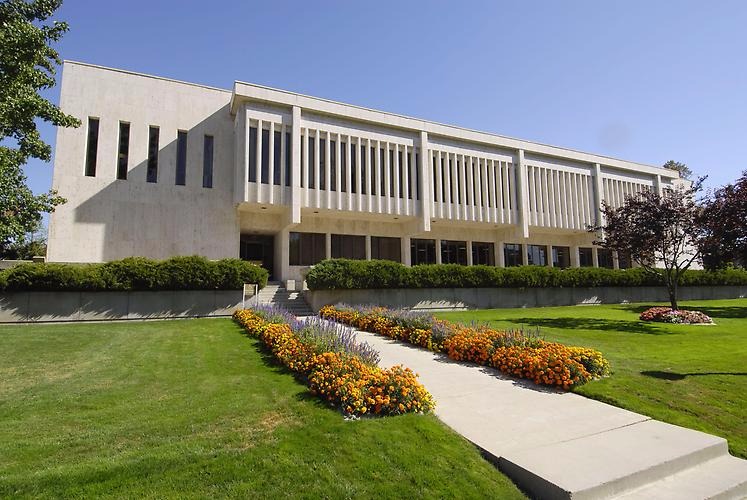
Idaho Supreme Court Building’s brutalist architectural style
Things are pretty quiet tax exemption-wise in the federal courts these days. Its been a good while now since a federal court has had to wrestle with tax exemption doctrine. But the state courts are lately grappling with tax exemption doctrine on a regular basis. In doing so, they provide accidental guidance on federal tax exemption. All the courts are applying state property tax law, of course, but they are addressing the fundamental issues common to property and income tax exemption. The federal tax issues the state supreme courts have recently addressed are whether government can define “churches” for tax purposes, whether public policy prohibits religious organization’s from discrimination based on identity or orientation, whether charity invariably requires no or below costs provision of goods or services, and the relevance of profit in our definition of charity. The latest example is an Idaho Supreme Court opinion (linked below) addressing “exclusivity” and the meaning of an unrelated business. Here’s the recap:
In Wisconsin the Supreme Court wrestled with what is meant by the phrase “primarily for religious purposes,” concluding that an organization must be “churchy” to be considered as operating primarily for religious purposes. The broader doctrinal question is whether a government can describe and then label one type of activity a “church” entitled to tax concessions. The problem is that when doing so, government necessarily determines that other religious activities are not “churches.” On what basis may a government make the distinction? Does the government “establish” religion or prohibit the free exercise by its distinction?
The Washington Supreme Court interpreted the state’s anti-discrimination to prohibit religious organizations from discriminating in the hiring of “co-religionists.” Do anti-discrimination laws, particularly those prohibiting discrimination on the basis of gender identity or sexual orientation, prohibit the free exercise of religion even when they apply only to an organization’s non-religious staffers (i.e., co-religionists)? Two organizations have bought suit seeking to vindicate their right to discriminate in hiring co-religionists. The U.S. Supreme Court will eventually settle that question.
In Utah, the Supreme Court ruled that a sports research and testing organization was not sufficiently charitable because in addition to scientific research and performing free drug testing for nonprofits and government agencies, the organization derived a very substantial profit from “market rate” drug testing services provided to professional sports leagues. The Utah Supremes Court held that profit-generating activities could not possibly be charitable. The implication is that charity requires free or below costs transfers.
And then last week, the Supreme Court of Idaho pitched in with what seems a sensible result. It’s opinion discussed health care as a charitable purpose, commerciality, and unrelated business. The case arose out of unfair business competition concerns because the petitioner, a nonprofit hospital, served all comers on an ability to pay basis, providing free or discounted care to some and charging normal rates to insured patients and others with sufficient income. The local property assessor asserted that by charging normal rates to those able to pay, the nonprofit hospital operated a business that competed unfairly with for-profit hospitals. Thus, the property tax assessor concluded that the percentage of the hospital’s property equal to the percentage of its revenues derived from the business should be taxed. The sole basis for exempting only 65% of the hospital’s property was that 35% of the hospital’s activities where provided to patients paying full price. That an activity generates profit, the Idaho Supremes said, does not by itself render an activity non-charitable. That is pretty much exactly opposite of what the Utah Supremes said. The Idaho Supremes discussed what “exclusively operated” means as that phrase relates to an organization’s profit-generating activities and ultimately ordered that the nonprofit hospital be 100% tax exempt.
On the federal level, nonprofit does not mean “no profit.” It means nobody is getting a profit. Nonprofit hospitals do not lose a percentage of federal income tax exemption equal to the percentage of paying patients unless business activity is unrelated to its charitable purpose. But not everybody agrees that’s as it should be so the Utah approach may not be an entirely illegitimate one. Some experts think all business activity, related or not, should be taxed. To do otherwise opens the door to calling all sorts of activities “tax exempt” even when those activities are indistinguishable from for-profit activities. The Idaho Supreme Court reversed, nevertheless, and in doing so concluded that health care is inherently charitable as long as it is dispensed on an ability to pay basis and even if some patients are required to pay market rates. Profit generation, by itself, does not preclude tax exemption.
darryll k. jones