
North Carolinians Protest and Sue to Get Their Nonprofit Hospital Back
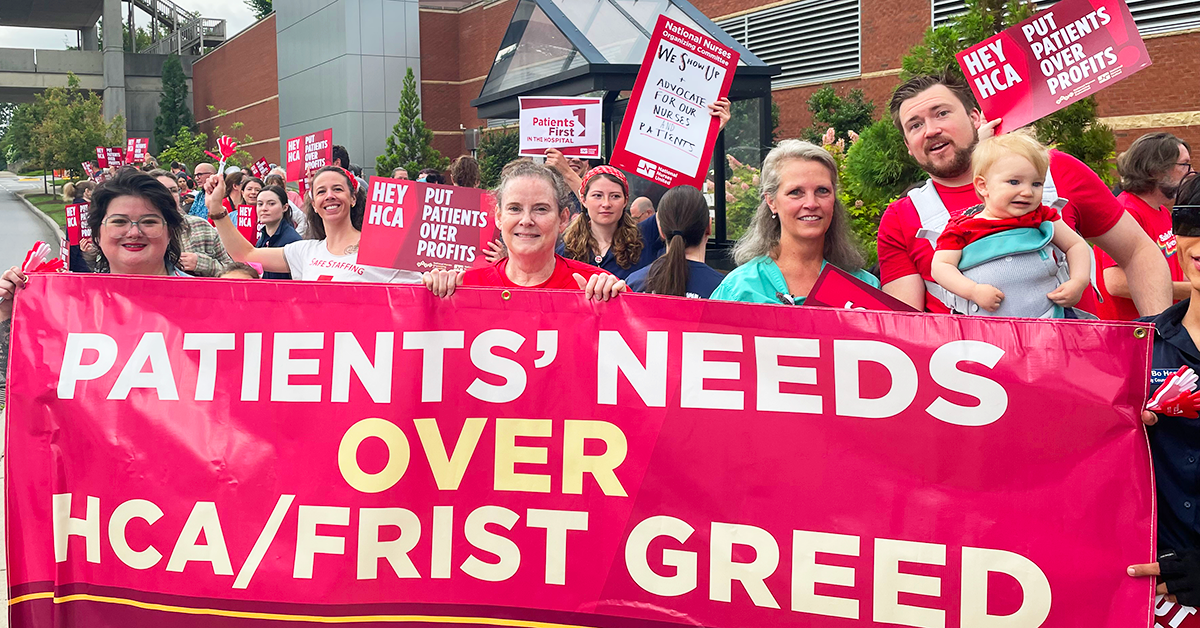
A group of nurses protesting against HCA, Asheville North Carolina.
An agitated crowd is forming over a nonprofit hospital case in the Tar Heel state. The AG is suing a for-profit health care system that acquired a nonprofit hospital, alleging that the for-profit is not providing the charity care it promised when the AG approved the acquisition. Stakeholders are also organizing against the for-profit’s continued ownership. The matter makes for an excellent case study of how AGs enforce charitable obligations sometimes. The Attorney General’s litigation file contains a fascinating composition of the petition, exhibits, timelines, a fact sheet, patient testimonials, and correspondence between the parties. I love watching and teaching cases in real time, rather than years later via a sterile appellate opinion. I’m telling you, law schools are the last arrivals to the pedagogical revolution. Anyway, if you teach, write, or practice in the area, I recommend bookmarking the page and downloading the whole case file. It makes for real good learning.
It seems HCA, a for-profit health system, came to town (Ashville, NC) back in 2019 and paid top dollar for a nonprofit hospital, all the while promising that in return for the AG’s approval, HCA would maintain an emergency room open to all, and maintain the historic level of charity care, at least. The crowd is forming because it thinks HCA is not providing the emergency room access and charity care it promised. There are public hearings and union contract negotiations everywhere in between. Here is a summary from Carolina Public Press:
HCA, the Tennessee-based for-profit hospital chain, acquired the Western North Carolina nonprofit Mission Health system in 2019 for $1.5 billion. This purchase resulted in the creation of the Dogwood Health Trust, a foundation which holds the money HCA paid to the nonprofit. In allowing the acquisition, the Attorney General’s Office placed key stipulations on the agreement to which HCA agreed.
Dogwood [Health Trust] has been entrusted with ensuring that HCA remains in compliance with those stipulations. The trust is tasked with hiring an independent monitoring company to help make this judgment. “It’s a little unusual,” Affiliated Monitors’ project manager Gerald Coyne said at a virtual media event Tuesday afternoon hosted by Dogwood.
“In a lot of states, when you have a proposed hospital merger that’s approved with conditions, those conditions are directly enforced either by the State Department of Health or by the attorney general or by both. Under this agreement, the decision was made at the time that the monitoring would … not (be done) by the state directly.” The first monitoring company, Gibbins Advisers, deemed HCA compliant each year, though two issues of potential noncompliance were resolved in 2020.
Here is the gist of the Attorney General’s complaint:
HCA has broken its promise and breached the APA [Asset Purchase Agreement]. Mission Hospital’s once efficient and orderly emergency department is now significantly degraded and unable to meet patients’ needs. Doctors and nurses are forced to treat patients in the waiting room, without even the bare minimum equipment or patient privacy protections, let alone adequate staff. Surgeons lack sterile equipment because HCA refuses to pay staff to clean surgical instruments. Local emergency management services are frustrated—and, in one county, have stopped sending ambulances to Mission—because of how long it takes for their patients to be transferred into the emergency department.
Responsibility for this downward spiral rests entirely with HCA. For instance, long wait times at the hospital’s emergency department are not because of an inadequate number of beds, but because of HCA’s profit-focused choices regarding how to staff the beds it has. HCA does not fully staff its emergency department or certain in-patient units at Mission. The number of fully-staffed inpatient oncology beds has decreased from 44 at the time HCA acquired Mission to 24 today—even though community demand for inpatient oncology beds has not decreased. Meanwhile, the oncologists Mission used to employ resigned because HCA deprived them of the nursing and administrative staff necessary to run an oncology practice.
The AG’s complaint is essentially asserting a constructive closure of the emergency room in violation of the purchase agreement. It’s a good thing the requirement is stated in the contract, because emergency rooms aren’t even always required for tax exemption. It looks as if HCA sought to fix things through a “plan of correction.” But this week, the Independent Monitor (appointed pursuant to the APA) told the Attorney General that HCA is still not operating an emergency room, and in fact is decreasing charity care.
That second allegation is interesting. The Independent Monitor explains that Mission Hospital had a written policy prohibiting the hospital from filing liens against patient/debtors on property worth less than $300,000. The Monitor asserts that HCA’s unapproved removal of that prohibition from its policies constitutes an improper restriction on charity care:
Buyer states that its practice is to never levy liens over patient debt and there are other company policies related to this prohibition of the use of liens. Nonetheless, Buyer’s revised Uninsured and Charity Care Policy, on its face, removes a restriction on Buyer’s ability to levy liens for nonpayment of patient debt and therefore provides less access for necessary medical care regardless of ability to pay for services. Given the absence of approval of the revision by the Advisory Board, Local Advisory Boards, and Independent Monitor, Dogwood intends to notify Buyer of potential noncompliance with Section 7.15 of the Purchase Agreement.
It’s probably not all that necessary to emphasize the math to prove that charity care is decreasing. The constructive closure of the emergency room is enough even if an emergency room is not required tax law.
Meanwhile, a new group, Reclaim Healthcare WNC, emerged and is advocating for the sale’s rescission, though I don’t understand how that is even possible. I suppose Reclaim might argue it has standing as a third party beneficiary. But not even the AG is seeking that remedy. Instead, it’s seeking to enjoin HCA from shutting down Mission’s emergency room and specific performance of the charity care obligation.