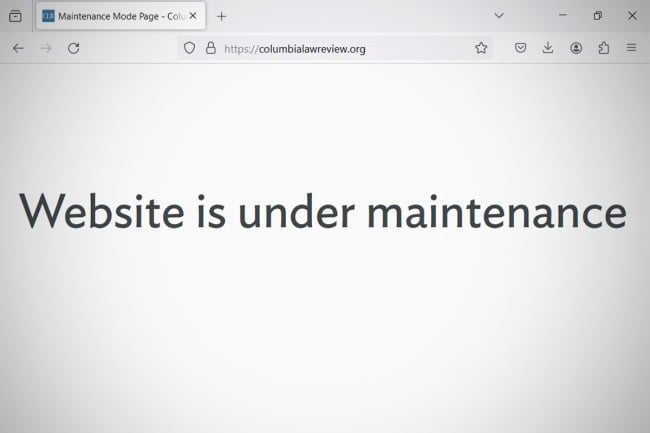
Columbia Law Review’s website is back online by the time of this post.
“As I suspected,” a reader told me in an email last week, “you have become a mouthpiece for Hamas.” He was reacting to my posting of an essay critical of Civil Society for not speaking out regarding Israel’s ongoing war effort. The night before the post, coincidentally, Israel launched an airstrike on an UNRWA facility where Hamas terrorists were hiding. There were also women and children taking shelter there — it was a school being used as shelter for displaced persons — and about 40 of them died too. Donald, the email writer, suggested I would understand if was the KKK. He said “please educate yourself” before concluding that this blog “was not helping things.” Except that if KKK terrorists were holed up in a near north Chicago neighborhood actively plotting the murder of all African Americans, the Air Force would still commit a war crime if it launched Sidewinders and Tomahawks, killing the Klansmen and 40 neighbors too. Even if those neighbors were sympathetic to the Klan.
The posted essay implies that Civil Society is afraid to speak up regarding Israeli war crimes in Gaza. Thirty five thousand civilian deaths make a rebuttable prima facie case. Explicit or implicit threats to an independent Civil Society will always make for an interesting and relevant topic on this blog. Because so many people are demanding ideological allegiance, not independence, from what is ironically sometimes called the “Independent Sector.” That’s what Republicans are doing, demanding ideological subservience actually. Hell, there are a whole lot of right wing nut job nonprofits I wish would shut up too, if I am being honest.
So the demand for situational ethics in Civil Society — you are either for us or against us, depending on context — generates a legitimate issue. I’m pretty sure Donald is against women and children dying in war. He just thinks it anti-Semitic to condemn those deaths and the Army that causes them in this situation. The same worrisome observation applies on an institutional level to Civil Society and lawmakers who get mad when Civil Society speaks against death and starvation in Gaza. It’s fair to admit, by way of example, that one source of our relative silence and apathy in Gaza is our unstated belief that the starving and dying civilians are probably sympathetic to Hamas anyway. Let’s just be honest about that. Secretly or not, our darkest thought is that maybe they deserve it. The posted essay asserts that we would think differently about the otherwise legitimate killing of Hamas, at all costs and despite whatever collateral damage, if Hamas were hiding in a different neighborhood. That’s situational ethics.
Anyway, tax exempt and nonprofit organizations are not isolated bystanders to history; they are important, influential, and indispensable history makers too. We want them to be that. Whatever an organization’s views may be, Civil Society functions less effectively when we demand ideological subservience. All law is contextual, moreover, and we can hardly understand Civil Society without context. Hence, the topic of this post.
At Columbia last week, the Law Review’s Board of Directors pulled the plug on the Law Review’s website for fear that the latest issue was being used as a “mouthpiece for Hamas.” From the Washington Post:
Student editors at the Columbia Law Review say they were pressured by the journal’s board of directors to halt publication of an academic article written by a Palestinian human rights lawyer that accuses Israel of committing genocide in Gaza and upholding an apartheid regime. When the editors refused the request and published the piece Monday morning, the board — made up of faculty and alumni from Columbia University’s law school — shut down the law review’s website entirely. It remained offline Tuesday evening, a static homepage informing visitors the domain “is under maintenance.” The episode at one of the country’s oldest and most prestigious legal journals marks the latest flashpoint in an ongoing debate about academic speech that has deeply divided students, staff and college administrators since the start of the Israel-Hamas war.
Several editors at the Columbia Law Review described the board’s intervention as an unprecedented breach of editorial independence at the periodical, which is run by students at Columbia Law School. The board of directors oversees the nonprofit’s finances but has historically played no role in selecting pieces.
The offending article, written by a Harvard SJD candidate who is also a human rights attorney, accuses Israel of genocide and crimes against humanity. There might be a good amount of evidence in support of the charges, according to the ICC. The editors say they accepted the article before October 7. Only situational ethics would require they withdraw the offer of publication in response to October 7. Regardless, the article probably makes life harder for Columbia as it fights accusations of anti-Semitism.
So after the Directors disabled the website, the editors posted the article elsewhere for public consumption. If I really were a mouthpiece for Hamas, I would need to read it. But that I haven’t and don’t need to read the article for this post proves my point. The point is that the context presents an interesting study about nonprofit governance and editorial independence in nonprofit news and scientific media. Whether the post is unflattering to Israel or Hamas is irrelevant, though the war generates reader engagement. Every story needs a hook.
Here is the academic point of interest: The board of a nonprofit media organization vetoed an editorial decision because the board disagreed with the writer’s views. A nonprofit board has ultimate authority, of course and can act according to its conception of charity. But would we be disinterested if, say, the Board of Directors for the Journal of the American Medical Association pulled the plug on JAMA’s website because it disagreed with an article’s assertions about COVID-19 public health measures? There was another article in that same Columbia Law Review issue about abortion, by the way. What if the board disdained that article’s assertion and decided to pull it over the editors’ objections? And how might that occurrence impact our willingness to subsidize by tax exemption JAMA or the Columbia Law Review?
I get paid to ask these questions, ya know. Like the rest of Civil Society, I shan’t be a potted plant.
darryll k. jones
