
For-Profit to Nonprofit Conversions: The IRS Says Don’t Bother
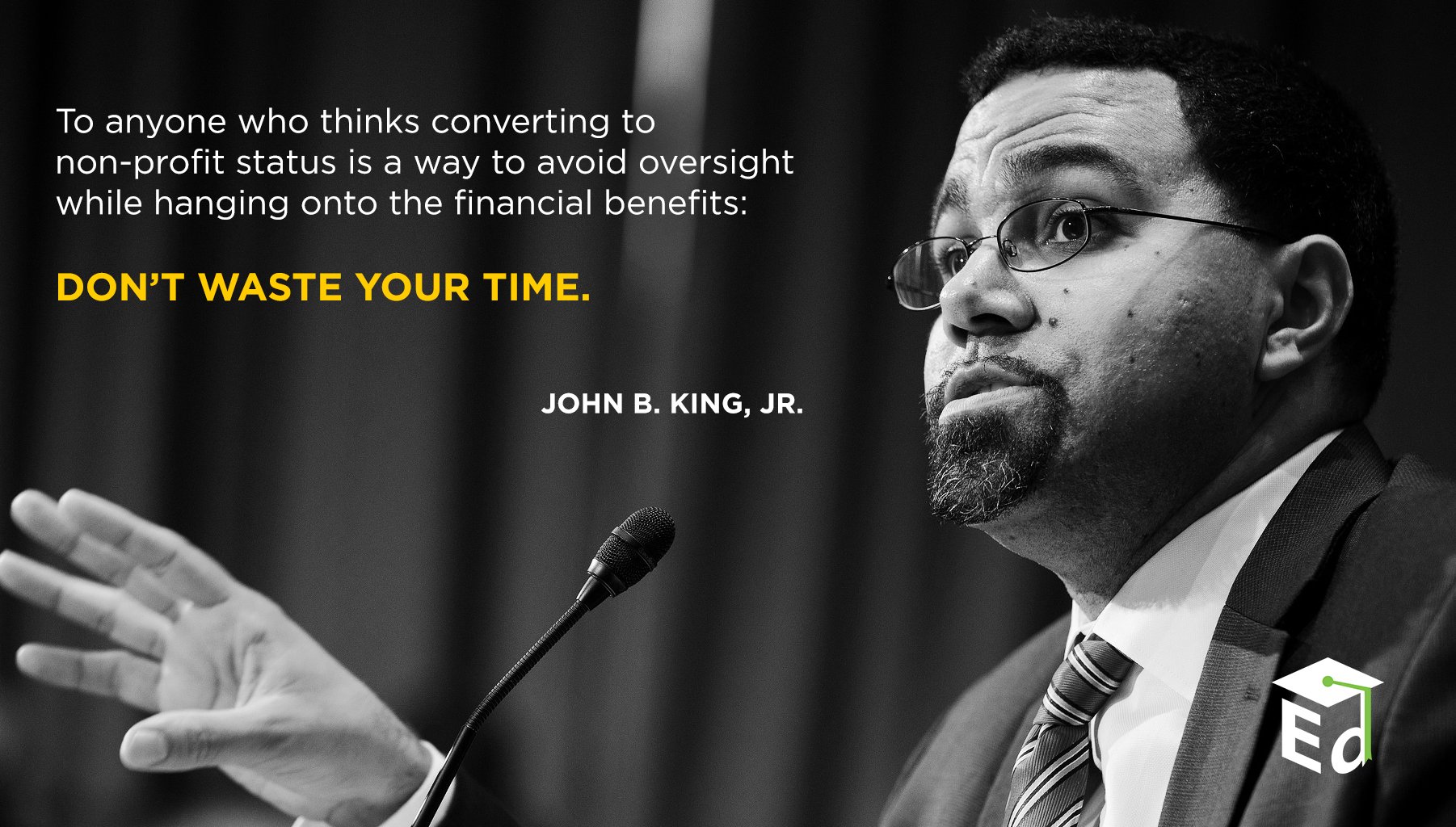
Is it ever really possible for a for-profit company to convert to nonprofit tax exempt status and continue operating using the same proven business model? Surely, there are plenty of instances where successful business-people get to an age where they want to give back; and why not by simply deciding that henceforth all profits, from what could have been a charitable endeavor in the first place, will no longer be distributed as profit? And why shouldn’t the former owners stay involved in what is now more a labor of love than profit? I don’t have a lot of links or citations to back it up, but it seems to me that the Service invariably looks askance at for-profit to nonprofit conversions, insisting that the successful for-profit owner transfer the business to a nonprofit and then go away completely. The picture above captures the apparent attitude, though it relates to the Department of Education.
That attitude animates Private Letter Ruling 202422013, released a few days ago. Here are factual excerpts:
In the past, your founder using a for-profit limited liability company (LLC) in conjunction with the for the profit companies, E and H, ran a large-scale artificial intelligence (AI) competition that was designed to be inclusive for all by catering to beginner and expert competitors. The participants competed for free and were eligible for potential prizes as well as were provided a forum for connecting with companies that sponsored the competition. Your founder subsequently formed you as a tax-exempt organization on C in B to conduct these same AI competitions.
You explained that every year you will host a few AI competitions, with various mini competitions held during the main ones. The competition requires a game engine/AI environment that takes actions from one or more team’s submitted AI agents and returns new observations to those agents. An agent is a user submission of code that defines logic for how the agent should respond to game observations. The game engine/AI environment is always built by and owned by you, but the code will always be open sourced under the D license.
You explained that you collaborate with E who is providing compute resources for running your competition, as well as giving you public visibility to their community. The competitions will be hosted on E’s Platform. H will provide the services for the competitions (such as the development, consulting, hosting and administration of the competition on E’s Platform). A review of E’s website (which states that E is the world’s largest data science community) shows that E hosts a number of different competitions, including competitions for businesses to solve various problems. H’s parent is a recognized leader among generative AI companies.
The PLR continues with quite a few details explaining that the computer competitions are entirely free, anybody can enter and that the competition has gained national exposure, sort of like the Scripps Spelling Bee. The only reason for pause is that the people who built this competition as a profit-making venture want to remain involved as it converts to nonprofit status. But even that continuing relationship is summarized in the PLR as a donative one:
One of your board members is an employee of E. The board member helps facilitate communication between you and E and provides competition support via engineering. No private code is shared between you and E, only open-source code. You do not pay or perform any monetary transactions to E other than providing E/H with prize pool money so E/H can help distribute it to competition prize winners. You have indicated that E through hosting the competitions on its platform and collaboration with you may receive potential new subscribers and benefit from well-run competitions. You may pay for various technological services such as E Cloud compute in the future. All fees and expenses, if any, will be paid to H.
You indicated that you have sponsoring relationships with the same for-profit entities as the for-profit LLC. You also explained that you primarily reach out to companies who have an interest in leveraging artificial intelligence in their company and are looking for potential new employees. These entities sponsor your competitions or provide donations to you. You will advertise sponsors or donors on various platforms including the competition website, your own website, F, and G. Depending on the amount of funding provided by the sponsor, you may also give out special prizes in their name.
Some sponsoring entities will provide various opportunities such as job opportunities in the AI technology space to participants. Specifically, you state that the sponsors/donors receive increased visibility and access to potential new candidates for hire. These sponsors often will contact the top competitors and give them opportunities for interviews. You stated that you do not share any resources with your for-profit sponsors.
Still, the PLR relies on revenue rulings and caselaw, all except one issued before 1966, to conclude that the organization does not qualify for tax exemption essentially because the former profit-takers are still involved in the organization. And from that fact, the PLR concludes that there is too much private benefit. I admire and respect the young exempt org attorneys in EO, but this ruling is miserly and bone-headed.
You are not operated for a charitable purpose, the ruling states, because you provide improper private benefit. You are not educational, or scientific, and because your operations benefit the entire public, you are not benefiting a recognized charitable class such as the poor or distressed! No kidding, read the PLR for yourself. Here are four propositions relied upon to deny exemption, none of which make a damn bit of sense to me.
-
- You do not meet Treas. Reg. Section 1.501(c)(3)-1(d)(1)(ii) which provides that an organization is not organized or operated exclusively for one or more exempt purposes unless it serves a public rather than a private purpose. Your AI competitions are opened to all. In addition, sponsors use the activities to find potential employees. [Open to all, therefore not charitable. WTF!?]
- Further, you do not limit your services to a specific charitable class. You claim that developing AI code will benefit the general public; but the general public is not a defined charitable class, as it includes all persons, not just those with charitable characteristics, such as the poor and distressed. [You don’t have to serve only the poor or distressed to be charitable these days. You just cannot exclude the poor and distressed like some hospitals and universities. There is a difference about which the PLR is confused.]
- You do not provide explicit training programs for your participants now, nor do you plan to. At most, you release public code serving as tutorials on various topics in AI and teach participants how to compete in the current competition. Even if a portion of your activities further educational purposes, a substantial portion of your activities are not primarily educational and are not otherwise exempt. [Educational exemption is clearly not limited to “explicit training.“]
- Your activity is of a type ordinarily carried on as an incident to commercial or industrial operations. Through your relationships with companies that are focused on the development of AI, your competitions enhance those companies’ opportunities for leverage in that industry. Any research resulting from the competitions is not made available to the public as it is owned by the creators of the code. You have not demonstrated that you conduct scientific research because your activities are an incident to commercial operations and the code created by the competitions is not shared with the public. [Most university research these days is commercially sponsored, what’s wrong with commercial sponsors?]