
Considering NYC PILOTS

“The Center for New York City Affairs at The New School is an applied policy research institute that drives innovation in social policy. The Center provides analysis and solutions. [It focuses] on how public policy impacts low-income communities, and strives for a more just and equitable city.” The Center recently published a brief addressing whether New York City would benefit from the implementation of PILOTs. The study focuses on the 14 tax exempt entities in the City owning property worth at least $500 million. It notes that there is legislation pending that would begin the process of amending the state constitutional provision mandating charitable property tax exemption.
A bill to begin the amendment process has been introduced this session in the State Assembly (A08478) and the State Senate (S07797). If adopted, the legislation would allow the City to alter the charitable exemptions of private universities with the new revenue to be used to help shore up the finances of the public City University of New York (CUNY).
While that slow process proceeds, the report suggest PILOTS be pursued with the top 14 charitable property owners.
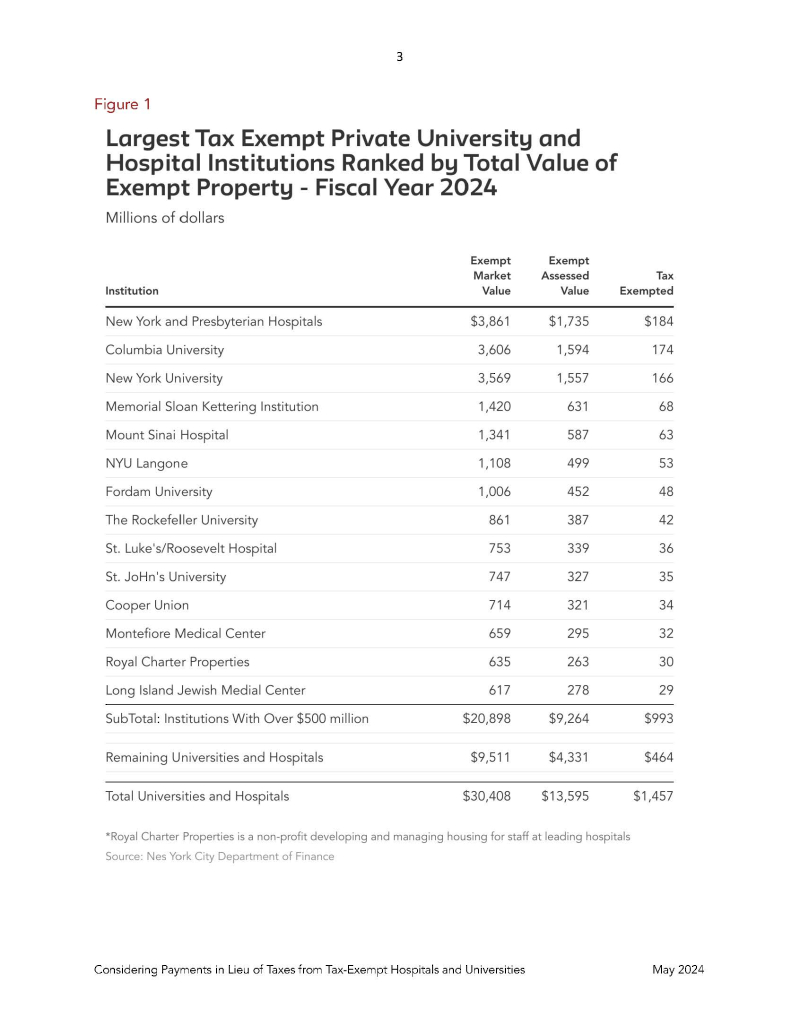
The report briefly summarizes arguments for and against NYC PILOTs before setting out the potential revenues from PILOT agreements requiring payments of 25, 35 or 50 percent of savings from property tax exemption:
III. Should Hospitals and Universities be Asked to Pay Tax or PILOTs?
Analysts and advocates looking for funds to sustain or enhance services at the local level have drawn attention to the incomes and wealth generated by private hospitals and universities.4 They have noted the large salaries received by senior executives of some of the wealthiest institutions, and a trend towards a more corporate and profit-seeking culture at some of those institutions, suggesting that the commitment to a charitable model is fading even as they retain the charitable exemption. It is also not unreasonable to expect private institutions to pay for at least some of the public services they receive. Advocates for having large medical and education institutions pay taxes or PILOTs note that such institutions, particularly universities, expand by purchasing formerly taxable property. The aggregate cost of the charitable exemption has outpaced overall property tax growth in the city. Between 2013 and 2023, the number of education exemptions in New York grew by 12.4 percent, more than twice as fast as the 5.1 percent increase in non-residential (Tax Class 4) parcels. The value of education exemptions grew by 89.7 percent while the increase in Class 4 assessments was 55.4 percent.
In their defense, these major non-profit institutions usually note that their faculty and staff, who are not exempt from paying income or sales taxes, are helping to pay for some of the public services used by their employers; this argument is particularly strong in the case of New York, which is less reliant on the property tax than many other cities. Hosting such major institutions helps New York in attracting visitors, students, and scholars to the city. The institutions also often point to the benefits they generate as drivers of economic growth in their host neighborhoods, and the value of the public good generated from the research and learning that occurs on campus and in their labs. However, while the entire region or nation may recoup those benefits, the burden of the foregone tax revenues is only borne locally. Also, tax exemption only benefits those institutions which own their property. Institutions that rent rather than own, which tend to have smaller budgets and endowments, receive no benefit from the exemption.
darryll k. jones