
Houston’s Regulation of Charitable Feeding Fails Intermediate Scrutiny
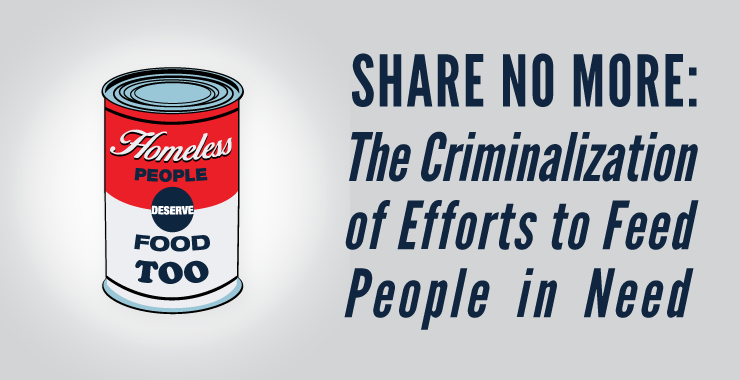
Click here for the full report.
As a dumb undergrad, I was always too proud to line up with hundreds of other people on the Plaza of the Americas outside Smathers Library at the University of Florida. There, students or anybody else could get a free vegetarian meal two or three times a week courtesy of the International Society for Krishna Consciousness. What the Krishnas served seemed like gruel to me back then. It wasn’t pizza, chicken wings, or burgers. I am smarter now, though. One or twice a month, I pay nearly $25 for a plate of chickpeas and potatoes, hummus and stuff. Yep, way smarter now.
One thing is certain. The Krishnas will feed anybody. The problem is what it’s always been since Mary and Joseph had to bed down in a manger for lack of any place else. People acting all “Christian” and stuff tend to attract the . . . well, the unwashed, unchurched unhoused hungry people. And when that happens, even other Christian-acting folk get anxious. We get tired of all God’s poor people milling around making a mess, sleeping and body-functioning anywhere, some causing other trouble in their desperate 24-hour struggle to survive living outside without a job or healthcare. We get tired of all that, let’s just be honest. Get a damn job! And so there is an increasing trend towards regulating and criminalizing what California calls “Nonprofit Charitable Temporary Food Facilities.” Not just in Ft. Worth or Great Falls, Montana. People in San Francisco and Seattle, are tired too and there is collective soul-searching about what to do.
In Houston last week a federal district court said that “Food Not Bombs, Houston,” a local nonprofit that has been feeding people for decades on a downtown square, engaged in expressive conduct when feeding unhoused people. And regulation of that expressive activity would have to survive “intermediate scrutiny.” Thus, Houston’s law restricting charitable food distributions to a single location (in this case, a police station parking lot) and imposing all sorts of other logistical ridiculousness (sufficient parking for 20 cars, for example, and porta-potties) could not survive intermediate scrutiny. The O’Brien test, by the way, states that “a government regulation is sufficiently justified if it is within the constitutional power of the Government; if it furthers an important or substantial governmental interest; if the governmental interest is unrelated to the suppression of free expression; and if the incidental restriction on alleged First Amendment freedoms is no greater than is essential to the furtherance of that interest.” In Houston, the City failed the test miserably. Restricting the expressive conduct of feeding people to one location is not the least restrictive means of regulating meal distributions, according to the opinion. Here are a few excerpts:
The threshold inquiry in this case is whether Plaintiffs are engaging in expressive conduct protected by the First Amendment. The First Amendment prohibits laws “abridging the freedom of speech . . . or the right of the people to peaceably assemble.” U.S. Const. Amend. I . The Supreme Court has “long recognized that [the First Amendment ‘s] protection does not end at the spoken or written word.” Texas v. Johnson, 491 U.S. 397 , 404 , 109 S. Ct. 2533 , 105 L. Ed. 2d 342 (1989).
As the Eleventh Circuit articulated, “in determining whether conduct is expressive, we ask whether the reasonable person would interpret it as some sort of message, not whether an observer would necessarily infer a specific message.” Holloman ex rel. Holloman v. Harland, 370 F.3d 1252 , 1270 (11th Cir. 2004). “Whether food distribution [or sharing] can be expressive activity protected by the First Amendment under particular circumstances is a question to be decided in an as-applied challenge[.]” Santa Monica Food Not Bombs v. City of Santa Monica, 450 F.3d 1022 , 1032 (9th Cir. 2006).
Applying this expressive conduct jurisprudence, the Court finds that FNBH’s food sharing is expressive conduct. The likelihood is great that an observer would appreciate FNBH’s message based on the context of the protest. Even setting aside the words on FNBH’s banners and t-shirts, the political message of feeding the hungry, eating with them, and doing so on public property, would be understood by an onlooker.
The Eleventh Circuit examined the food sharing protest by Fort Lauderdale Food Not Bombs and similarly found that the food sharing was expressive conduct protected by the First Amendment . In doing so, the Eleventh Circuit examined the context of the food sharing. Specifically, the Circuit found that the (1) presence of signage, (2) the public nature of the events, (3) the public forum status of parks, (4) the fact that homelessness was an issue of public concern, and (5) the inherently expressive nature of food sharing, all supported the conclusion that Fort Lauderdale Food [*5] Not Bombs was engaged in a form of protected expression. Fort Lauderdale Food Not Bombs v. City of Fort Lauderdale, 901 F.3d 1235 , 1242-43 (11th Cir. 2018).
The Court finds that the activity, context, and environment here are nearly identical to those above, such that an neutral observer would understand that Plaintiffs engage in food sharing as part of and with the intent to protest the “criminalization of poverty,” “overinvestment in war” and “policing at the expense of the hungry.” (Doc. No. 4 at 10). As such, Plaintiffs are engaged in expressive conduct protected by the First Amendment.
darryll k. jones