
The 1619 Project and Donor Power
Nikole Hannah-Jones won a Pulitzer Price in Commentary for her Introductory Essay to The 1619 Project. Here is a bit from her essay, which also won an Emmy for Outstanding Documentary or Nonfiction Series:
In August 1619, just 12 years after the English settled Jamestown, Va., one year before the Puritans landed at Plymouth Rock and bought 20 to 30 enslaved Africans from English pirates. The pirates had stolen them from a Portuguese slave ship that had forcibly taken them from what is now the country of Angola. Those men and women who came ashore on that August day were the beginning of American slavery. They were among the 12.5 million Africans who would be kidnapped from their homes and brought in chains across the Atlantic Ocean in the largest forced migration in human history until the Second World War. Almost two million did not survive the grueling journey, known as the Middle Passage.
Before the abolishment of the international slave trade, 400,000 enslaved Africans would be sold into America. Those individuals and their descendants transformed the lands to which they’d been brought into some of the most successful colonies in the British Empire. Through backbreaking labor, they cleared the land across the Southeast. They taught the colonists to grow rice. They grew and picked the cotton that at the height of slavery was the nation’s most valuable commodity, accounting for half of all American exports and 66 percent of the world’s supply. They built the plantations of George Washington, Thomas Jefferson and James Madison, sprawling properties that today attract thousands of visitors from across the globe captivated by the history of the world’s greatest democracy. They laid the foundations of the White House and the Capitol, even placing with their unfree hands the Statue of Freedom atop the Capitol dome. They lugged the heavy wooden tracks of the railroads that crisscrossed the South and that helped take the cotton they picked to the Northern textile mills, fueling the Industrial Revolution. They built vast fortunes for white people North and South — at one time, the second-richest man in the nation was a Rhode Island “slave trader.” Profits from black people’s stolen labor helped the young nation pay off its war debts and financed some of our most prestigious universities. It was the relentless buying, selling, insuring and financing of their bodies and the products of their labor that made Wall Street a thriving banking, insurance and trading sector and New York City the financial capital of the world.
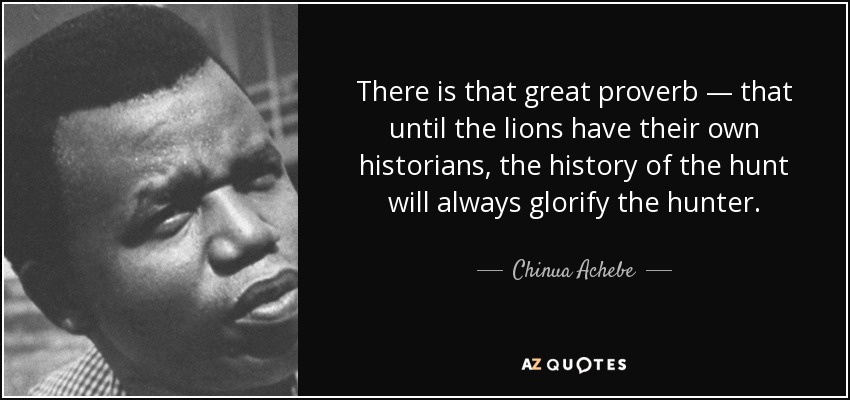
The 1619 Project scared the pants off of right-wing white folk, some of whom can’t stomach the prospect of Hannah-Jones’ telling ever being whispered in darkened slave cabins late at night. Or in public schools. Most of them are just like me and haven’t even read it. The 1619 Project, along with reactions to police murders of Black suspects, spawned the whole anti-woke movement. As if history is an immutable unbiased truth, the property of those who told and taught it their own way for so long. History is only “revisionist” because it revises somebody else’s revision. “Until the lion learns to write, the history of the hunt will always glorify the hunter.” Hannah-Jones is a lion who writes, is all.
Anyway, UNC wanted to offer Hannah-Jones an endowed tenured position but a big donor waged war. Susan King, UNC’s Dean of Journalism fought back and UNC eventually offered Hannah-Jones the position. She declined after having forced the whole conversation and thereby exposing the sometimes unchecked arrogance of some donors. Woman King ended up resigning after the PR debacle. She recently wrote an essay entitled, “What I learned About Donor Power From Trying to Hire Nikole Hannah-Jones.” Here is an interesting excerpt:
I was dean of the University of North Carolina at Chapel Hill journalism school when our faculty recruited Pulitzer Prize-winning journalist and alum Nikole Hannah-Jones to be the prestigious Knight Chair in Race and Investigative Journalism. That was the plan, at least until a donor clash blew it up. I’ve relived that experience repeatedly in recent months as college campus protests over the Israel-Hamas war have resulted in public discord between donors and university presidents. This ultimately led to the resignation last week of Harvard President Claudine Gay less than a month after University of Pennsylvania President Liz Magill stepped down.
Hussman didn’t think hiring Hannah-Jones was a good decision, and he said so to me and the university’s development leader. He also reached out behind the scenes to members of the university governance boards who would vote on Hannah-Jones’s tenure. And when the controversy went public, so did he.
I liked and respected Hussman. I also understood why he gave to his alma mater. He wanted to rebuild trust in journalism and felt the best way to do that was by preparing young journalists to be objective reporters who relied on facts to tell the story — not opinion. This fueled a well-worn debate about reporters’ motivations in shaping a story. His perspective was seen as narrow by the new generation of reporters, many of whom were women and people of color and who chose journalism so that underreported viewpoints would finally make it into the mainstream.
It also led to a narrative of a rich, white male leader using his influence and prestige to demand a university reject a highly successful Black woman journalist. It was a nightmare. Deciding whom to support, however, wasn’t hard. I respected Hussman‘s desire to rebuild trust in journalism, but I also believed that a large donation should never buy decision-making power.
. . .
darryll k. jones