
DOJ’s Latest Salvo in Battle Against Inflated Conservation Easement Deductions
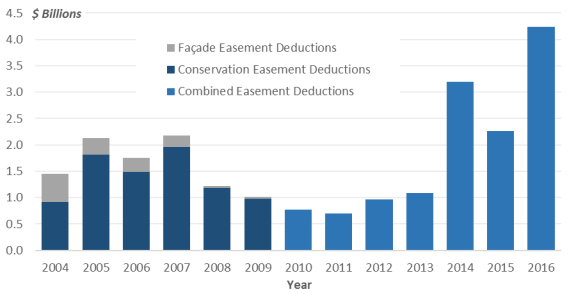
DOJ filed a reply brief in the government’s latest offensive against illegitimate conservation easement deductions. The case is Brooks v. Commissioner pending in the 4th Circuit. Here is the argument summary:
Taxpayers, through an LLC, purchased Cotton Row Farm, an 85.314-acre parcel of vacant property in Liberty County, Georgia, for $1,350,000. They subdivided the property into two parcels, and roughly a year later, granted a conservation easement on the smaller parcel, which still allowed them to use roughly half of that plot as horse paddocks, and still more of the land for other purposes. Taxpayers then claimed a charitable contribution deduction based on that easement, asserting that it was worth $5.1 million—several times what they paid for the fee interest in the entire, undivided Cotton Row Farm just one year earlier. The Tax Court correctly upheld the Commissioner’s disallowance of the deduction and imposition of a gross valuation misstatement penalty.
1. To obtain a tax deduction for a qualified conservation contribution, a taxpayer must strictly comply with the substantiation requirements in the Code and pertinent Treasury Regulations. The Tax Court correctly held that taxpayers had failed to meet no fewer than three of these requirements here.
First, taxpayers failed to provide proof of a contemporaneous written acknowledgment that Liberty County provided no goods or services in exchange for the conservation easement, as required by I.R.C. § 170(f)(8)(A). The court properly rejected taxpayers’ invitation to find equivalent facts at trial, which would not meet the Code’s strict requirement of a contemporaneous written acknowledgment.
Second, the Tax Court correctly concluded that the five-page “Baseline Report” in evidence did not meet the baseline documentation requirements of Treas. Reg. § 1.170A-14(g)(5). Under that regulation, taxpayers were required to provide Liberty County with adequate documentation of the condition of the property at the time of the easement donation. Here, the Tax Court correctly found that the lack of detail in taxpayers’ baseline report, and lack of corroborating maps and photographs, did not adequately document the condition of the property, making it impossible for Liberty County to determine whether any exercise of the substantial rights that taxpayers retained in the property violated the terms of the easement. Taxpayers have not shown any error in that factual determination.
Third, the Tax Court correctly found that taxpayers misreported their cost basis in the donated property, an error which misled the IRS as to the inaccuracy of their appraiser’s valuation and failed to fulfill the substantiation requirements of Treas. Reg. § 1.170A-13(c). Here, taxpayers reported their cost basis in the entire, undivided property— which was more than double their basis in the easement parcel. The Tax Court correctly held that taxpayers’ grossly overstated basis rendered the appraisal summary materially incomplete.
2. The Tax Court correctly held that the gross-valuation- misstatement penalty applies here. After weighing expert testimony, the court reasonably rejected taxpayers’ expert’s error-riddled calculations and instead agreed with the IRS expert’s valuation of the easement at $470,000. There was no error, much less clear error, in that finding. Because taxpayers claimed a value of $5.1 million for the easement on its tax return—more than 200% of the actual value—the Tax Court properly upheld the gross valuation misstatement penalty.
3. Taxpayers do not contend that the IRS failed to comply with the supervisory approval requirement of I.R.C. § 6751(b)(1) in imposing the penalties at issue. Rather, taxpayers solely complain that they did not receive the evidence of IRS compliance with § 6751(b)(1) at least 14 days before trial. But as the Tax Court found, taxpayers were not prejudiced by the admission of this evidence, particularly as they had not raised the issue nor sought discovery on supervisory approval before the evidence was produced one week before trial. The Tax Court did not abuse its discretion by admitting this evidence.
The Tax Court’s decision is correct and should be affirmed.
darryll k. jones