
China’ Proposed Revised Nonprofit Law: Government Supervision and Mandatory Payouts
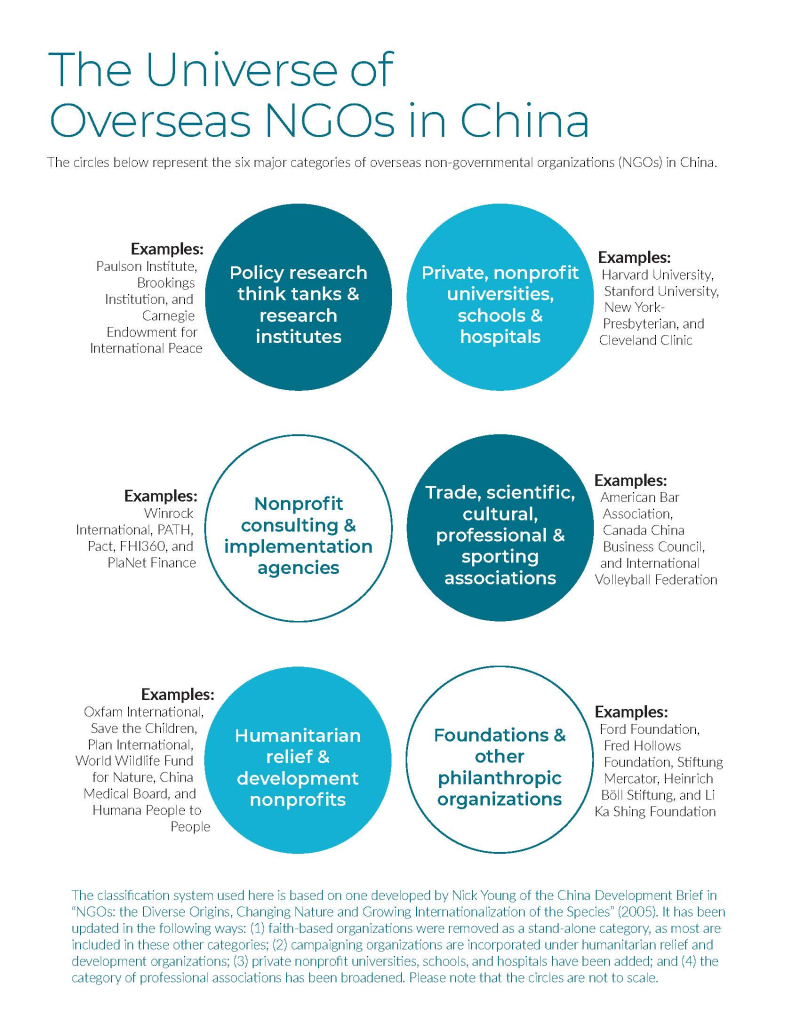
From ICNL China Philanthropy Law Report
I’m not sure whether the lead couple of paragraphs in this South China Morning News story is unnecessarily alarmist. The headline is “All China charities to be overseen by police, anti-spying agencies under proposed revisions to 2016 law” and the first few lines say:
The article regards proposed revisions to China’s 2016 Charity Law posted online last week and open for public comment until November 23, 2024. Here is the precise provision of concern — as translated by an independent organization, thankfully:
Article 103: The civil affairs departments of people’s governments at the country level and above shall perform their duties in accordance with law, conducting oversight inspections of charitable activities, guiding charity industry organizations, and preserving positive order for charity.
Departments such as for industry and information technology, public security, national security, finance, taxation, auditing, internet information, and financial regulation are to perform regulatory duties in accordance with the law within the scope of their respective duties.
Industry regulatory departments for areas such as education, science and technology, culture, health, sports, emergency management, the environment, and health insurance shall strengthen guidance, management, and services for charitable activities in the corresponding industry.
Where charitable organizations have professional supervisory units, the professional supervisory units shall conduct guidance and oversight of them.
I’m not so sure this all that remarkable. All of our own counterparts — FBI, DOJ, CIA, IRS, State AGs, local police departments and even state and local departments of business regulation and tax — have subject matter jurisdiction over nonprofit organizations though there is not a single law referring to all those agencies as they relate to nonprofit or tax exempt organizations. The SCMN headline suggests that China is lining up the State’ regulatory apparatchiks against nonprofits. But its looks just as likely that the revisions are merely comprehensive in describing nonprofits’ legal existence in China. There are people more knowledgeable than me on this topic who might think otherwise. Consider this blog post from a practitioner who recently — before the proposed amendments — helped a nonprofit seeking to do business in China:
The CCP is already belligerent when it comes to any kind of foreign influence within China, and that is especially true where nonprofits are concerned. Nonprofits in China that fall into any potentially problematic category, including education (see here and here), finance, and healthcare, could easily be singled out by the CCP as problematic and get shut down quickly (the American Chamber of Commerce in Chengdu received only 72 hours’ notice.)
The CCP is extremely bullish on promoting “Chinese credentials” for every type of licensing, so even if you are in a less problematic industry, you may run into significant obstacles. And China’s nonprofit law includes its ubiquitous provision prohibiting any foreign entity or person from endangering state security or damaging the national or public interest. All of those criteria are intentionally broad and vague and used to target undesirable companies and individuals.
If you were to seek to enter the China market with a business entity, your business model would fit the Social Association 社会团体 (“SA”) model, which is the equivalent of a nonprofit membership association. However, because SAs are subject to significant regulatory approval and oversight by both the national Ministry of Civil Affairs and a government ministry or other state agency within your line of work, you would most likely find the prospect of entering the China market prohibitively expensive and cumbersome.
Further, you would most likely be stonewalled based on the CCP’s recent shift in enforcement priorities and the fact that China’s foreign nonprofit law does not include a provision permitting a foreign nonprofit to establish a Chinese subsidiary, instead requiring you to set up a representative office or register to carry out temporary activities (requiring annual approval). Establishing a representative office as a nonprofit requires partnership with a Chinese nonprofit with a similar mission, which will be responsible for oversight of the activities in China. But establishing a representative office would open you to full financial liability for all China activities.
Sill, the proposed amendments seem fairly broad in scope. They set forth broad rules relating to what we would call determination letters, public disclosures, charitable solicitation registration, donor agreements, private inurement, tax benefits, public benefit, and even mandatory annual payouts. All of those things are regulated under US law. So facially, the rules don’t seem all that draconian but then, the proof is rather in how the rules are applied in a country with very little separation of powers. So maybe the SCMN headline is warranted.
Still, there are lessons to be learned even for U.S. law. The payout provision is particularly interesting:
Article 61: Charitable organizations shall actively carry out charitable activities, fully and efficiently utilizing charitable assets, and obey the principle of highest necessity in managing costs, acting frugally, and reducing unnecessary expenses. Of charitable organizations, charitable foundations with public fundraising credentials’ annual expenditure for carrying out charitable activities must not be less than 70% of its total income for the previous year or 70% of the average income for the last three years; annual management costs must not exceed 10% of that year’s total spending, and where there are special circumstances making it difficult for annual expenditures and management costs to comply with the provisions above, a report shall be made to the civil affairs departments where they are registered and a public explanation of the situation shall be made.
Seventy percent seems high and my initial reaction is that the provision does not allow for long term sustainability. It might make foundations (I am gonna find out what a Chinese foundation is for a later post) susceptible to temporary but severe financial shocks. Still, its worth studying.
darryll k. jones