
What Happens to Charitable Contributions Under a Wealth Tax?
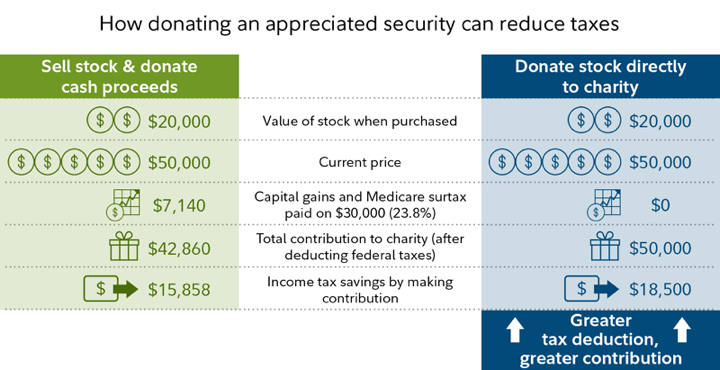
The Joint Committee on Taxation sent a letter to Congressman Richard Neal yesterday outlining some of the tax systems — Subchapter K, for example — not just individual provision, that could be at risk if the Supreme Court determines that realization is required by the 16th Amendment. It makes some interesting points about pass thru taxation, especially, but it doesn’t address the effect of a wealth tax such as that proposed by President Biden or Senator Warren, on charitable giving. Especially the huge benefit that allows wealthy folk to get fair market value charitable contribution deductions for appreciate long term capital assets. If the appreciation is taxable without regard to realization, as we understand it now, would that disincentive charitable giving by those with the most to give? I would think that for well off people, donating appreciated assets is a significant part of their financial strategy precisely because of the current law double tax benefit (no gain inclusion plus fair market value deduction).
Here is a case study from Norway concluding that wealth taxes there decreased charitable giving:
We study how tax incentives affect charitable giving using two quasi-experiments from Norway. First, using a shock to wealth tax exposure, we estimate the semi-elasticity of giving with respect to the after-tax rate of return on wealth. Inconsistent with the notion that households accelerate giving to reduce future taxes, we find that a 1% wealth tax reduces giving by 26%. We also find that wealth taxation reduces the likelihood of giving but only among ex-ante nongivers. Second, using bunching at an income-tax deduction threshold, we estimate a modest compensated own-price elasticity of giving of -0.44. This elasticity exhibits only minor heterogeneity with respect to income and wealth, but is considerably larger for religious than nonreligious giving. We develop a simple life-cycle model with endogenous charitable giving to interpret our combined findings. We find that the effects of wealth taxation on extensive-margin giving can be rationalized by entry costs equal to one third of the marginal giver’s lifetime giving. Removing these entry costs would increase aggregate giving by about 21%. Importantly, the calibrated model exhibits weak intertemporal substitution effects with an EIS of only 0.08. This implies that households both give and consume less when the after-tax rate of return goes down. In settings where the level of giving is high, the crowd-out effects of capital taxation on giving are substantial.
darryll k. jones