
The Top Public Charities are mostly all DAFs
This just in from Inequality.org:
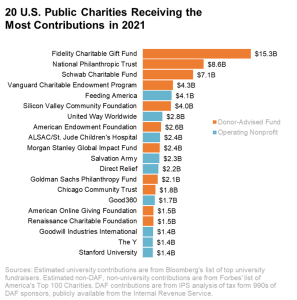
Last year, we wrote about how donor-advised funds, or DAFs, had become the top recipients of charitable giving in the United States. At the time, we were astounded to discover that DAF sponsors made up six of the top 10 and nine of the top 20 most successful public-charity fundraisers in the country. We’ve updated the data for 2021 — the most recent year for which complete data is available — and the picture has only gotten more stark. Donor-advised fund sponsors now make up seven of the top 10 and eleven of the top 20 public charities in the United States.
. . .
Public charities are nonprofits that rely on a broad base of donors for their revenue — as opposed to private foundations, which are usually created and supported by just one or two major donors. In contrast to private foundations, DAF sponsors qualify as public charities, and so receive the same preferential tax treatment as working charities. As we have reported before, DAFs are growing explosively. The assets held in U.S. DAFs have grown by 513 percent over the past 10 years — rocketing from $38 billion in 2011 to $234 billion in 2021.
And DAFs now rake in 22 percent of all U.S. individual charitable giving. Of particular concern are DAF sponsors that are affiliated with for-profit Wall Street financial corporations. As we have documented, these commercial DAFs provide enormous publicly-subsidized tax benefits to their high-rolling contributors while actively encouraging the warehousing of charitable wealth. And commercial DAFs have been growing explosively. The Fidelity Charitable Gift Fund, for example, has been the most successful charitable fundraiser in the country for the past six years.
. . .
darryll k. jones