
One Last Plea for NCAA’s Tax Exemption after NLRB’s Complaint.
When college athletes officially become employees, will that fact just add to the evidence in opposition to the NCAA’s “unjustifiable” tax exemption? I don’t think it should have relevance one way or the other, believe it or not. Why should it? Most of us reading this blog are probably employees of exempt entities. Exempt organizations may and must have employees at some point, so it should hardly dispute NCAA’s exempt status that it “employs” athletes, as the NLRB asserts in a new complaint filed last week. Meanwhile, a separate case filed under the FLSA is working its way through the 3rd Circuit and some people think it will end up in the Supreme Court. That case too is about whether athletes are employees. NLRB’s complaint was widely anticipated, by the way, after NLRB Office of General Counsel, citing Justice Kavanaugh in Alston said this in 2017:
Justice Kavanaugh, in his concurring opinion in Alston, went further. He strongly suggested that the NCAA’s remaining compensation rules also violate antitrust laws and questioned “whether the NCAA and its member colleges can continue to justify not paying student athletes a fair share” of the billions of dollars in revenue that they generate. Moreover, he suggested that one mechanism by which colleges and students could resolve the difficult questions regarding compensation is by “engag[ing] in collective bargaining.”
General Counsel basically invited athletes to file complaints.
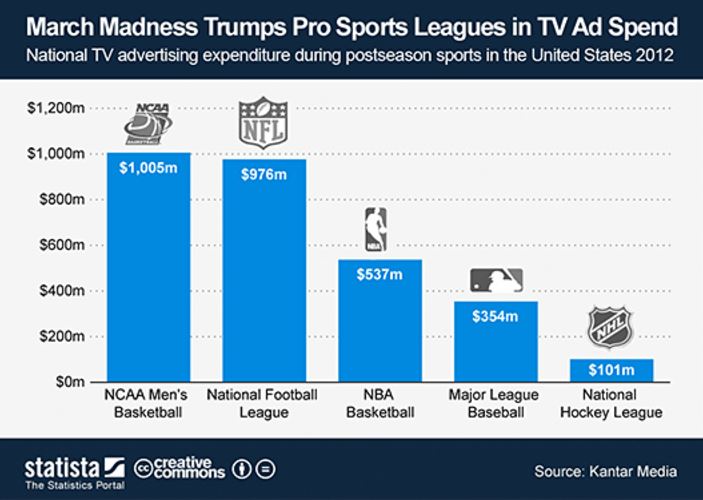
The NCAA has a lot of legitimate concerns regarding the classification of athletes as employees, but that result says nothing about whether organizations that put on college football and basketball games — that’s what we are talking about primarily, we are hardly worried about track and field or rowing — should be tax exempt. In fact, we might not be so concerned if Congress had not overruled the Cotton Bowl Ruling (PLR 9147007) holding, quite correctly, that advertising revenue was unrelated taxable income. What else, other than advertising revenue makes us think holding sporting events is not an exempt purpose. Its the thrill of victory and the agony of defeat! It can’t be high salaries that make this not exempt because nonprofit hospital CEO’s and university presidents make as much or more than Nick Saban. There is no private inurement. It can’t be that admission is not free because you have to pay to attend the opera. It can’t be that there is nothing “amateur” about college sports. Because we don’t demand that nonprofit hospitals operate like amateurs as a condition of tax exemption. In fact tort law holds nonprofit hospitals to the same standard of professionalism as their for-profit counterparts. It can’t be private benefit (though there is lots of that, honestly), and it sure isn’t political activity because the NCAA’s lobbying effort in Congress is likely to fall in the self-preservation exception.
Let’s just tax advertising revenue like we shoulda done long ago — that’s really what this is all about — and then leave the NCAA alone to figure out how to preserve the beautiful intangibles that distinguish it from the NFL or the NBA. True fans know the distinctions. Let’s not turn the NCAA into the NFL/NBA.
darryll jones