
Health Affairs: What’s Behind Losses At Large Nonprofit Health Systems?
There is an interesting analysis published in Health Affairs last week. It answers the question posed in the headline by pointing not to an increase in uncompensated care, or expensive uninsured experimental treatments for very rare diseases, but to losses from nonprofit hospitals’ stock market investments. The authors’ don’t drop the other shoe by suggesting that profit seeking investment loses decrease charity care, but they say this in their conclusion:
Wall Street losses should not impact private payers’ and taxpayers’ payments to hospitals. Asking these constituents to foot the bill for hospitals’ investment losses not only lacks justification but will insulate hospitals from the consequences of their investment decisions, motivating less fiscally responsible behavior in the future.
. . . .
Here is a summary of their findings:
We collected the most recent quarterly financial statements from 10 nonprofit hospital systems: Advent, Ascension, Advocate Aurora, CommonSpirit, Mass General Brigham, Sutter, Trinity, UPMC, Northwell, and Providence. Financial statements were downloaded from each hospital system’s website. These systems were selected due to their size and the public availability of their financial reports. While this did not constitute a statistically representative sample, it did provide insight into the financial profiles of some of the nation’s largest systems and the most important factors behind those profiles.
All 10 hospital systems reported negative overall profit margins (net income divided by revenue). Average overall profit margin fell from 9 percent in 2021 to -6 percent in 2022.
As shown in exhibit 1, a closer look at financial measures for our 10 selected nonprofit hospital systems reveals a more complex picture. Patient care revenue, revenue obtained from providing hospital services, slightly increased, by just below 1 percent in relative terms from 2021 to 2022. However, investment income, revenue from financial investments, declined by 185 percent between 2021 and 2022. Investment losses are highlighted by Ascension’s $4.7 billion loss and CommonSpirit’s $3.7 billion loss (Exhibit 2). Overall, investment losses accounted for approximately 85 percent of overall financial losses.
Exhibit 1. Average financial ratios and changes in ratios for ten large nonprofit hospital systems

Other sources attribute hospital financial losses to increased labor costs, particularly for nurses and health professionals, and increased supply costs. Our analysis suggests that investment losses are actually the primary driver of these nonprofit health systems’ overall losses. It is possible that financial performance of smaller hospitals and systems may have been different.
Exhibit 2. 2021 to 2022 Change in investment assets for ten large nonprofit hospital systems 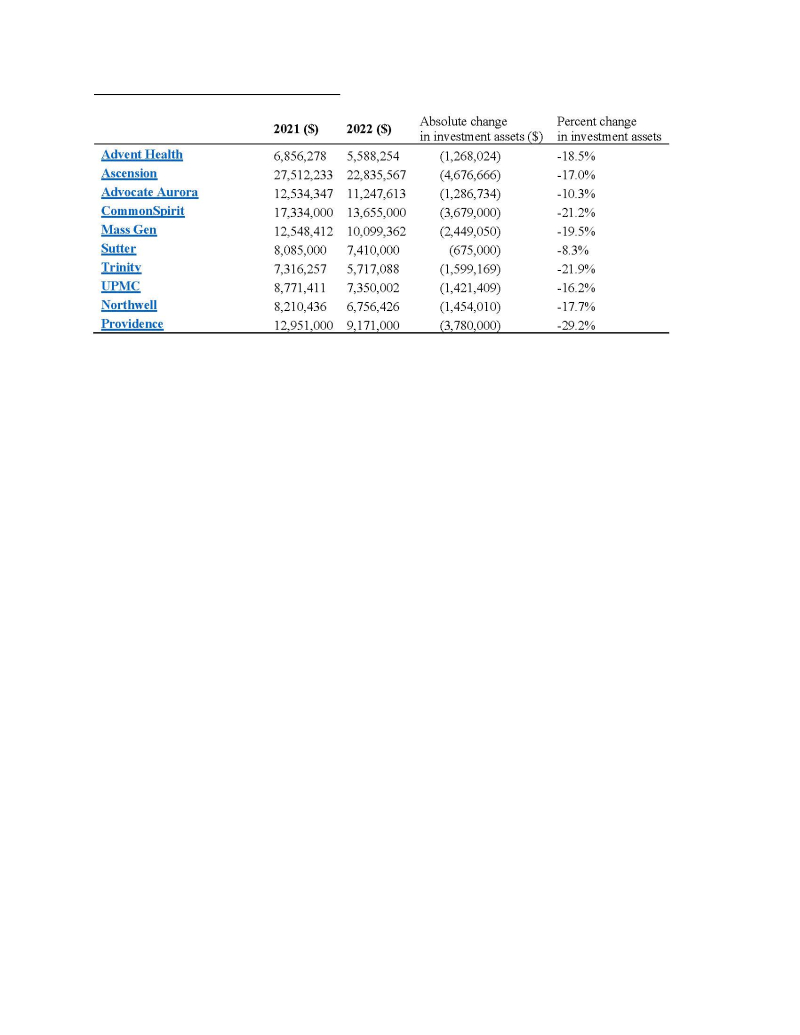
darryll jones