
Leonard J. Henzke, Jr. – The Man, the Myth, the Legend

Is Lenny the bearded guy or the baby-faced guy?
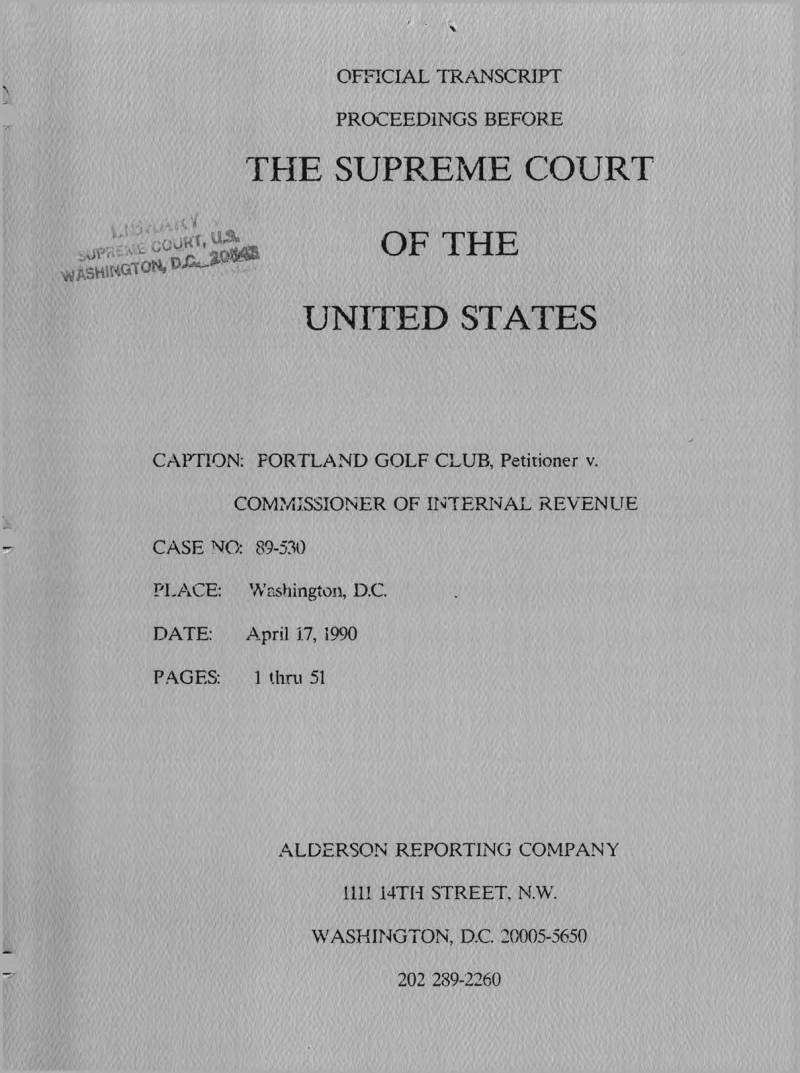
If you click on the oral argument transcript pictured below, you can get a digital copy of the entire official transcript of Lenny Henzke Jr.’s oral argument before the Supreme Court in Portland Golf Club v. Commissioner. I never met or knew Lenny but I hope he won’t mind me calling him by that name. And I am not just calling him “the man, the myth, and the legend” to get a cheap chuckle. By the way, this is not an obituary, more an unauthorized mini-biography. Two things are true though: (1) The “man/myth/legend” description is not entirely inaccurate given the important tax exemption cases he’s argued — he argued Bob Jones early on, perhaps the most important of all — and (2) for all the grief he has caused me reading his cases, he owes me a handshake and the right to call him Lenny. Anyway, after Congress enacted the unrelated business income tax, Lenny got really busy. He argued successfully in Presbyterian and Reformed Publishing Co v. Commissioner. That case ushered in a more nuanced application of the “commerciality doctrine,” intended as a backstop to the unrelated business income tax. A backstop because the commerciality doctrine can preclude exemption for an organization whose activities are directly related, as if on a straight line, to the organization’s charitable mission. Indeed, the activities — religious publishing — were themselves charitable as we understand the term. The government wanted to yank the organization’s exemption because they were too successful in their charitable mission. Back in LL.M school I remember Professor Willis finally shrugging his shoulders and saying “we love charities that are meek, humble, starving, and mild; if they get too big, strong and loud in the market, we hate them though they are only a bigger stronger more economically efficient version of themselves.” It was Professor Willis who first led me and the rest of his students through a consideration of United Cancer Council, even before the 7th Circuit issued its influential opinion. The court issued its opinion after getting an earful from our subject on oral argument. Lenny somehow convinced the bluntly irascible Judge Posner — the most famous jurist never to sit on the Supreme Court IMHO — that there was no private inurement because there were no insiders. I wonder if it was Lenny who first broached the “first bite” doctrine. I thought it was a dumb rule, but at least it gave me the opportunity to submit comments and then appear at the public hearing on the proposed excess benefit regulations. Those types of things were important during my pre-tenure days.
Anyway, I thought about Lenny while reading Presbyterian and Reformed Publishing yesterday for a post I will let loose tomorrow. Come to find out, Lenny really did the impossible. Not only did he recover a whole $21 dollars for the government in Bob Jones University, he convinced the 4th Circuit to reverse the district court’s literally correct decision rejecting the government’s asserted authority to deny tax exemption to racially discriminatory charities. I mean, let’s just be honest. The district court’s decision was literally correct, and might have prompted acquiescence, especially with the onset of conservatism that marked Reagan’s ascendency. I guess Lenny was being dogged for us all back then. Some guy named Carr Fergurson was apparently on brief (and quite a few scholarly pieces) with Lenny before the 4th, but I bet it was Lenny who ran the hard yards to the 3 yard line, where some other guy carried the ball over the goal line at the Supreme Court. The public policy doctrine was born. It was Henzke, no doubt, who put in the lonely intellectual hours at DOJ Tax and proved that all law is public policy. His name didn’t appear on the briefs when the case was appealed and successfully argued to the Supreme Court, but I am sure Lenny is the father of the public policy doctrine that helped make the promise of Brown v. Board of Education a reality. Tax law, with help from Lenny “Thurgood” Henzke, Jr., extended separate and unequal to private schools. I tell my students all the time that they can do civil rights or constitutional law in tax. You can even argue before the Supremes. Lenny got his revenge, apparently, for not even being included in the Supreme Court briefs in Bob Jones. About 4 years later he prevailed in Presbyterian and then he took the Government the distance — all the way to the Supreme Court — in Portland Golf Club, losing on a TKO. By the way, my students know that free green fees for life in exchange for services is an “accession to wealth” Lenny. And we all know what that means.
Great job, Lenny.
darryll jones