
Would Americans Make Charitable Donations without Tax Incentives?
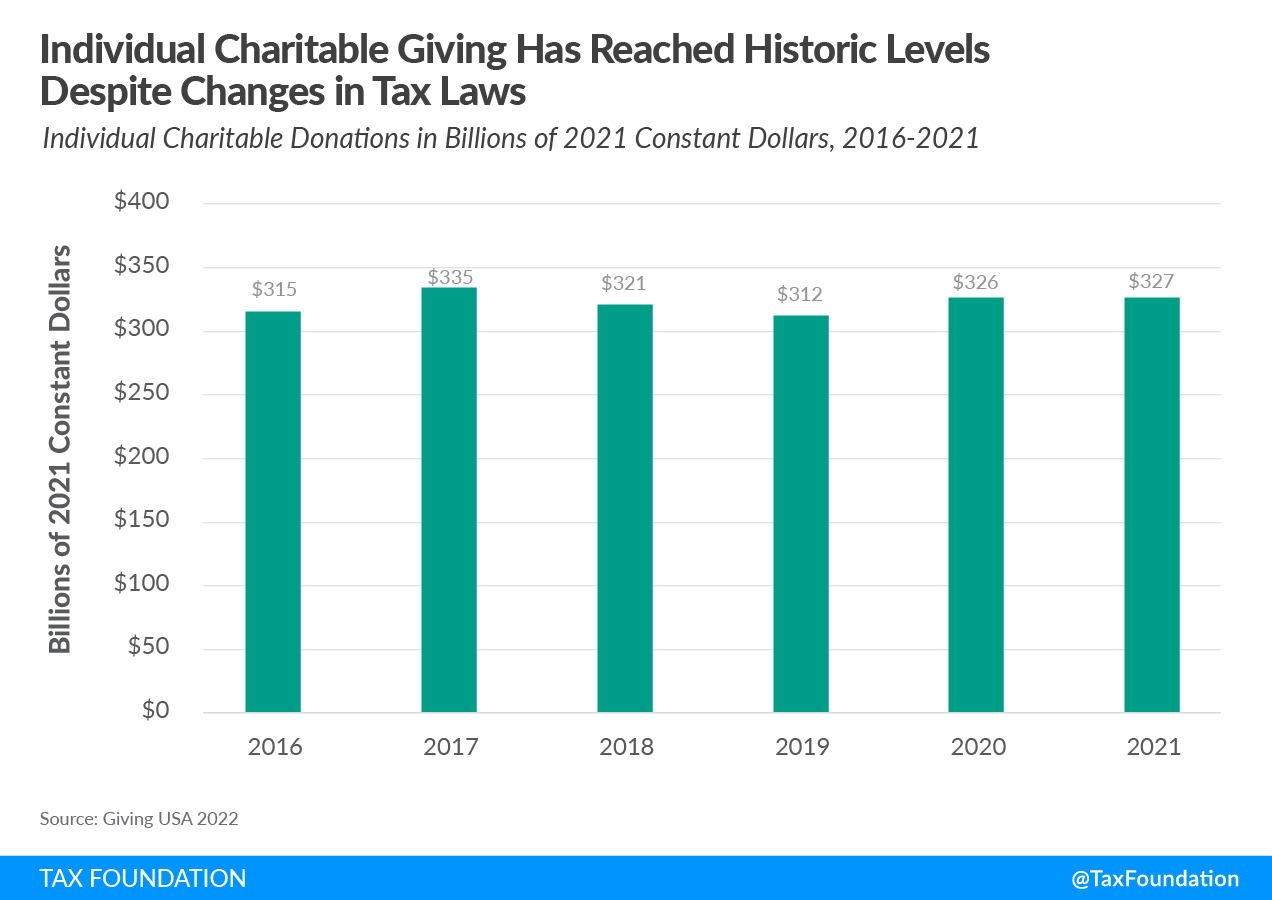
The Chart above is from what looks like an informative Tax Foundation report put out just before last Christmas. Here is a summary:
The tax treatment of charitable giving over the past few years has been influenced by two major tax events: the 2017 Tax Cuts and Jobs Act (TCJA) and the 2020 Coronavirus Aid, Relief, and Economic Security (CARES) Act. These changes provide a case study of how changes in tax policy can influence taxpayer behavior in the short term, but also how these policies have turned the charitable deduction into a province of the rich.
Despite these wild fluctuations in tax policy, history shows that giving is tied more to higher after-tax incomes and a growing economy than tax incentives for charitable giving.
How the TCJA Affected Charitable Giving
The TCJA made three significant changes to the tax code that influenced charitable giving:
Lowered marginal tax rates
-
- Nearly doubled the size of the standard deduction
- Increased the limit from which charitable gifts could be deducted from adjusted gross income (AGI)
Let’s look at the ramifications of each of these changes.
Rate Reductions Caused Timing Shifts
As lawmakers crafted the TCJA, they were very clear that one of the goals was to reduce marginal income tax rates. In 2017, the individual income tax had seven brackets ranging from 10 percent to a top marginal tax rate of 39.6 percent. Indeed, TCJA lowered most tax rates—including the top rate to 37 percent.
Many taxpayers took advantage of these prospective changes by increasing their charitable gifts in 2017 to deduct them at the higher tax rates. This was especially the case among high-income taxpayers.
As Table 1 illustrates, overall charitable tax deductions jumped 9 percent in 2017 compared to 2016, from roughly $234 billion to $256 billion. However, charitable tax deductions for taxpayers earning between $200,000 and $500,000 jumped 14 percent while deductions for those earning $500,000 to $1 million increased by 18 percent.
Meanwhile, charitable tax deductions for those earning $1 million to $10 million rose by a staggering 72 percent, or $22.5 billion. As we will see, charitable tax deductions for these wealthy taxpayers dropped off considerably in 2018, indicating that they brought forward deductions into the year with the higher tax rates.
darryll jones