
Is Trump’s Seven Springs Conservation Easement The Poster Child of Abusive Tax Shelters? The Omnibus Bill Contains an Anti-Abuse Pill

My spring semester is rescued! Ways and Means released DJT’S tax returns (links below) and there is enough to keep the conversation going indefinitely in my Fed Tax, Partnership Tax, and Exempt Organizations classes. So many teachable moments! There are just so many shenanigans going on. These aren’t those boring tax returns we used to get from Bush, Obama, and the Bidens. Here we have a rich, influential person with lots of real estate, dividends, COD income, imputed interest and everything!
Meanwhile, buried deep in the recently signed Omnibus Spending Bill is a provision designed to stop people from lying about the value of conservation easements. The concept of conservation easements is fairly simple. A property owner dedicates a portion of his, her, or its property to a charitable purpose (via a promise to conserve the property) and, in return gets a deduction equal to decrease in value after a portion of the property has been removed from the market via the conservation easement. So, if I pay $7.5 million in 1995 for an estate in upstate NY, like DJT did, and 19 years later I dedicate a portion to environmental conservation, I can take a charitable contribution deduction for $22 million just like DJT. In that year, DJT valued the estate at $57 million, a better than 2000% return on the purchase price. This was actually quite modest, compared to the nearly $300 million valuation of the property claimed in unrelated loan transactions. Its all right here, in the NY Attorney General’s complaint, specifically paragraphs 220 through 265.
We have previously blogged about conservation easements here, here, and here. The policy and economics behind IRC 170(h)(2)(C), by the way, is sound enough. A property owner gives up valuable rights when property is voluntarily and forever dedicated to conservation. The owner should get a deduction, right? But only for the real decline in market value; and if we are really being technical the owner should not get any deduction beyond basis because none of the appreciation has been taxed (but that is a different issue). Regardless, the policy depends on honest and accurate valuation. It used to be, if you wanted a HELOC, the brokerage firm would send an appraiser to you home and, if the appraiser knew how much you were trying to borrow, the appraisal would always magically land at just enough to support the loan. Human nature is human nature, I guess. Buried in the 4,000 page recently signed Spending Bill we find a potential solution:
SEC. 605. CHARITABLE CONSERVATION EASEMENTS.
(a) LIMITATION ON DEDUCTION.—
(1) IN GENERAL.—Section 170(h) is amended by adding at the end the following new paragraph:
‘‘(7) LIMITATION ON DEDUCTION FOR QUALIFIED CONSERVATION CONTRIBUTIONS MADE BY PASS-THROUGH ENTITIES.—
IN GENERAL.—A contribution by a partnership (whether directly or as a distributive share of a contribution of another partnership) shall not be treated as a qualified conservation contribution for purposes of this section if the amount of such contribution exceeds 2.5 times the sum of each partner’s relevant basis in such partnership.
There are other policing provisions, but the most important exceptions are those [seemingly] allowing unlimited valuations after 3 years or to family partnerships. The combination of tax exemption, charitable contributions, and Subchapter K makes this provision one that promises to proliferate all sorts of complexities so I am withholding judgment on whether the provision is effective or can be avoided with a few tweaks. I have to study the focus on partnerships. And on top of that, the provision authorizes the Secretary to enact regulations applying the rules to S corporations and “other pass-through entities” (such as REITS?). Egads, the complexity is going to be so good!
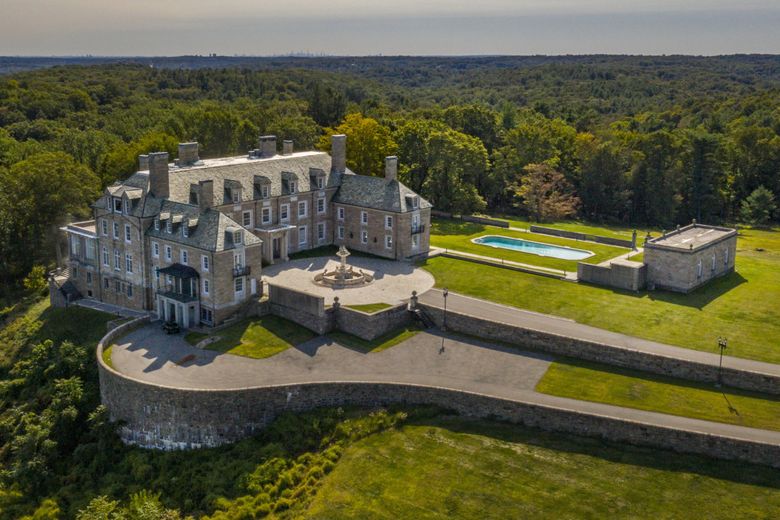
Anyway, with the three year and family partnership exceptions, I am not sure the statute would have precluded Trump’s conservation easement deduction claim. He acquired Seven Springs in 1995 and claimed the charitable deduction in 2015. The deduction, about $22 million is 350% more than Trump paid for the entire property! We the people have essentially paid for the Grand Estate at Seven Springs (pictured above). The three year exception is tied in some convoluted way to the later of when the partnership acquired the property or when any partner acquired an interest in the partnership (my students and I will go bonkers trying to figure it out) but it holds the possibility that Trump’s position would not be precluded by the provision. I have my suspicions for why the provision focuses on partnerships, but apparently the abuse is much more lucrative when it is obtained by use of a pass-through. Trump used several layers of LLCs (taxed as partnerships, presumably) to get his deduction. Here is what Ways and Means has to say about it:
Numerous investigative reports have revealed that the former President, through the complex arrangements of his personal and business finances, has engaged in aggressive tax strategies and decades-long tax avoidance schemes, including taking a questionable $916 million deduction, using a grantor trust to control assets, manipulating tax code provisions pertaining to real estate taxes, and extensively using pass-through entities. Media reports have also revealed that he benefited from massive conservation easements, and that certain of his golf courses failed to properly account for wages paid to employees, raising questions about compliance with payroll and Social Security tax laws. As President, he took pride in “brilliantly” maneuvering the tax laws to his personal benefit. Even as he was championing the Tax Cuts and Jobs Act of 2017, the former President referred to the tax code as “riddled with loopholes” for “special interests—including myself.”
Joint Committee had this to say about it:
Our review of the 2015 returns noted above revealed certain issues we thought warranted examination. These are:
Regarding Seven Springs, the agent’s notes mention two alternative adjustments for disallowing part or all of the charitable contribution easement deduction. The first would disallow the entire $21.1 million deduction based on the fact that the appraisal was not a qualified appraisal. The second would reduce the deduction to $8.95 million based on a valuation adjustment. The agent’s notes suggest the possibility of the imposition of a section 6695A penalty (i.e., the penalty for substantial and gross valuation misstatements attributable to incorrect appraisals).
. . . .
A charitable contribution of a conservation easement of $21,078,900, which was made by Seven Springs LLC, ultimately flowed through to the 2015 Form 1040 (on December 11, 2015, Seven Springs LLC placed a parcel of land in Westchester County, NY, in a conservation easement). The June 16th letter did not request the Federal income tax returns for Seven Springs LLC; as a result, we did not receive nor review such returns.
. . .
Charitable contributions.– Specifically, whether the conservation easement deduction of $21.1 million and other large donations reported on the 2015 Schedule A (Form 1040) were supported by required substantiation.10 Even though the deduction was limited in 2015 as a result of Mr. Trump not having any taxable income, it still became part of the charitable contribution deduction carryforward amount (such that it may be deducted in future years if not subject to limitations) and, therefore, would warrant review.
Here are the links to DJT’s tax returns:
- Individual: 2015, 2016, 2017, 2018, 2019, 2020
- DJT Holdings LLC: 2015, 2016, 2017, 2018, 2019, 2020
- DJT Holdings Managing Member LLC: 2015, 2016, 2017, 2018, 2019, 2020
- DTTM Operations LLC: 2016, 2017, 2018, 2019, 2020
- TTM Operations Managing Member Corp: 2016
- LFB Acquisition LLC: 2015, 2016, 2017, 2018, 2019, 2020
dkj