
Did Mr. Smith Go to Morehouse Without First Talking to His Tax Attorney?
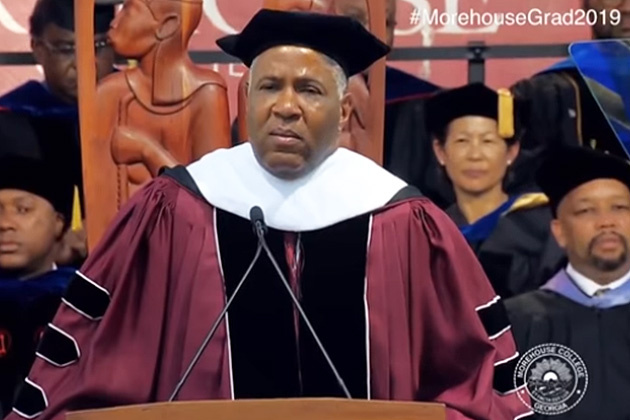
Its commencement season and the biggest story thus far is Mr. Smith’s announcement that he would pay off the student loans of the Class of 2019 at Morehouse College (“The House”). The New York Times published a teaser about the tax consequences to all involved:
On Morehouse’s Atlanta campus and beyond, administrators, students and parents — and no shortage of tax and philanthropy experts — have spent the last few days wondering how, exactly, Robert F. Smith, a titan tech investor, would fulfill his promise to 396 graduates. The surprise announcement was both an extraordinary gift — and a complicated one.
I read the article thinking it would address Sections 61(a)(11), 102, 108, 117, 501(c)(3) and all the gift tax provisions the details of which I have spent my time since tax school trying never to have to deal with. But it did not. Some of the comments to the article speculate that a billionaire would not be so unsophisticated that he would not have consulted a tax attorney before deciding to pay off the student loans — I was available, he coulda just flown me to some island resort and we coulda talked it over after a couple of rounds of golf! I would have reported the income even!
Anyway, here is my starting hypothesis. The students do not have COD because the payment or discharge of their debts was simply the vehicle by which Mr. Smith demonstrated his “detached and disinterested” generosity. It is a gift under 102. An article in Forbes agrees. This was not like Oprah hollering on national TV (from which she received advertising revenue) that “you get a car, you get a car, and you get a car!” If not a gift, much of the payments would be excluded as qualified scholarships under IRC 117. If its income, no doubt the students’ have fewer assets than liabilities — they were broke students, after all! — so 108 would provide exclusion. As for the gift tax consequences, Mr. Smith might have avoided that (if they even apply) by making a charitable contribution (instead of a gift directly to the students) to The House, a 501(c)(3) organization no doubt, with the stipulation that it be used to pay the expenses of the class of 2019. As to the latter assertion, I suppose I would want to research whether targeting the gifts to a particular class strips the “contribution” of its deductibility just to make sure, but I doubt it. Comments?
Darryll K. Jones