
“Analysis of the law Relating to Public Benefit” by the Charity Commission for England and Wales (and one more short comment on Panera Cares)
Happy Friday! I was thinking about the extent to which other countries have charitable definition and enforcement “challenges” and thought I would use the wonders of the internet to explore the question. Since American laws of charity are derived in large part from the UK, I started there. Of course, I have known about the Charity Commission for England and Wales for a long time but I have only visited [virtually] sporadically. I don’t want to assert that somehow the folks in jolly old England do it better than us because there is a wealth of guidance on the “Charities and Nonprofits” section of IRS.gov. I would have to do a much more comparative analysis, but the Charity Commission has some interesting resources, especially for practitioners and scholars who want to inject historical policy perspectives into their advocacy. Anyway, the Commission has a page entitled “What Makes A Charity” which “outlines what the law in England and Wales says a charity is.” By the way, a report commissioned by the British Parliament concluded that the Charities Act of 2006’s articulation of the “public benefit” doctrine was “critically flawed so it sounds like the Brits have as much difficult as we do in defining the public benefit doctrine. The problems do not appear to have been solved by the Charities Act of 2011, which largely supplanted the 2006 Act. That particular page has about five white papers on the topic. Here is an excerpt from a publication entitled “Analysis of the Law Relating to Public Benefit:”
Public benefit not a static concept
31. The legal concept of charity, including the concept of public benefit in charity law, is not static. Charity law is not “frozen at some time in the past”; “it must be remembered that the concept of what is and is not for the public benefit (as seen by society generally, and as reflected in judicial recognition of the views of society) changes over time. As we will see, changing social perceptions have, in the past, resulted in changes in what is seen as for the benefit of society and, accordingly, of what is properly to be accorded
charitable status.”12 A purpose which was formerly recognised as being for the public benefit may cease to be recognised as such, and purposes which were not formerly recognised as being for the public benefit may be recognised as such. Thus in National Anti-vivisection Society v IRC Lord Simonds said: “If to-day a testator made a bequest for the relief of the poor and required that it should be carried out in one way only and the court was satisfied by evidence that that way was injurious to the community,
I should say that it was not a charitable gift, though three hundred years ago the court might upon different evidence or in the absence of any evidence have come to a different conclusion.”
. . .
The two aspects of public benefit
39. In the modern law, the concept of public benefit as integral to a charitable purpose is regarded as having two principal aspects, namely that, for a purpose to be charitable:
a. it must be beneficial, and any detriment or harm that results from the purpose must not outweigh the benefit (‘the benefit aspect’); and
b. it must benefit the public in general, or a sufficient section of the public (‘the public aspect’).
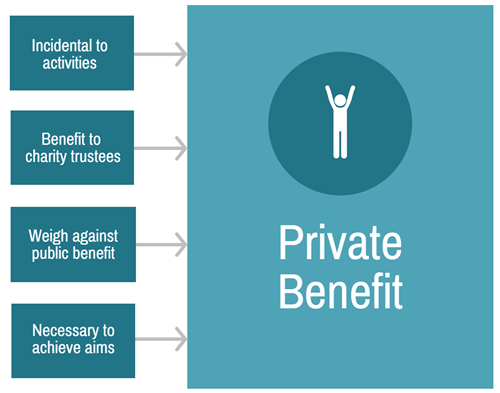
40. In addition, a charitable purpose may only benefit individuals or other legal entities to an extent that is no more than incidental to the furtherance of the charitable purpose. This principle can be regarded as part of one or other of the two aspects described above or as a separate requirement. The Commission’s public benefit guidance deals with it as part of the second aspect.
The entire paper is about 20 pages but its paragraph 40, I think, that might trip up the folks at Panera Cares, about which we blogged a last week.
Darryll K. Jones