
Charities in China
The China Law Philanthropy Report, updated in August 2018, is definitely worth reading. Here is a brief excerpt from the introduction:
Since the establishment of the People’s Republic of China (PRC) in 1949, China’s legal framework has mainly followed the civil law tradition. At the same time, it has significant characteristics of a Leninist state in which all state institutions come under the control of the Communist Party of China. At present there is no civil code in China. The General Principles of Civil Law, which came into effect in 1987, intend to create a consistent framework for the interpretation of civil law. China’s legal framework is constraining for civil society in general and philanthropic giving in particular. During the current administration of President Xi Jinping, Chinese civil society has come under a great deal of pressure. In terms of both freedom for civil society and philanthropy, China ranks very low among the world’s countries. In 2016, Freedom House gave China the lowest possible ranking of seven for political rights, along with six for civil liberties.2 Similarly, the World Giving Index 2016 ranked China near the bottom with a score of 140 for philanthropic giving. The
Hudson Institute’s Index of Philanthropic Freedom 2015 ranked China 52 out of 64 countries in terms of creating an enabling environment for philanthropy.
Nevertheless, philanthropy has a rich and varied history in China, which is still felt in the practice of philanthropy in Taiwan and among the Chinese diaspora. In the PRC, in contrast, philanthropic traditions were largely erased as a result of the Communist Party’s rigid rule from 1949 to 1978, when the state dominated all forms of social life, including voluntary giving. Even during the 1980s and 1990s, most philanthropic activity was controlled and shaped by government policies, priorities, and institutions. The government organized charitable donations, and people gave not because they wanted to but because they were politically and socially pressured to do so. There was little choice about the recipients either. Donations generally went directly to the government or to government-organized NGOs (GONGOs), which dominated the nonprofit sector and had a monopoly on public fundraising.
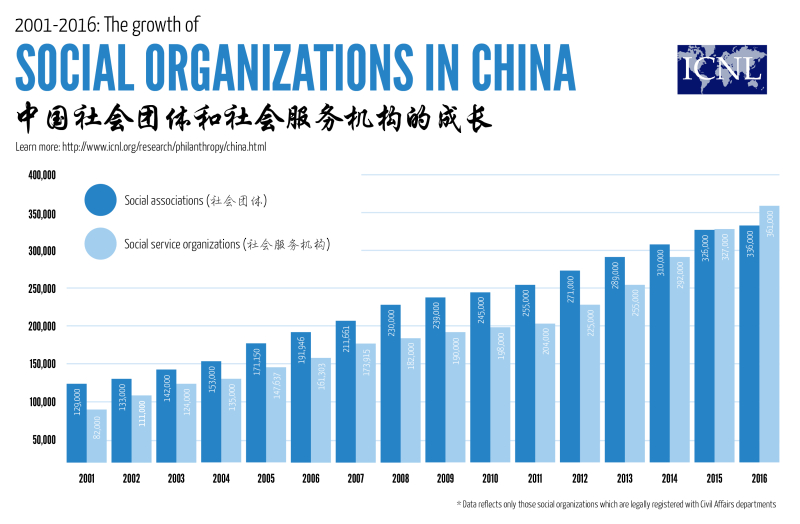
There was also little information or transparency about the use of donations. Companies donated as well, but their donations almost always went to projects in conventional areas, such as poverty alleviation, disaster relief, education, or health, which were carried out by the government or GONGOs. During this period the idea of corporate social responsibility (CSR) began to gain traction in Chinese companies, but it was regarded more as means to strengthen the private sector’s relationship with the government than with target communities. This situation began to change about ten or fifteen years ago, as private foundations—or what the Chinese call “non-public fundraising foundations” (that is, mostly corporate and family foundations)—mushroomed and exceeded the number of GONGOs, many of which are public foundations or, in Chinese, “public fundraising foundations” (for more, see our interactive timeline The Rise of Philanthropy and Civil Society in China, 1976-2017). In addition, scandals in the philanthropic sector, primarily with GONGOs, were publicized on social media and generated public debate about reducing the government’s monopoly on philanthropic activities and promoting greater transparency and accountability in the sector. At the same time, the CSR programs implemented by Chinese companies became somewhat more diverse as companies began to work with nonprofit organizations (NPOs) as well as GONGOs. International influences also played an increasingly important role as both NPOs and philanthropists looked overseas, particularly to the United States, for models for shaping the philanthropic sector.
dkj