
Happy National Volunteer Week! Here’s the grim legal side of altruistic labor
Happy National Volunteer Week! We know that volunteering can do lots of good, but what about when volunteering goes bad? Volunteer law is one of my primary scholarly interests, and in honor of the millions of Americans who volunteer each year, below are just a few of the ways that law 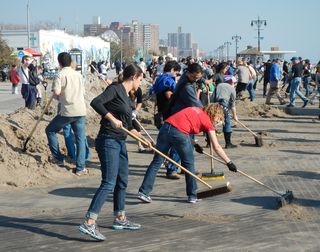
Volunteer Liability: Who gets sued when a volunteer commits a tort? The Federal Volunteer Protection Act provides a low level of immunity—with lots of exceptions and caveats—to volunteers for simple negligence. (Ask yourself whether regulation of unpaid labor fits within Congress’s power under the commerce clause.) Some states also offer immunity of different flavors. Iowa immunizes volunteers for almost anything they do within the scope of their employment. Vermont immunizes volunteer librarians. (?!) Ohio just enacted a law immunizing volunteer architects. (Why architects? No idea. Underworked lobbyists, possibly.)
Fortunately, volunteers are rarely sued, and most suits involve intentional torts or accidents while driving (covered by insurance). (So, please don’t sue me.)
Organizational liability: Organizations are liable for the acts of their agents under common law master-servant principles. This applies to employees and volunteers alike. But volunteers often interact with organizations in less formal ways than employees, and not always as simple to determine scope of “employment.” Notably, immunity for the volunteer does NOT immunize the organization, making charities the prime defendant when suit is brought. Which, again, is fortunately pretty rare, especially for your small, community-based charity.
Volunteer Discrimination: Employers can’t discriminate against employees on race, sex, religion, disability, and other protected characteristics. Sometimes, but not often, these laws also protect volunteers. (In fact, there is a circuit split about whether unpaid workers are covered under federal employee anti-discrimination laws.) Still, even if anti-discrimination isn’t the law, be nice to your volunteers. It’s the right thing to do.
Volunteers and Minimum Wage: One of the least settled areas of law involves application of minimum wage laws to volunteers. Cases are all over the place on this, and challenges involving unpaid interns and student-athletes add layers of confusion to the tests for charitable volunteers. Department of Labor has issued various informal “guidance” (read: no Chevron deference) on the topic of unpaid workers, but their positions are rejected by courts as often as they are upheld. Nevertheless, it would be pretty weird if your organization violated minimum wage laws by allowing someone to volunteer for your charity. (Not legal advice: just common sense.) One caveat is that a paid employee of your nonprofit can’t “volunteer” for your organization performing the same type of services as would normally be paid to perform. (Note that the linked regulation only applies to government, but Department of Labor applies same rationale to nonprofits).
Much, much more could be said, which is why this is a fun area in which to write (not to mention volunteering as a rewarding personal pastime). Happy National Volunteer Week everyone!
@JosephWMead