
Campaign Legal Center Files FEC Complaint re: George Santos
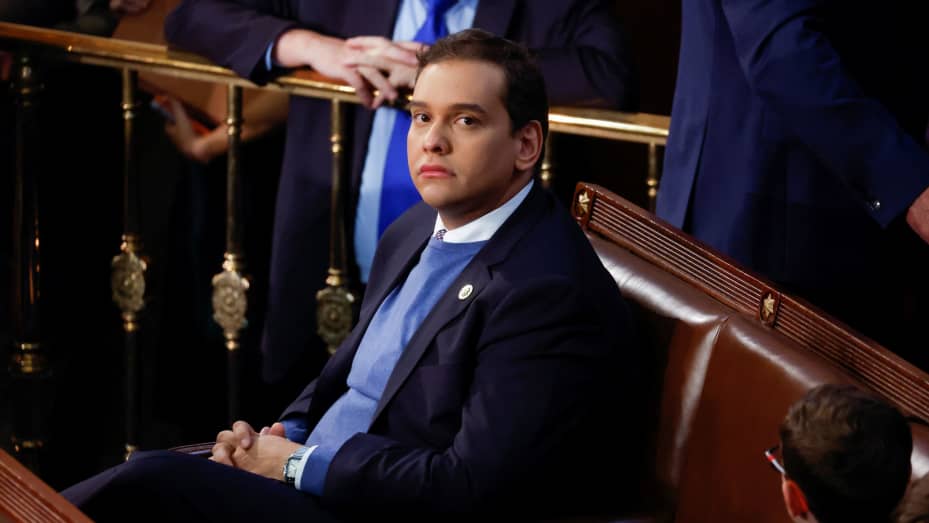
Call me bleeding heart, but I worry about the human being known as George Santos and hope he understands that this too shall pass. Maybe like a very painful gallstone, but it will pass if he doesn’t let it kill him first. I mean, just think if every one of us had all of our boneheadness displayed in headlines and bright lights. Granted this was a whole lot more than the average boneheadedness, but watching him sitting all alone in the House Chamber last week and knowing that prosecutorial sharks are circling makes me worry about his mental state. He will inevitably lose his seat in Congress. I hope he lives through it and finds peace when all is said and done.
But meanwhile the nonprofit Campaign Legal Center has filed a complaint with the FEC alleging all sorts of malfeasance, including “straw donor contributions.” Here are a few allegations from the complaint:”
2. Santos purported to loan his campaign $705,000 during the 2022 election.3 But it is far from clear how he could have done so with his own funds, because financial disclosure reports indicate that Santos had only $55,000 to his name in 2020,4 and his claims of having earned millions of dollars in 2021 and 2022 from a supposed consulting business that he started in May 2021, Devolder Organization LLC (“Devolder LLC”), are vague, uncorroborated, and non-credible in light of his many previous lies.5 As set forth below, the overall circumstances instead indicate that unknown individuals or corporations may have illegally funneled money to Santos’s campaign through the newly formed Devolder LLC.
3. In addition, Santos’s campaign appears to have routinely falsified its disclosure of disbursements. The campaign reported an astounding 40 disbursements between $199 and $200, including 37 disbursements of exactly $199.99.6 The sheer number of these just-under-$200 disbursements is implausible, and some payments appear to be impossible given the nature of the item or service covered. Accordingly, there is reason to believe Santos’s campaign deliberately falsified its disbursement reporting, among numerous other reporting violations. Moreover, some of the reported disbursements made by Santos’s campaign appear to violate federal laws prohibiting the conversion of campaign funds to personal use, including disbursements to pay rent on a candidate’s personal residence. This complaint is filed pursuant to 52 U.S.C. § 30109(a)(1) and is based on information and belief that respondents violated the Federal Election Campaign Act (“FECA”), 52 U.S.C. § 30101, et seq. “If the Commission, upon receiving a complaint . . . has reason to believe that a person has committed, or is about to commit, a violation of [FECA] . . . [t]he Commission shall make an investigation of such alleged violation.”
21. FECA provides that “[n]o person shall make a contribution in the name of another person or knowingly permit his name to be used to effect such a contribution, and no person shall knowingly accept a contribution made by one person in the name of another person.”
22. The Commission regulation implementing the statutory prohibition provides the following examples of contributions in the name of another: a. “Giving money or anything of value, all or part of which was provided to the contributor by another person (the true contributor) without disclosing the source of money or the thing of value to the recipient candidate or committee at the time the contribution is made.” b. “Making a contribution of money or anything of value and attributing as the source of the money or thing of value another person when in fact the contributor is the source.”
23. The requirement that a contribution be made in the name of its true source promotes Congress’s objective of ensuring the complete and accurate disclosure by candidates and committees of the political contributions they receive,35 and ensures that the public and complainants are fully informed about the true sources of political contributions and expenditures. Such transparency also enables voters, including complainant Wieand, to have the information necessary to evaluate candidates for office, “make informed decisions[,] and give proper weight to different speakers and messages.”
25. Straw donor contributions like those alleged here are serious violations of federal campaign finance law that have led to criminal indictments and convictions in recent years.39 As explained in one such indictment, the straw donor ban works in tandem with other campaign finance laws to protect the integrity of our electoral system and to ensure that all candidates, campaign committees, federal regulators, and the public are informed of the true sources of money spent to influence federal elections.40 Another recent indictment highlighted how straw donor schemes have been used to skirt FECA’s source prohibitions, such as the ban on contributions by government contractors.
26. Even for contributions that would otherwise be legal — i.e., contributions that would not be prohibited or excessive, if made in the true contributor’s own name — the prohibition of contributions in the name of another serves FECA’s core transparency purposes by ensuring that voters have access to complete and accurate information regarding the sources of electoral contributions.
Here is a brief primer on dark money and nonprofits.
darryll jones