
The Essential Role of Financial Reserves in Not-for-Profit Healthcare
The American Hospital Association is out with a useful report, finally. By that I mean, instead of responding to previous studies by changing the subject or calling researchers names, the Association has commissioned a study that helps inform the debate regarding exempt healthcare. I have noted before that the law’s approach to exempt hospitals helps us understand how tax exemption rules should be interpreted throughout civil society. I think the easy lesson emanating from this report is that exempt organization fiduciaries are entitled to business judgement rule deference when it comes to how much to spend currently and how much to save for rainy days. Here the introduction:
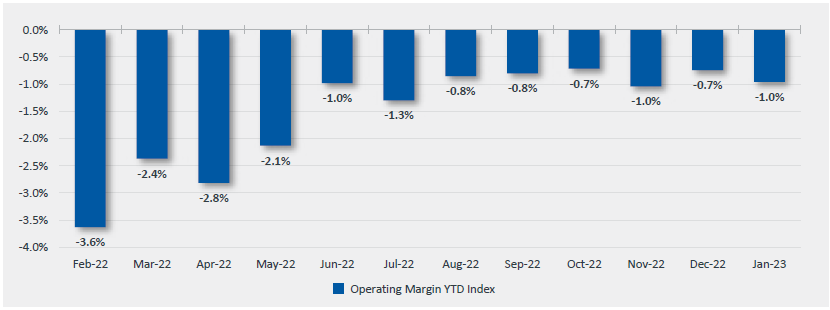
Figure 1: Kaufman Hall Operating Margin Index (Year-to-Date by Month), February 2022 –January 2023
Introduction
Anyone unfamiliar with the financial structure of not-for-profit hospitals and health systems may question why these organizations carry often significant financial reserves on their balance sheets. The answer is straightforward: with limited sources of funding, hospitals and health systems rely on financial reserves to maintain their financial stability and support their growth. These reserves ensure that hospitals and health systems can continue to serve their communities through good times and bad and can continue to invest in the highly skilled professionals and lifesaving technologies that define modern healthcare.
Not-for-profit hospitals and health systems have essentially two sources of funding: they either earn revenue from operations and investments (providing patient services makes up most of this revenue) or they borrow funds through issuance of debt in the bond markets or other forms of borrowing (e.g., bank lines of credit). Unlike for-profit organizations, they do not have access to equity markets. Also, unlike for-profit organizations, they are not obligated to shareholders who expect that excess funds will be distributed as dividends. Instead, not-for-profit hospitals and health systems have an obligation to their mission and the communities they serve, and strong financial reserves help ensure that they can meet this obligation even in times of operational disruption and financial distress.
The importance of financial reserves was demonstrated over the course of 2022, when year-to-date median operating margins for not-for-profit hospitals and health systems remained in negative territory throughout the year. This means that more than half of the hospitals providing data for Kaufman Hall’s monthly National Hospital Flash Report ended the year with negative operating margins, and have not seen an improvement as they move into 2023. Net losses in 2022 for some of the nation’s largest not-for-profit health systems were well above $1 billion and in some cases approached $2 billion. These losses were driven by multiple factors, including ongoing operational disruptions related to the COVID-19 pandemic, staffing shortages that limited the ability to run operations at full capacity, rapidly escalating costs for supplies and—especially—labor (including the heightened use of expensive contract labor to help ease staffing shortages), and investment losses.
darryll jones