
Tiger’s Appointment to PGA Tour Board Complicates an Already Questionable Joint Venture

Player demands may sink the PGA Tour partnership with LIV Golf, if that boat hasn’t already sunk. The players want equity in Newco, the joint venture’s tentative name, as well as majority control of PGAT’s board. Super players like Tiger and Rory will get equity in a NewCo team, while also serving on PGAT’s board, apparently. The players are capitalists, akin to physicians in a practice plan, for example, who demand a revenue share from an exempt hospital as compensation for services. We would not tolerate physicians controlling the hospital board but that is what is about to happen with PGA. Then they want control over the revenue generating entity from which revenues are shared. That is a problem.
The PGA Tour’s road to its joint venture with LIV golf is fairly transparent because Congress and the media are shining a colonoscope up their butts and taking pictures. Colonoscopic paparazzi, lets call them. A story in yesterday’s WSJ (free link) reports that Tiger has been appointed the sixth player director on PGAT’s 12 member board. That means six player directors, only five independent directors, and one director appointed by the PGA, an exempt org separate from the PGAT. Which means the board is evenly divided, at best, between capitalists and charitalists. Or the majority of the board are capitalists with financial interests in bottom line outcomes, depending on what we know about the PGA director.
Control is a basic requirement for a nonprofit partnership with venture capitalists who take equity in the charitable mission — that is what joint ventures are all about, venture capitalists investing in charitable organizations and getting a profit, like always, from their investment. A majority of joint venture governors must be charitalists — appointed by the charitalists. Capitalists must be in the minority on the board to prevent profit seeking from taking precedence over charity. PGAT says it will retain requisite control. But check out this diagram:
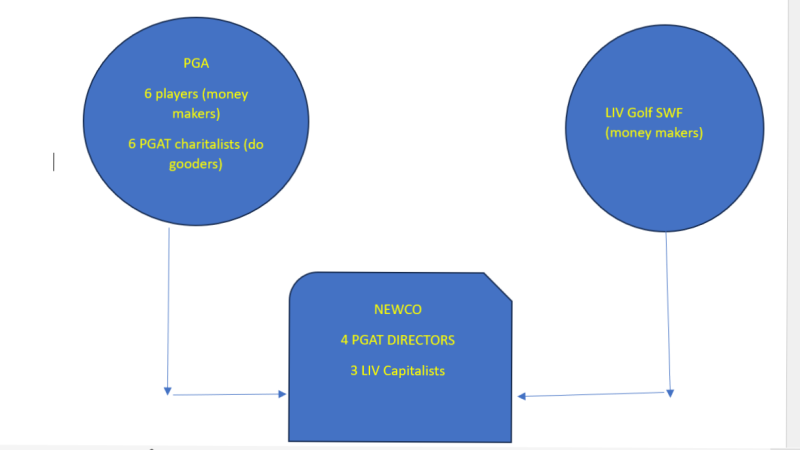
PGAT has majority control by its selection of 4 directors, ostensibly suggesting that charitalists will control NewCo. But PGAT itself is controlled by capitalists money makers, since that is what the players are. Those capitalists have profit interest in NewCo, the entity they govern through their status as directors on PGAT’s board. That’s because Tiger and other player directors will get an equity interest in NewCo, meaning they will be capitalists with personal financial interests in NewCo, while also serving as charitalists on PGAT’s Board, where personal financial interests must be subordinated to the charitable mission. The money makers on PGAT’s board benefit from votes on NewCo that put profits first and they lose money when NewCo puts charity first. In other words, Tiger and the other players have a personal financial interest in NewCo. By putting Tiger and other players on PGAT’s board, we have instant insider status! And this complicates the grant of an equity interest in NewCo, PGAT’s clearly related party. Private inurement is a potential problem when a charity shares revenue with the charity’s insiders, even if through a related party. That might be overcome by a compensation committee, maybe. Its not a complete bar to revenue sharing. But the capitalists presence on NewCo’s board, directly or by controlling the PGAT vote, also raises private benefit problems because if capitalists are in the majority, there is greater likelihood that NewCo will operate for private benefit. That’s because majority control is essentially a prophylactic, ensuring that charity prevails in Newco’s decision making. Its an “organized” requirement, not an “operated” requirement. Giving majority control to capitalists in a whole entity joint venture means the nonprofit is not “organized” for a charitable purpose.
Long story short, if interested capitalists dominate the board, there is no guarantee that they will vote to place disinterested charitalists on the Newco board, and therefore no guarantee that PGAT (as a charity — a business league to be technical but same private inurement and benefit prohibitions) will control the board. The six players have dominant control if we assume the PGA director is independent from PGAT. So the players could nominate four Greg Normans, whose interests are entirely pecuniary, not charitable. PGAT might still argue that charitalists control Newco, but if they don’t even control PGAT that can’t be true. The control element lacking, the joint venture must cause revocation of PGAT’s exempt status. As well it should. The more people with equity interests in a tax exempt organization, the more likely it is that the organization will, in fact, operate for private benefit. Its human nature.
darryll k. jones