
CalNonprofits Webinar on Donor Advised Funds
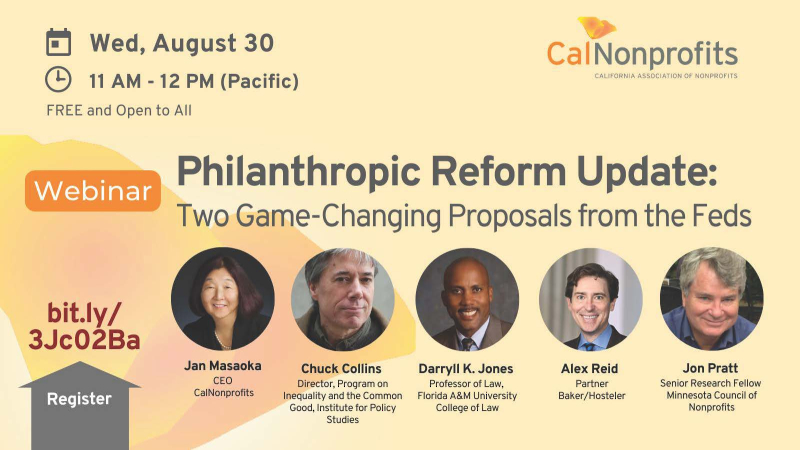
Join us near the noon hour on Wednesday. Here is a short teaser with registration info:
Two new recommendations coming out of Washington have the potential to bring about game-changing philanthropic reforms: the U.S. Treasury Department has recommended establishing payout requirements for Donor-Advised Funds (DAFs), a response to the current warehousing of billions of charitable dollars in these popular philanthropic vehicles. It is also proposing limits on how private foundations can use DAFs to meet their own payout requirements.
-
- Jan Masaoka, CEO of CalNonprofits;
- Chuck Collins, Director, Program on Inequality and the Common Good, co-editor of org at Institute for Policy Studies;
- Darryll K. Jones, Professor of Law, Florida A&M University College of Law;
- Alex Reid, Partner at Baker/Hosteler; and
- Jon Pratt, Senior Research Fellow, Minnesota Council of Nonprofits
Hear from a panel of in-the-know experts on two new game-changing efforts coming out of Washington to create a more transparent and accountable charitable landscape. Catch up on where philanthropic reform stands today and where it’s headed. Click here to register.
Here are the questions I have kicked around in my head and will address in an entirely spontaneous colloquy:
1. Who are the natural constituents for DAF reform and if everybody knows that the Wimpy syndrome is at work, why hasn’t anything been done about it yet? The Wimpy syndrome is best demonstrated by the phrase, “I will gladly pay you at some point in the short or long term future, as my whim dictates, for a tax deduction today.”
Preliminary thoughts: Suppose donor puts $1 million in a DAF and takes a $1 million charitable contribution, saving $370,000 in taxes. Donor has foresworn personal consumption and is appropriately compensated by the tax savings. Presumably, trading personal consumption for public benefit is good for everyone. But does the fact that public benefit can be delayed indefinitely deprive the public of a fair bargain? Maybe we need to better value both sides of the putative equation. To what extent is the donor really sacrificing personal consumption and are we actually measuring public benefit? If the public believes that eventual public benefit is better than none at all, or that it is getting a fair deal, we may never achieve an urgent consensus for “reform.”
2. If nothing ever changed and donors were allowed continued use of DAF’s would our tax system nevertheless be fairer if capital has been diverted from conspicuous consumption and towards eventual public good. Or might we achieve more public benefit by denying the deduction altogether — using the tax revenue for direct spending instead — and encouraging personal consumption or business investment of the “contribution.”
I am still thinking it over. Registration is free, by the way.
darryll k. jones