
NCAA Loses Another Round in Amateur vs. Pro Battle
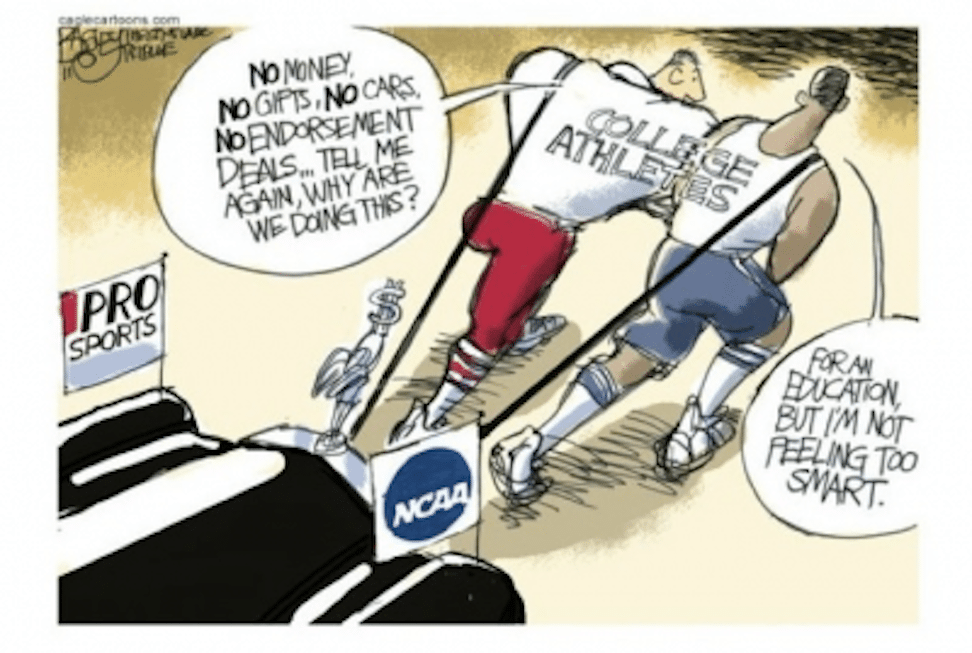
Three things can be true at the same time. First and foremost, student athletes ought to share in the revenues they help generate. Second, student-athletes should not be treated like common law employees. And third, universities and the NCAA should not be treated as employers. There are a whole host of unintended and unnecessary consequences — having nothing to do with education or charity or fairness to students — from treating student-athletes and the universities they play for as employees and employers. Or NCAA rules as things to be regulated by market rules. The sooner the law mediates these three assertions, the sooner we can preserve a meaningful distinction between sports competition as an educational and charitable endeavor, and sports as a business. Another thing is true in life if you think about it. Sex and money ruin everything. You ever notice how your favorite best friend turns into your on-again-off-again worst enemy as soon as the two of fall into each other’s passionate embrace? The only other thing that has that effect is money. Yeah. And right now, money is ruining college sports, though student-athletes ought to get a fair cut of it.
Last Friday, a federal district court judge in State of Tennessee v. National Collegiate Athletic Association enjoined the NCAA from enforcing its NIL rules regulating the extent to which student-athletes may exploit their athletic personhoods. Here is a bit from the opinion:
Since its inception, the NCAA, the governing body of intercollegiate athletics, has limited compensation of student-athletes in an attempt to maintain amateurism across college spo11s. The original 1906 bylaws provided that ‘”[n]o student shall represent a College or University in any intercollegiate game or contest who is paid or receives, directly or indirectly, any money, or financial concession.”‘ Joseph Ranieri, The First Step: Student-Athletes Finally Get the Right to Be Compensated for Their Names, Images, and Likenesses, 18 DePaul J. Sports L. 1, 4 (2022) (quoting Intercollegiate Athletic Association of the United States Constitution By-Laws, Art. VII, §3 (1906)). In 1948, however, the NCAA “authorized colleges and universities to pay athletes’ tuition.” Nat’ Collegiate Athletic Ass’n v. Alston, 594 U.S. 69, 77 (2021) (citation omitted). Almost ten years later, “the NCAA expanded the scope of allowable payments to include room, board, books, fees, and ‘cash for incidental expenses such as laundry.”‘ Id. ( citation omitted). Then, in 2014, the NCAA permitted conferences “to increase scholarships up to the full cost of attendance.” O’Bannon v. Nat’! Collegiate Athletic Ass’n, 802 F.3d 1049, 1055 (9th Cir. 2015).
Despite the foregoing evolution of student-athlete compensation, the NCAA has long prohibited student-athletes “from receiving any ‘pay’ based on … athletic ability, whether from boosters, companies seeking endorsements, or would-be licensors of [athletes’ NIL].” Id. But that changed in July 2021 when the NCAA’s Interim NIL Policy went into effect, allowing student athletes to engage in NIL activity and to be compensated accordingly. This change created a market for student-athletes’ NIL, which quickly led to the creation of NIL collectives, e.g., “organizations created by alumni, boosters, or businesses with the purpose of providing NIL opportunities to their school’s athletes.” Kassandra Ramsey, NIL Collectives-Title IX’s Latest Challenge, 41 Cardozo Arts & Ent. L.J. 799, 801 (2023).
The first known collective, the Gator Collective, launched merely two months after the NCAA’s interim policy went into effect. Id. Since then, “approximately 200 NIL collectives have been created across several colleges and universities.” Id. at 802. With the rise of NIL collectives, the NCAA issued supplemental guidance regarding the involvement of third parties in the NIL landscape. The guidance clarifies that NIL collectives are considered “boosters” to the extent their “overall mission .. . is to promote and support a specific NCAA institution by making available NIL opportunities to prospective student-athletes (PSA[s]) and student-athletes (SAs) of a particular institution[.]” NCAA, Interim Name, Image and Likeness Policy: Guidance Regarding Third Party Involvement (May 2022), https://www.ncaa.org/sports/2 021/2/8/about-taking-action.aspx (last accessed February 14, 2024). The guidance reiterates that boosters, which now include NIL collectives, are prohibited “from engaging in recruiting activities, including recruiting conversations, on behalf of a school.” Id. Boosters are also prohibited from guaranteeing or promising student-athletes an NIL agreement that is contingent on initial or continuing enrollment at a particular institution. Id.
Because the NCAA classifies NIL collectives as boosters, any NIL discussions between collectives and student-athletes are considered impermissible inducements under the NCAA rules. Thus, student-athletes are prohibited from discussing potential NIL deals until they commit to a particular school. Plaintiffs initiated this action, alleging that the foregoing prohibition, referred to as the “NIL-recruiting ban,” constitutes an “illegal agreement to restrain and suppress competition” within the labor market of Division I athletics. Plaintiffs also moved for a temporary restraining order (“TRO”) and a preliminary injunction (1) “enjoining the [NCAA]; its servants, agents, and employees; and all persons in active concert or participation with them, from enforcing its NIL-recruiting ban or taking any other action to prevent prospective college athletes and transfer candidates from engaging in NIL discussions prior to enrollment” and (2) enjoining enforcement of the “Rule of Restitution (NCAA Bylaw 12.11.4.2) as applied to the NIL-recruiting ban” The Court denied Plaintiffs’ Motion for a Temporary Restraining Order due to the failure to demonstrate irreparable harm [Doc. 29]. Thereafter, the partiies provided supplemental briefing [Docs. 32, 37], and, on February 13, 2024, the parties presented oral argument on Plaintiffs’ Motion for a Preliminary Injunction. The motion is now ripe for review.
In the wake of that ruling, NCAA President Charlie Baker warned that dragging universities and student-athletes into professionalism would end up destroying intercollegiate sports, and excluding 95% of student-athletes from college and university sports competition:
NCAA President Charlie Baker said Friday that action by Congress was needed to protect what he described as the “95 percent” of athletes whose ability to play college sports would be endangered by a court ruling or regulatory decision declaring them as employees of their schools. Speaking to a small group of reporters near the NCAA’s Washington office, Baker was realistic but still hopeful about the prospect of Congress doing what it didn’t do despite persistent requests from his predecessor, Mark Emmert: granting the NCAA a limited antitrust exemption that would allow it to make rules safeguarding college sports without the constant threat of litigation.
If we don’t figure this out, the same reasoning will extend downwards into high schools and even Pop Warner and Little League. Capitalism is our national religion. But life should not always be about the money.
darryll k. jones