
On Coercive Philanthropy and Aggressive Donors
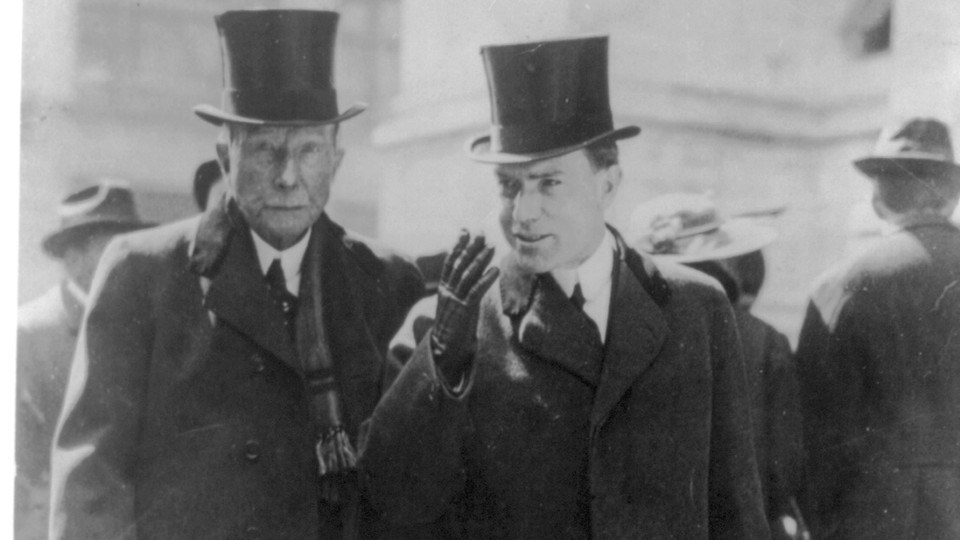
John D. Rockefeller and son, from Is Big Philanthropy Compatible with Democracy
HistPhil, which means “history of philanthropy,” is a very useful and interesting blog that has been around for about ten years. I am only just now learning of it.
Founded in 2015, HistPhil is a web publication on the history of the philanthropic and nonprofit sectors, with a particular emphasis on how history can shed light on contemporary philanthropic issues and practice. In founding and editing this blog, we hope to foster humanistically oriented discussion and debate on the sector and to bring together scholars, nonprofit practitioners, and philanthropists in common dialogue on the past, present, and future of philanthropy. For more on the vision and motivation behind HistPhil, please see the opening post. And if you would like to pitch a blog post idea, please feel free to contact us via email,
There is a fascinating conversation going on right now regarding something my Tax Notes article touched upon without awareness of some apt phrases used by the historians on that blog. The conversation concerns donor anger and activism of the sort expressed by wealthy donors to Harvard, Penn, and other elite universities considered permissive in their response to alleged hate speech. Permissive, and therefore complicit, according to the donors and even some in Congress. The scholars set out to find historical antecedents for what they call “aggressive donors” engaging in “coercive philanthropy.” In the opening round, John Thelin and Richard Trollinger describe the phenomenon before concluding “the aggressive alumnus as major donor and activist is a product of our own times. ”
Recent campus conflicts at elite American universities, The New York Times declared in a recent article, signal a “new politics of power” in which “wealthy donors expect money to buy a voice in university affairs.” Activist donors with their “new playbook” have used unrest on campus as an opportunity to advance a distinctive set of institutional reforms. Their ambitious goal to change a university’s culture as well as its policies means that campus governance now goes beyond presidents and trustees to include philanthropists. Specifically, these are prominent alumni who, as discontented donors, use both internal networks to engage with fellow alumni along with the added external leverage of using social media to orchestrate their plans and attract supporters. They made fortunes in such fields as high-tech and financial services. Their aggressive strategies resemble insider takeovers of business corporations transplanted to academic institutions. The most conspicuous of this new breed are Marc Rowan at the University of Pennsylvania and William A. Ackman at Harvard.
Another scholar offered this comment to the post:
If John Thelin and Richard Trollinger had looked a little harder, they would have found earlier examples of donors behaving like Marc Rowan and William Ackman did recently. The most famous (or infamous) was Mrs. Leland Stanford, who played a strong role in Stanford University’s governance after her husband died. Her efforts not only contributed to the creation of the AAUP, but may even have led to her “murder,” as Richard White suggests in “Who Killed Jane Stanford?” Similarly, Andrew Carnegie’s grants to higher education aimed, at least in part, to incentivize colleges and universities to distance themselves from their religious roots, just as John D. Rockefeller’s support for medical schools sought to change how they educated doctors.
Closer to our own time (though now a half-century ago), David Packard, William E. Simon, John M. Olin and other business-philanthropy leaders urged donors to stop funding programs and scholars in higher education that opposed capitalism. And the principal monument to Herbert Hoover at Stanford University, the Hoover Institution, was long regarded by the school’s faculty as a controversial imposition that needed to be brought under tighter university control. Mr. Rowan and Mr. Ackman are following in their footsteps. But keeping in mind what may have happened to Mrs. Stanford, let’s hope they are watching their backs.
And then another scholar followed up with another post:
It may be more instructive to examine several prominent white women philanthropists for precedents of what Margaret Rossiter called “coercive philanthropy,” writing about Mary Elizabeth Garrett. In my book, Funding Feminism: Monied Women, Philanthropy, and the Women’s Movement 1870-1967, I explore the ways in which donors Garrett, Phoebe Apperson Hearst, Katharine Dexter McCormick and other women in the late nineteenth and early twentieth centuries U.S. wielded their giving to force universities to open their doors to women or to increase the number of women admitted by providing scholarships or erecting a women’s building or a dormitory. Garrett, the daughter of a former trustee of Johns Hopkins University (which was all-male at the time), Hearst, a member of the Board of Regents at the University of California, Berkeley, and McCormick, an alumna of Massachusetts Institute of Technology (MIT), were willing to make demands of the universities to which they gave large donations of approximately $350,000 to $5 million.
Clearly, donors can be as aggressive and coercive — in the legitimate way the historians are presumably using the words — as they want to be. And apparently there is historical precedent. Charitable fiduciaries can concede or not but ultimately it must be their call. Its all part of the fabric of civil society. Its just that tax laws ought to be neutral in the treatment of donors and as long as only the wealthiest get the charitable contribution deduction, I don’t think tax law is neutral.
darryll k. jones