
Democratizing Charity: The Potential of DAOs in Nonprofit Administration
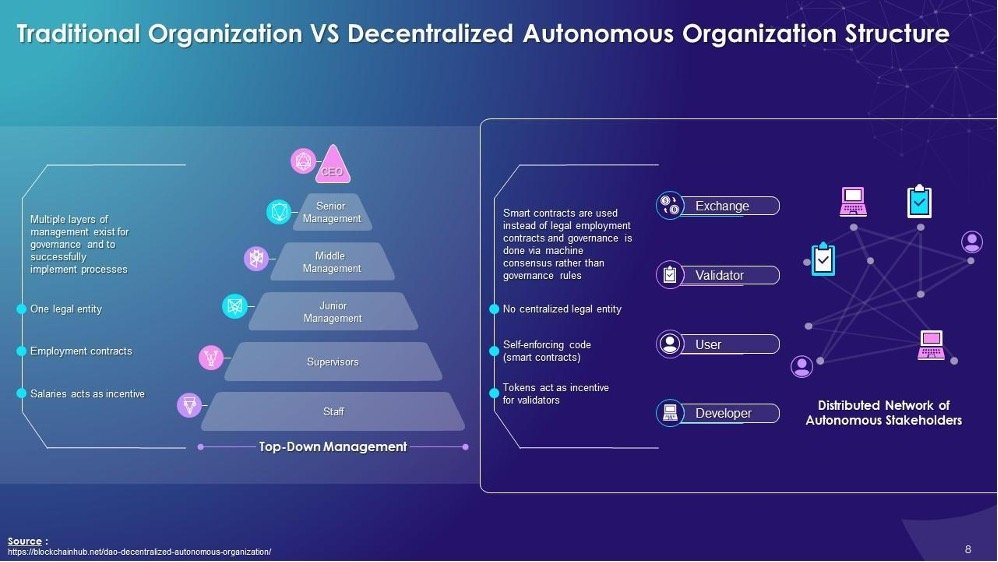
Look, I am still just trying to wrap my brain around the basic cashless society — tap your card and blink twice to pay for dinner, things like that. But the IT nerds won’t give us a chance to catch our breathe. They are already on to Decentralized Autonomous Organizations. I admitted and expressed my ignorance on the matter a few months ago. A techy submitted a comment in response to that post. In techy language I could barely understand with links to more reading I have not yet had time to check out. These guys think complete sentences are mathematically redundant so the comment is hard to follow.
BTW, Lloyd might understand this stuff. His recent article likely proves it. Just understand, though, that by the time it takes to download the article his conclusions will be “overcome by events.” That’s just how fast technology is changing. Even as we speak because the nerds “ain’t got time to tarry,” as my father-in-law used to say. Lloyd still believes the nerds mean to keep us around, bless his heart.
Coincidentally, I ran across a media article this week regarding how DAOs — these virtual robots — can facilitate broader participation in civil society. The robots might even eliminate the need to worry about private inurement, private benefit and excess benefit transactions. And if they are virtual, not only can they do our jobs but we can’t even see them.
I’ll tell you what. I am slowly getting the eerie feeling this is all about killing off lawyers, I’ll just be honest about it. Take a close look at the picture above. “No centralized legal entity” and “self-enforcing code (smart contracts).” Lawyers ain’t needed here. People either, for that matter. But lawyers, especially, are just a bunch of Eddie Haskells in this world. Polite, yes, but aggravating and completely useless. Don’t say I didn’t warn us.
Here is an excerpt from Democratizing Charity: The Potential of DAOs for Nonprofit Administration:
Non-profit organizations have, over the years, played a critical role in the social well-being and community development of individuals in vulnerable environments. However, despite the goal to achieve a noble cause, nonprofits face several challenges, most notably fund mismanagement due to a lack of transparency and efficient accountability systems. A recent charity fraud report by BDO revealed that 36% of charity organizations experienced a surge in fraudulent instances in 2023 compared to the previous year. What’s even more worrying is that half of the detected frauds were linked to trustees, members, staff, or the volunteers. This begs the question: could the novel Decentralized Autonomous Organization (DAO) concept, pioneered by crypto innovators, bring more transparency if adopted by charity organizations and the larger nonprofit community?
DAOs are designed to operate as decentralized entities. Instead of having the C-suite level making all the decisions in closed door meetings, DAOs empower users or a community with a direct say on matters development. For example, in the context of traditional banks, strategic decisions are either made by the board or top management. In contrast, a DeFi lending protocol like MakerDAO is governed by the Maker Governance community through a native token dubbed MKR. What this provides for is a more decentralized governance approach such that even a user who holds a minimal amount of the MKR token can have a say in the protocol’s governance.
It is also worth noting that most of the DAOs in existence are built on public blockchains networks. This means that all the proposals raised by DAO members can be viewed and audited by anyone. More importantly, it is much more seamless to track and audit the use of treasury funds that a DAO may be obligated to run. This is the main reason why DAOs could be the perfect poster boy for charity organizations and corporations. While DAOs are yet to fully morph into the organizations they are intended to, it would be naive to ignore the role they could play in charity organizations. For starters, crypto is already paving the way, with over 56% of the top 100 charities now accepting digital asset donations. Going by these trends, it is inevitable that charity organizations will start embracing DAOs as a way to introduce transparency and incentivize the community to act in good faith.
Take for example the Prom nonprofit foundation which is in-charge of its ZkEVM Layer ecosystem; this decentralized organization is sustained through the revenue it collects from transaction fees. However, what really distinguishes Prom, is the nonprofit’s approach of sharing some of the revenue with active DAO members who in turn contribute to product development through a community-driven governance model. Similarly, centralized nonprofit organizations could borrow a leaf from DeFi DAOs by leveraging blockchain infrastructure to implement better checks and accountability. This will likely reduce the fraudulent cases associated with personnel, not to mention that DAOs also have the potential to build more vibrant and trustworthy funding vehicles. Given the underlying value proposition, it is only a matter of time before DAOs are embraced by nonprofit organizations and corporations as a futuristic form of governance.
I’m telling you, the kids are down in the basement tinkering around with some sort of machine to get rid of lawyers.
darryll k. jones