
The Impact of Political Polarization on Charitable Giving (and other giving trends)
Giving Tuesday, whose motto is “Let’s transform the world through radical generosity” has released another of its really good reports. We have previously blogged about this group of nonprofit number crunchers here and here. Earlier this year, the group released The National Study on Donor Advised Funds. One of their latest reports looks at global trends in giving during 2023. The Report provides data on a host of different questions regarding the elasticity of charitable giving relative to different variables, including the degree of political polarization in a country. Interestingly, the report concludes that political polarization is not that big a deal when it comes to charitable giving even across political boundaries. At least not yet. The Report nevertheless concludes that increasing amounts of polarization is a matter of concern:
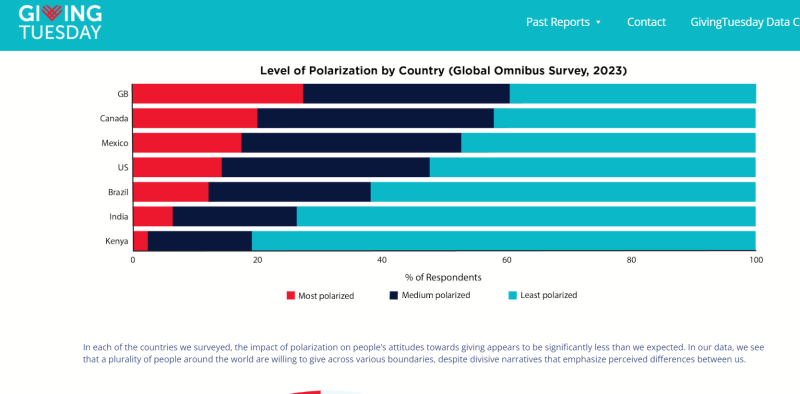
In each of the countries we surveyed, the impact of polarization on people’s attitudes towards giving appears to be significantly less than we expected. In our data, we see that a plurality of people around the world are willing to give across various boundaries, despite divisive narratives that emphasize perceived differences between us.
Yet we do see some consistency in the data across several lines of questioning. Perhaps unsurprisingly, people in the “least polarized” group tend to give more overall. This aligns with the fact that Kenya, India and Brazil – countries with the greatest percentage of respondents in the ‘least polarized’ group – are also the countries in which the percentage of people who give is greatest, as we examined in detail in our 2022 Lookback Report.
We might assume from this finding that these people give more because they are less polarized, that is to say that they are more compassionate and open-minded people, therefore they give more diversely. But is it possible that they are more compassionate and open-minded precisely because they give more? Causality could go either way, or both.
In our Giving Pulse survey, people who self-identify as “compassionate” are not any more or less generous than others. Moreover, the most generous people are more likely to agree with some polarizing statements (e.g. “A decline in the share of Americans belonging to organized religion is bad for society”) and also more likely to agree with other inclusive, depolarizing statements, such as “compromise is how things get done in politics.”
Nevertheless, for those of us in the USA, the evidence that more polarization in society is associated with reduced giving should alarm us. This is further supported by a 2023 survey published by the American Immigrant Council about “belonging” in America. A sense of belonging is related to less polarization, and that study found that the people who don’t feel like they belong in their communities are less likely to get involved in civic activities, such as volunteering or donating to nonprofits. Currently, 74% of Americans feel that they don’t belong, or have ambiguous feelings about their place in the community. We plan to delve further into the relationship between generosity, prosocial behavior, polarization, trust, and belonging in the coming year.
darryll k. jones