
Revoking an Anti-Semitic Organization’s Tax Exemption
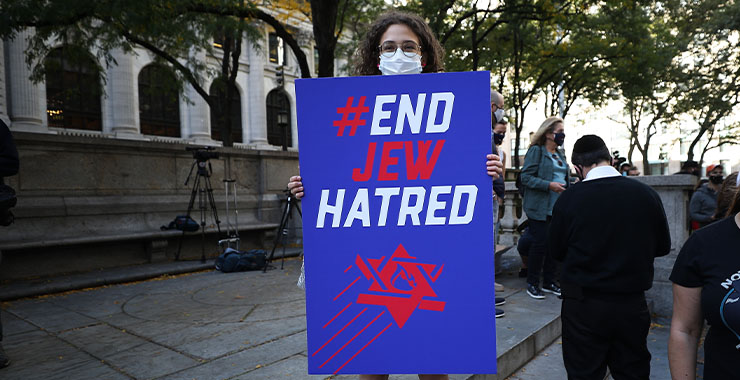
I am situational. We all are, but not all the time. Sometimes we’re rigid. We are too complex to have just one response all the time but sometimes we do. Some of my hate mailers think I tolerate towards Jews what I would not tolerate towards African Americans. That I am being situational where I should be rigid that anti-Semitism is always wrong, just like racism. That is true, of course, and I am rigid about it. But I am not being situational in my occasional defense of tax exemption for nonprofit pro-Palestinian organizations. It is not because I necessarily agree with their positions, by the way, and I don’t have to explain myself.
But to learn one must admit fallibility and allow other ideas. So I thought about it. And now a weekend article in the Times provides an opportunity to talk about it. Within Our Lifetime, is a fiscally sponsored Pro-Palestinian advocacy group. It has educational resources on its website, all apparently expressing anti-Israeli positions. I didn’t read much of it. The article points out that WOL often engages in hate speech:
Within Our Lifetime’s anti-Zionism is so vitriolic that it has alienated some prominent critics of Israel’s war in Gaza, including Representative Alexandria Ocasio-Cortez, a New York Democrat. As protesters waved Hamas flags outside of a Nova Music Festival commemoration in June, Ms. Kiswani called the festival, where hundreds were killed on Oct. 7, “the place where Zionists decided to rave next to a concentration camp.”
Ms. Kiswani was defiant when a protester from a Within Our Lifetime rally in June boarded a city subway and shouted for Zionists to raise their hand and leave the train, in an episode that led the city police to file misdemeanor charges. “We don’t want Zionists in Palestine, NYC, our schools, on the train, ANYWHERE,” Ms. Kiswani wrote on X in response to the uproar. “This is free speech, it is saying we don’t want racists here.”
That’s hate speech. It’s never hard to recognize, even if it’s always hard to define. That’s why we can’t revoke tax exemption for hate speech. Because we can’t define hate speech. Saying so isn’t situational. But just to be sure, we also shouldn’t revoke the Proud Boys tax exemption for marching through Springfield to perpetuate the lie that Haitians — by which the Proud Boys, JD and DTJ mean “black people” — are eating dogs and cats. Both groups are engaging in stochastic terrorism, the consequences of which are invariably and inevitably violent somewhere. We still can’t revoke tax exemption just for the words.
Or maybe we can because neither hate nor hate speech is charity and we can limit tax exemption to charity. Charity cannot be precisely defined but it definitely excludes hate and hate speech. And racial hatred, broadly defined to include anti-Semitism, is contrary to firmly established public policy. We can revoke exemption because hate is not charity. But this only kicks the can because we still need to define hate and “hate speech” to implement the axiom that neither is charity. What is hate speech and what is educational speech? That is the million-dollar question. And it is a question the government is not even allowed to answer.
The most the government can do is condition tax exemption on a pedagogy that decreases or eliminates subsidization of “indoctrination,” the indispensable pedagogy for teaching hate. The government can employ a better articulated “full and fair exposition” test, one that doesn’t even require unbiased teaching (an impossibility anyway). Epistemologists can articulate the difference between education and indoctrination and they allow for the teacher’s bias when making the distinction. It is do-able because epistemology is an advanced science translatable to a legal standard. With it we can unsubsidized indoctrination and indoctrination is necessary to teach hate.
Most racist or anti-Semitic organizations, according to our varied and subjective perceptions, would still survive a necessarily wide test. Broadly stated, the test would only require that an educational organization not entirely exclude objective, non-dogma from whatever it claims as a curriculum. The test would likely only capture the most virulent racist or anti-Semitic organizations, like the Ku Klux Klan which is both racist and anti-Semitic. Still, acknowledging the principle that hate is not charity is worthwhile, even if its articulation won’t very often preclude tax exemption.
So if Within Our Life Time allows for even a slight bit of objectivity in whatever constitutes its curriculum, it should retain exemption as an educational organization despite its hate speech. So would the Proud Boys.
darryll k. jones