
Trump Wins Campaign Intervention Olympics: What About The Johnson Amendment?
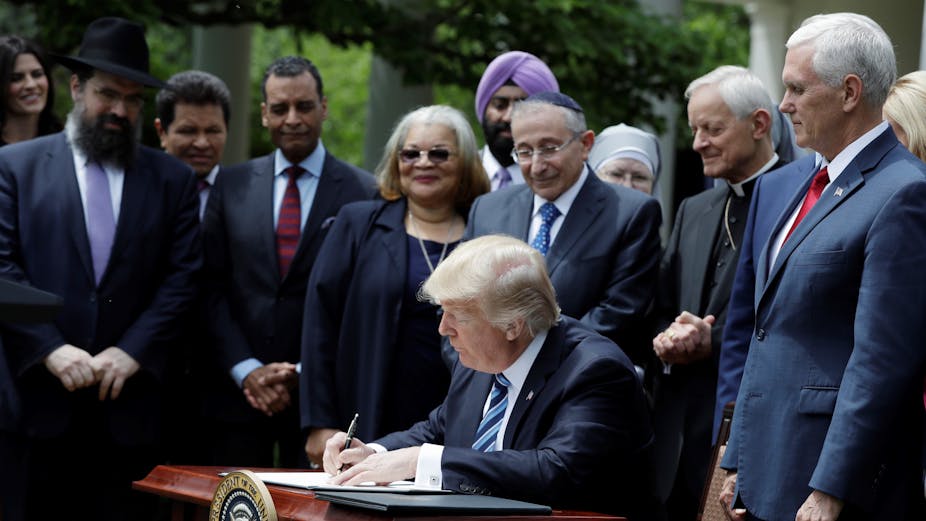
Sound and fury signifying nothing: At the ceremonial signing of EO 13798 (2017)
Now that one party will be in control of all three branches of federal government what sort of changes might we expect in nonprofit and tax exemption law? Let’s start with campaign intervention, the most visible issue. Trump has promised to do away with the Johnson Amendment. Within the first week, he said just last month. But let’s cut him some hyperbolic slack. If he means it, Ways and Means will comply very quickly because it is led by political expediency more often than not. Finance will go along too, if push came to shove. Finance has not often jumped into the frat boy hearings Ways and Means has conducted against Civil Society for the last two years. It likes to think things through at least. So it might take some pushing and shoving to get Finance on board. But eventually, the Johnson Amendment could be gone in one fell swoop.
I still wouldn’t bet on that happening as fast as all that. A wide spectrum of nonprofit organizations – left, center, and right leaning – want the cover and legitimacy the Johnson Amendment affords. It’s not like the Johnson Amendment prevents what it prohibits anyway. Language is too complex for a law against “endorsement” or “opposition” to really prevent a nonprofit from endorsing or opposing one candidate or another. Let’s just be honest about it.
There are benefits to keeping the Johnson Amendment even for the most politically inclined charities. With it, charities can associate with, support, and curry favor from any political patron while at the same time prevent their own capture by political patrons. Have cake, eat it too. With the Johnson Amendment even the most politically biased nonprofit can deny and fend off explicit political capture. That helps the organization and the entire sector maintain at least nominal credibility. Civil Society – left, center, or right — understands that once nonprofit groups become explicitly identifiable by political beliefs, the whole sector will suffer as political winds invariably shift back and forth, and successive politicians demand explicit loyalty in exchange for legislative favors. The effect will be universal because politics is all about “you are either for us or against us.” Even organizations that want nothing to do with politics will be forced to pick one side or the other. They will have to be one or the other, or not exist at all. And donors will respond to Civil Society accordingly. They will want to know who an organization is with before making a donation. Maintaining the Johnson Amendment helps them fight off those pressures, and the perception or reality of political capture.
Trump promised though, and his victory speech included the phrase, “promises made and promises will be kept.” But he made that promise to religious folks. He doesn’t have to get rid of the Johnson Amendment for non-religious organizations if all he wants to do is keep a promise. He doesn’t even have to keep the promise for non-church religious organizations. Truth be told, he should keep that promise to churches only. As applied to organized worship, and only that, the Johnson Amendment is unconstitutional, unworkable, and unenforceable anyway. It violates the First Amendment twice. “You know that,” as Trump would say with insufferable smugness.
The Johnson Amendment should be entirely repealed only with regard to organized worshippers, nobody else. It should continue to apply to other religious (and non-religious) organizations. Because there is a difference between organized worship and activities motivated by religious beliefs. Only churches engage in organized worship. And organized worship – when people are talking to God, rather than to each other — is the essence of free exercise. A tax-exempt radio broadcast, even one about religion, isn’t talking to God. A religious broadcast isn’t worship. It’s an organized activity about religion but it isn’t worship. And religious organizations may be regulated more than organized worship. We already admit this much in the Tax Code. For example, not every religious organization is entitled to the protections of the Church Audit Procedures because not every religious organization is engaged in the essence of worship.
Just for the sake of argument, assume the Johnson Amendment does not violate the right of free speech, and political silence may be required as a condition of tax exemption. That dubious assumption would still not overcome the constitutional barrier against laws prohibiting the free exercise of religion. If we stipulate that the Johnson Amendment does not violate the right of free speech then it should be maintained for religious organizations (and all other groups) because they are not organized worshippers engaged in the essence of free exercise. But the Johnson Amendment necessarily intrudes into worship if it prevents speech about a political candidate vis-a-vis worship.
Trump could keep his promise, to churches at least, by issuing an Executive Order amending or supplementing the delicate and ineffectual verbal tap dance in EO 13798. I quote it below, read it for yourself. It has lots of words, but it changed nothing. It merely supports the routine exercise of prosecutorial discretion in favor of churches and religious organizations. Something the Service was doing anyway. To really keep the promise, Trump only needs to say that the government shall bring no enforcement action against any “house of worship” for any speech on the basis that the speech endorses or opposes a candidate for political office. That is the pragmatic state of the law today anyway.
Sec. 2. Respecting Religious and Political Speech. All executive departments and agencies (agencies) shall, to the greatest extent practicable and to the extent permitted by law, respect and protect the freedom of persons and organizations to engage in religious and political speech. In particular, the Secretary of the Treasury shall ensure, to the extent permitted by law, that the Department of the Treasury does not take any adverse action against any individual, house of worship, or other religious organization on the basis that such individual or organization speaks or has spoken about moral or political issues from a religious perspective, where speech of similar character has, consistent with law, not ordinarily been treated as participation or intervention in a political campaign on behalf of (or in opposition to) a candidate for public office by the Department of the Treasury. As used in this section, the term “adverse action” means the imposition of any tax or tax penalty; the delay or denial of tax-exempt status; the disallowance of tax deductions for contributions made to entities exempted from taxation under section 501(c)(3) of title 26, United States Code; or any other action that makes unavailable or denies any tax deduction, exemption, credit, or benefit.
darryll k. jones