
U.S. Catholic Bishops Sue For Violations of Separation of Powers and the APA
From The Dispatch:
For decades, the U.S. government has asked faith-based charities to help resettle refugees legally admitted into the country and help care for unaccompanied minors who cross the border. Donald Trump and Congress funded both of those programs for all four years of Trump’s first term. In order to ease the burden on border towns in 2019, Trump and an overwhelming majority of Congress created a third program giving grants to religious charities and other organizations to provide assistance to migrants released inside the United States by the federal government.
But in the opening weeks of Trump’s second term, these religious groups have found themselves in the crosshairs of the MAGA movement. They’ve been branded as corrupt, possibly criminal, and bearing blame for the border crisis—all for their participation in one or more of the programs once funded by Trump.
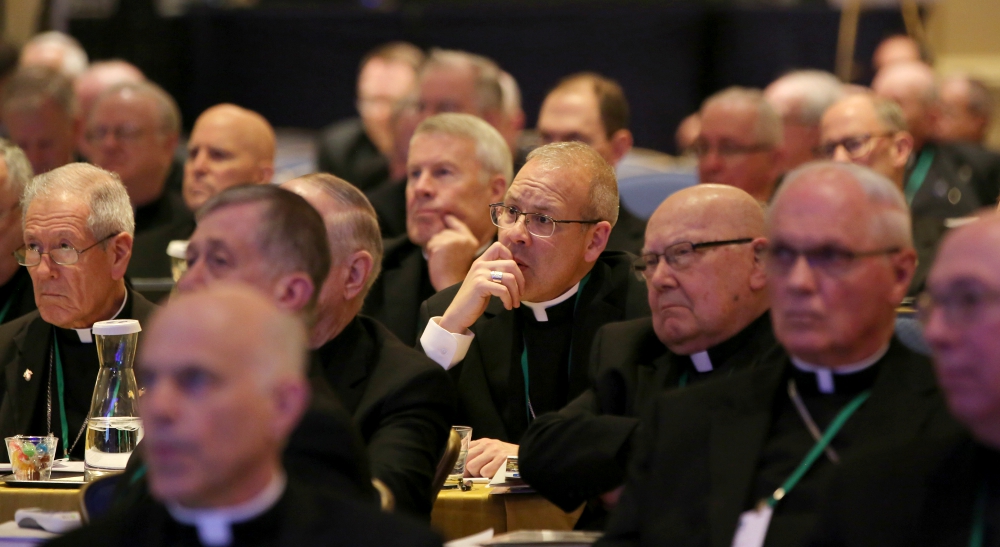
On Tuesday, the United States Conference of Catholic Bishops elaborated on Congress’ long ago appropriation of monies and the Executive Branch’s supervision and payment of those monies in pursuit of legislation adopted by Congress. That is how our Constitutional Democracy is supposed to work. Right now, it ain’t working. You understand the issue, it doesn’t take a Con Law student. Or even one who has taken Administrative Law or has read the Administrative Procedure Act. Here are parts of the factual allegations. The several APA- and Constitutionally-based causes of action are articulated in the complaint:
III. USCCB’s Refugee-Resettlement Program And Cooperative Agreements
37. Each year since the enactment of the Refugee Act of 1980, USCCB has entered into agreements with the federal government to provide initial-resettlement services for refugees. USCCB receives and coordinates the distribution of PRM awards for initial resettlement through its Migration & Refugee Service. USCCB partners with subrecipients, most of whom are local Catholic Charities, across the United States to accomplish this work. These partners are strategically chosen in concert with the State Department and state refugee coordinators to achieve goals such as partnering with subrecipients in locations that will facilitate family reunification efforts.
38. Today, USCCB runs the largest non-governmental refugee-resettlement program in the United States. Resettlement Services, USCCB, (last visited Feb. 14, 2025) https://perma.cc/2DPN-M47N. USCCB currently serves approximately 17% of refugees being resettled in the United States. And since 1980, USCCB has provided refugee-resettlement services to more than 930,000 refugees.
39. In providing this assistance, USCCB has consistently devoted more resources than it receives in related federal funding. In 2023, for example, USCCB paid $4 million more on its refugee-resettlement and related programs than it received from the federal government. KPMG, United States Conference of Catholic Bishops and Affiliates: Consolidated Financial Statements with Supplemental Schedules, December 31, 2023 and 2022, at 30 (Aug. 16, 2024), https://perma.cc/59YQ-TH5L. And those numbers do not account for the additional cash, in-kind contributions, or volunteer services provided by local Catholic Charities and other subrecipients.
40. For Fiscal Year 2025, USCCB entered into two cooperative agreements with PRM awarding USCCB around $65 million for initial refugee resettlement. One of the agreements covers refugees; the other covers refugees and special immigrant visa holders from Afghanistan, who are treated like refugees for initial-resettlement purposes. In all other relevant respects, the terms of the cooperative agreements are materially identical. Both cooperative agreements run from October 1, 2024 to September 30, 2025.
41. Both cooperative agreements require USCCB to “[a]ssume responsibility for sponsorship of the refugees assigned to” it “under this agreement.” On the day a refugee is admitted, USCCB must ensure that each refugee is met at the airport, transported to their home, and provided a first meal as well as food and clothing for their immediate needs. USCCB also must ensure that “refugees assigned to it” are provided the required home visits within 72 hours of arrival, and that the housing provided to the refugees is safe, sanitary, and adequately furnished. USCCB must then assist refugees with, among other things, applications for social security cards, health insurance and medical care, English-language programs, cultural orientation, and employment services during the first 90 days they are in the United States.
Last month, Vice President James Donald Bowman said the USCCB is nothing more than gangsters and human smugglers.
darryll k. jones