
Revocation Was Not the Point of John Dean’s Memo
There are stories in the news on an almost daily basis discussing DJT’ assault on Civil Society, especially big universities. Honestly, I have found it very difficult to engage those stories with any degree of seriousness. I feel as though if I do, I am legitimizing what are patently illegitimate assertions. If I shake my fist and say “the President can’t just revoke Harvard’s tax exemption!” aren’t I recognizing even the slight possibility? The quasi-legal arguments he makes are just so transparently stupid. No, a university may not deny admission on the basis of race. But DEI is more than that. It does not have to include an affirmative admissions policy and yet folks think anything DEI is a ground for revocation. DEI can just be a voluntary university-supported program to help any homesick student get through that first lonely semester. But the mob is implying that if a university touted “diversity, equity, and inclusion,” for ALL students it should lose its tax exempt status. Does a sign in dorm open to all students that reads, “be kind to your neighbor, be considerate, stay woke” cause concern for the university’s tax exemption?
Nearly 100 percent of the statements made in support of revoking tax exemption, for universities at least, are patently unconstitutional. They are all just silly and none of them hold water. Major donor Bill Ackman chimed in with the simplistic assertion that Harvard “has become a political advocacy for one party.” How, when? Nobody can tell that by the composition of the Supreme Court. And what if Harvard really did teach and, through its educational curriculum, advocate that people stay woke. Woke to historical injustices wherever they are found and against whomever perpetrated. Besides, I bet you the vast majority of Harvard folk are digging for rocks, doing math problems, or dissecting creatures or something. Even if they weren’t and even if they were radical leftists, that is still no reason to revoke tax exemption; it is no more reason to revoke the U. of Chicago’s tax exemption for teaching the superiority of capitalism over communism.
As for grants and contracts, the government can always purchase — through research contracts and so forth — defined scientific services and expertise, instructing the researchers what problems they should investigate and how they must report their findings. But the government may not refuse to contract or bargain with a university researcher, or any single individual, merely because there are people within the university who disagree on matters of government orthodoxy unrelated to the research project. The government may not deny a researcher the opportunity to apply for research funding, because the government does not like the way the researcher and his husband raise their nonbinary child. A University that hires middle eastern scholars who study conflict in the region does not forfeit its right of equal protection under the law simply because some scholars criticize U.S. policy toward the Middle East. The law may not withdraw even its discretionary beneficial impact on organizations and citizens just because the organization or citizen advocates a legal position with which government disagrees, even vehemently.
The legal points made by Trumps’ assault on Civil Society are, of course, mostly procedural — they assert that Harvard and others lack oversight, tolerate waste, etc. Those assertions are effective to disrupt, only because the government must be given the opportunity to police and verify that Universities are using funds — even tax exemption — in the matter Congress intended. It doesn’t take a lot of study and genius for DOJ attorneys, afraid of losing their jobs, to assert flimsy arguments in support of administrative processes that invariably gum up the works, maybe for years. Flimsy, yes, as were former Interim U.S. Attorney Ed Martin’s inquiries to scientific research organization and Wikipedia. The questions and assertions in both letters were so stupid, that we might have been tempted to ball them and throw them out, without a second thought. But the apparatchiks have resources and like pro se litigants they can force even the well informed and educated nonprofit or tax exempt scholar to devote attention to the task of debunking absurd accusations. And even that process takes time and diverts resources.
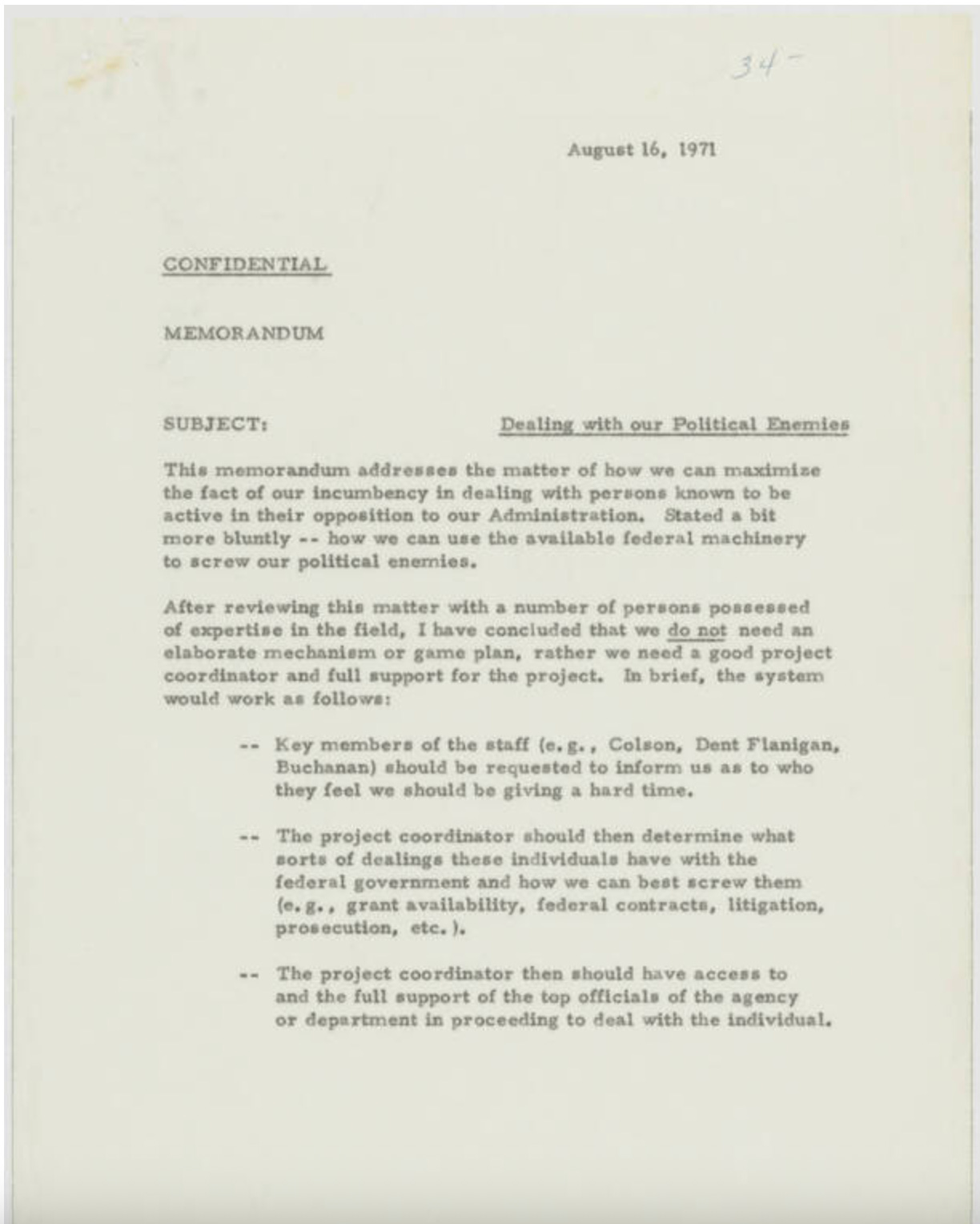
The point of Trump’s campaign, like the point of John Dean’s 1971 memo is just to screw things up.
Jonesing