
PGA Tour/LIV Golf Plan of Merger Suggests Private Benefit
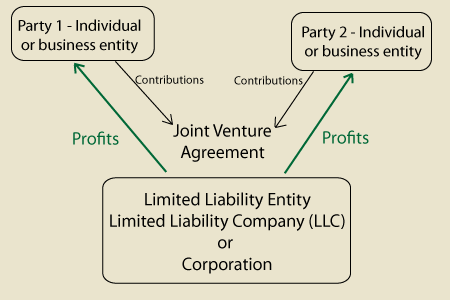
On Tuesday, the PGA Tour and LIV Golf delivered their plan of merger to the Senate Permanent Subcommittee on Investigations. For PR reasons, the parties don’t want to call it a plan of merger but that is pretty much what it is. The picture above depicts what the parties are planning. They are calling it a “framework” instead. Its supposed to be confidential but I have sources deep inside the House of Saud. I’m like Ving Rhames in the Tom Cruise Mission Impossible movies. I dropped down from the ceiling whilst men in clean white robes lounging on overstuffed pillows were eating Dolma. They didn’t even see me coming or leaving, bruh. So here it is:
It is, of course, merely an agreement to enter an agreement, but it provides hints regarding the question whether the PGA Tour’s 501(c)(6) status will survive the transaction. Trust me, it won’t. Or at least it shouldn’t. Oh the plan of merger has an important Revenue Ruling 98-15 requirement alright — that the exempt organization maintain voting control over “Newco,” the as of yet unnamed LLC into which PGA Tour will pour all of its assets and energy. Its too soon to know whether the deal will cause revenue sharing type private inurement. But its becoming clearer that the deal probably won’t survive a private benefit analysis. The whole deal, me thinks, contradicts the notion that PGA Tour is a neutral benefactor of the golf industry. No, PGA Tour is more the once dominant competitor trying desperately to maintain its dominance and willing to convey substantial private benefit on PIF to do so. Its too much private benefit. Look, its ok for the owner of Joe’s Diner to be President of the tax exempt “Diner’s Business League” and to benefit Joe’s Diner and other diners by improving the whole industry. But when Joe establishes and uses the Diner’s Business League to consolidate Joe’s market dominance . . . well, the Diner’s Business League is just not the neutral benefactor it needs to be anymore. And you gotta be a neutral business benefactor to be a business league under 501(c)(6).
Its all right here in National Muffler Dealers Association v. United States. Here is what the Supremes said about it:
“It is an organization of the same general class as a chamber of commerce or board of trade. Thus, its activities should be directed to the improvement of business conditions or to the promotion of the general objects of one or more lines of business as distinguished from the performance of particular services for individual persons.” Treas. Regs. 74, Art. 528 (1929).
This language has stood almost without change for half a century through several reenactments and one amendment of the statute. During that period, the Commissioner and the courts have been called upon to define “line of business” as that phrase is employed in the regulation. True to the representation made by the Chamber of Commerce, in its statement to the Senate in 1913, that benefits would be received “in common with all other members of their communities or of their industries,” supra at 440 U. S. 478, the term “line of business” has been interpreted to mean either an entire industry, see, e.g., American Plywood Assn. v. United States, 267 F. Supp. 830 (WD Wash.1967); National Leather & Shoe Finders Assn v. Commissioner, 9 T.C. 121 (1947), or all components of an industry within a geographic area, see, e.g., Commissioner v. Chicago Graphic Arts Federation, Inc., 128 F.2d 424 (CA7 1942); Crooks v. Kansas City Hay Dealers’ Assn., 37 F.2d 83 (CA8 1929); Washington State Apples, Inc. v. Commissioner, 46 B.T.A. 64 (1942). Most trade associations fall within one of these two categories. The Commissioner consistently has denied exemption to business groups whose membership and purposes are narrower. Those who have failed to meet the “line of business” test, in the view of the Commissioner, include groups composed of businesses that market a single brand of automobile, or have licenses to a single patented product, or bottle one type of soft drink. The Commissioner has reasoned that these groups are not designed to better conditions in an entire industrial “line,” but, instead, are devoted to the promotion of a particular product at the expense of others in the industry.
Its all just a long winded way of saying a business league can’t exist for private benefit. By the way, the first Senate hearing is set to convene on July 11th. No word yet on whether Senate Finance or House Ways and Means will hold hearings.
darryll k. jones